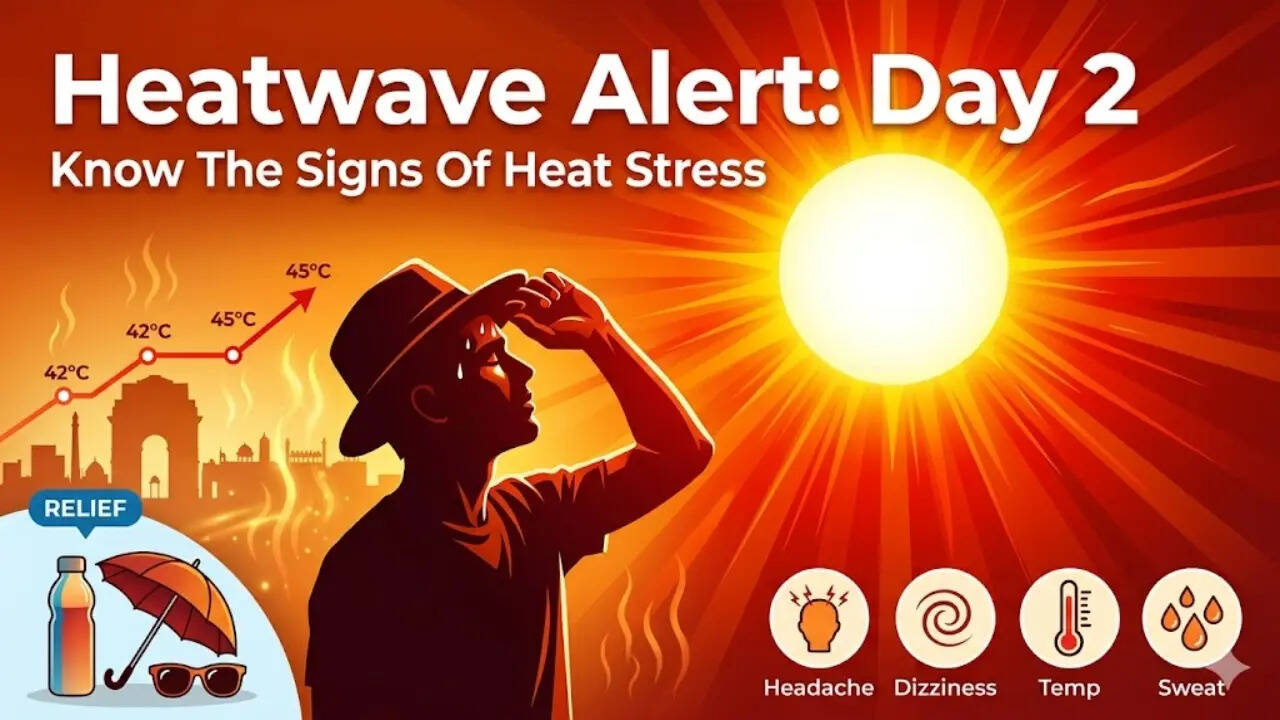
For the past two days, Delhi locals have been waking up to extreme heatwave conditions. The India Meteorological Department (IMD) issued a warning of an extreme heatwave for Friday and Saturday, and we are now on day 2. On Friday, temperatures in the national capital were recorded at 43.1 degrees Celsius and 41.9 degrees Celsius. At the Ridge station and Lodhi Road, a high of 41.8 degrees was recorded, which met the criteria for heatwave conditions. Citing this, the IMD issued a yellow alert for Saturday, forecasting isolated heatwave conditions in the city. With this comes an increased risk of heat stress.What is heat stress?Heat stress refers to a state wherein the body absorbs more heat from the environment or produces heat through exertion that overwhelms the body's natural cooling system. This is caused by humidity, high temperatures, or exercise, leading to symptoms like headaches, dizziness, and, in extreme cases, heatstroke.Heat stress occurs when the body is exposed to radiant heat, high air temperature, physical exertion, high humidity, or low air movement. It harms the body's ability to maintain a normal core temperature, thereby resulting in dehydration and cardiovascular strain. It is advised to wear protective clothing and drink plenty of water to stay hydrated.What are the signs of heat stress?Dr Anirban Chattopadhyay, Senior Consultant, Critical Care Medicine, CK Birla Hospitals, CMRI, in an interaction with Health and Me, spoke about the symptoms of heat stress. The expert said, “As the summer season begins and the sunlight is now scorching, heat and related symptoms increase. One of the early symptoms of heat exhaustion is headache, light-headedness, dizziness, and brain fog. This happens because the brain is temperature-sensitive. That is why patients often experience a headache when temperatures rise. This occurs due to vasoconstriction. One may experience dizziness and brain fog because the brain cannot withstand high levels of heat. These are the early symptoms of heat stress.”When heat stress or prolonged heat exposure continues, it can progress to a more serious condition. This may even lead to a comatose state, known as heatstroke. Therefore, avoid direct sunlight exposure. If possible, stay indoors during peak hours, from 12 pm to 3 pm. Drink plenty of water to keep yourself hydrated, and consume electrolyte-containing fluids to maintain balance. When going out, use umbrellas and sunglasses, and wear breathable fabrics like cotton.Heatwave across Central and North IndiaThe heatwave is not restricted to the national capital—it is currently affecting northern and central states such as Madhya Pradesh, Rajasthan, Bihar, Chhattisgarh, Chandigarh, and Haryana. The conditions are likely to continue until April 27, with low chances of relief in the coming week.