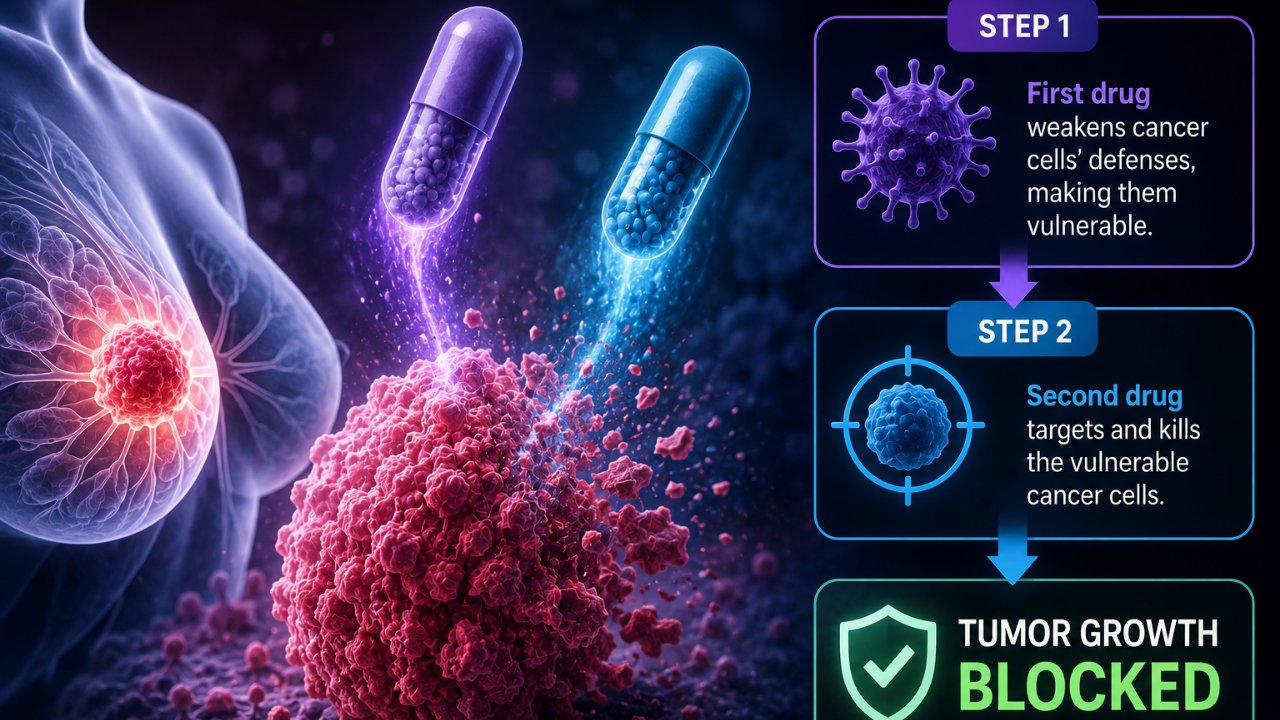
Triple-negative breast cancer is notorious as it can respond to chemotherapy initially, only for some cancer cells to adapt, survive and eventually become resistant to treatment. Researchers at the Medical University of South Carolina’s Hollings Cancer Center may have found a way to turn that against the tumour's nature.In a new study published in Cell Reports Medicine, scientists used a two-step drug strategy that first weakened drug-resistant cancer cells and then blocked the backup system they turned to for survival. Marking a breakthrough, the combination significantly slowed tumour growth in several models of triple-negative breast cancer, including the ones made from patients whose tumours had stopped responding to chemotherapy treatment. An important thing to note is that this is still laboratory and preclinical research and not a treatment that is readily available to patients.How Does The Two-Step Drug Strategy Work? Also read: Mystery Behind Rare Cancer Cluster In California Community Deepens After 20-YO Warning Emerges: What Is Ewing Sarcoma?First Step: The researchers mainly focused on a protein called lysyl oxidase, or LOX. LOX has always been studied for its role outside cancer cells, where it can make it easier for cancer to spread by altering the tissue around the tumour.But the research team found that LOX has another job inside triple-negative breast cancer cells. It helps them produce energy, maintain healthy mitochondria and cope with cellular stress. Blocking LOX therefore cancer cells from spreading.Burge Ulukan, PhD, a postdoctoral fellow and co-first author of the study, “LOX helps cancer cells keep multiple survival systems running. When we blocked LOX, the cancer cells lost that advantage." He added, “When we inhibit it, we are inhibiting multiple arms. We're disrupting cells' energy production and making them much more vulnerable to treatment.” But the researchers observed that the instead of simply dying, the cancer cells adapted again after LOX was blocked.Second Step: Also read: The next step in the strategy is blocking the cancer's backup route. Once LOX was blocked, the cancer cells became increasingly dependent on another protein called DHODH, which gave the scientists with an even better second target. They paired an experimental drug used to block LOX with leflunomide, an FDA-approved drug that blocks DHODH. Together, the drugs pushed the cancer cells towards ferroptosis, a form of cell death caused by damaging molecules building up inside the cell. The combination significantly blocked tumour growth across several models and performed better than the LOX inhibitor combined with standard chemotherapy. The researchers reported no major weight loss or signs of kidney or liver toxicity in the models tested. Ozgur Sahin, PhD, co-leader of the Hollings Cancer Biology and Immunology Research Program, described the strategy as, “It's a one-two-punch approach. First, we block LOX, which weakens the cancer cells. As they adapt and become dependent on a backup survival pathway, we deliver the second punch by blocking that pathway, too.” Why Triple-Negative Breast Cancers Are Challenging To Treat? Triple-negative breast cancer gets its name as its cells lack three common treatment targets: oestrogen receptors, progesterone receptors and HER2. This leaves doctors with fewer targeted treatment options than they have for some other breast cancers.Chemotherapy remains an important treatment, but resistance can develop quickly. Sahin said, “Triple-negative breast cancer is one of the most aggressive, deadliest versions of breast cancer. Chemotherapy is really the mainstay, and interestingly, this subtype is sensitive to chemotherapy compared to others, but resistance develops quite quickly.” Till now, the findings have been demonstrated in labs and preclinical models. The researchers are now developing a newer version of their drug to trap LOX to prepare for human testing.