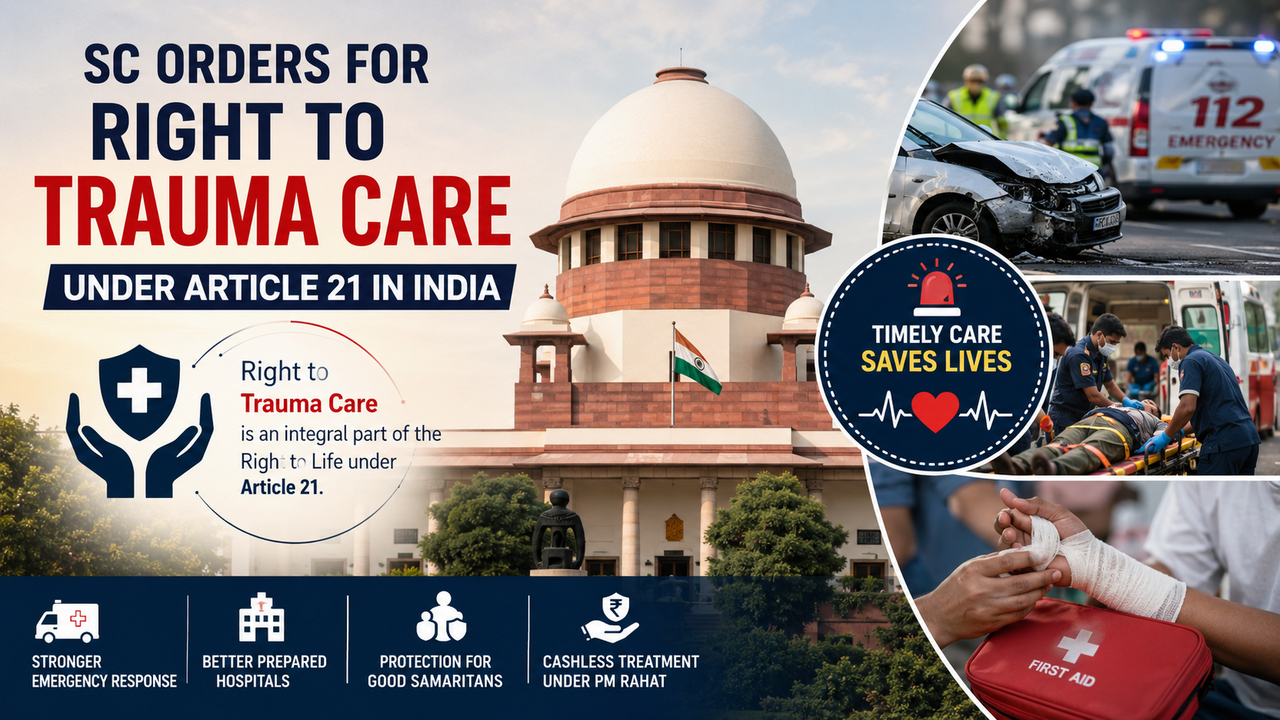
In a landmark order, the Supreme Court of India has recognized the Right to Trauma Care as an integral part of the Right to Life under Article 21 of the Constitution. The court issued comprehensive, time-bound directions covering the entire trauma chain of survival — comprising the inter-linked and coordinated chain of survival from the site of injury to definitive hospital care — aiming to strengthen emergency medical response and ensure timely access to trauma care across the country. The directions, issued in SaveLIFE Foundation & Anr. v. Union of India & Ors., are binding on all 36 States and Union Territories. They cover the full spectrum of traumatic injuries, including: Road crashes Falls Burns Drowning Industrial accidents Fires Explosions Disaster-related trauma In its the apex Court stated that “a uniform framework for trauma care, building public awareness, standardization of first aid skills, and proper Good Samaritan laws is required, since the right to trauma care of citizens is an integral part of the right to life enshrined under Article 21 of the Constitution of India.” Why Is The Order Significant? India records approximately 4.67 lakh accidental deaths every year from road crashes, falls, burns, drowning, industrial injuries, violence, and disasters. Of these, road crashes alone account for approximately 1.77 lakh deaths annually. As per the 201st Report of the Law Commission of India, 50 per cent of those killed in road crashes could have been saved had they received timely emergency medical care. The NITI Aayog-AIIMS Emergency and Injury Care Report (2021) found that at least 30% of all trauma-related deaths in India are attributable to delays in emergency care. Despite the scale of preventable loss of life, India had no unified, enforceable national trauma care framework. Responses compiled from 34 States and Union Territories and placed before the Court revealed a deeply fragmented system, including inconsistent ambulance standards, unintegrated emergency helplines, absent trauma registries, ungraded hospital facilities, and patchy implementation of centrally mandated schemes. The petition was filed by SaveLIFE Foundation in October 2024. Also read: Ebola: Inside India’s RT-PCR Tests For The Bundibugyo Strain| ExplainedWhat Has The Supreme Court Ordered? The Supreme Court’s directions cover nine domains of the trauma chain of survival. All States and Union Territories are bound by these directions, with compliance to be reported before the Court-appointed monitoring authority. Integration of a single national emergency number — 112 — within three months. Establishment of grievance redressal systems to protect Good Samaritans who provide emergency assistance to trauma victims. Establishment of a National Medical Rescue Protocol for trauma cases. Addition of all registered ambulances — public and private — under the National Ambulance Code (AIS-125, December 2014). The Court also mandated GPS or Vehicle Location Tracking Device (VLTD) fitment and real-time integration with helpline 112, along with periodic audits covering response times, quality of care, equipment, and outcomes. All States and Union Territories have been directed to adopt and implement the standardized Emergency Medical Technician (EMT) curriculum notified by the National Commission for Allied and Healthcare Professions (NCAHP) within three months. States and Union Territories must establish State Trauma Registries linked to a Coordinated Trauma Registry within four months of the issuance of these guidelines. All States and Union Territories have been directed to grade and designate all public and private medical facilities according to trauma care capacity within three months. Cashless treatment for trauma victims under the PM RAHAT scheme. All States and Union Territories have been directed to undertake sustained, multilingual, district-level awareness campaigns covering all the above within one month. Read More: Heatwave In India: Temperatures Continuously Rising; Stay Hydrated, Says PM ModiCompliance Mechanism The Court has also directed that copies of its order be sent to the Chief Secretaries of all States and Union Territories, who are required to submit Action Taken Reports to the Registry of the Supreme Court within the timelines prescribed for each direction. The matter is expected to be listed after four months for issuance of further directions based on the compliance reports received.