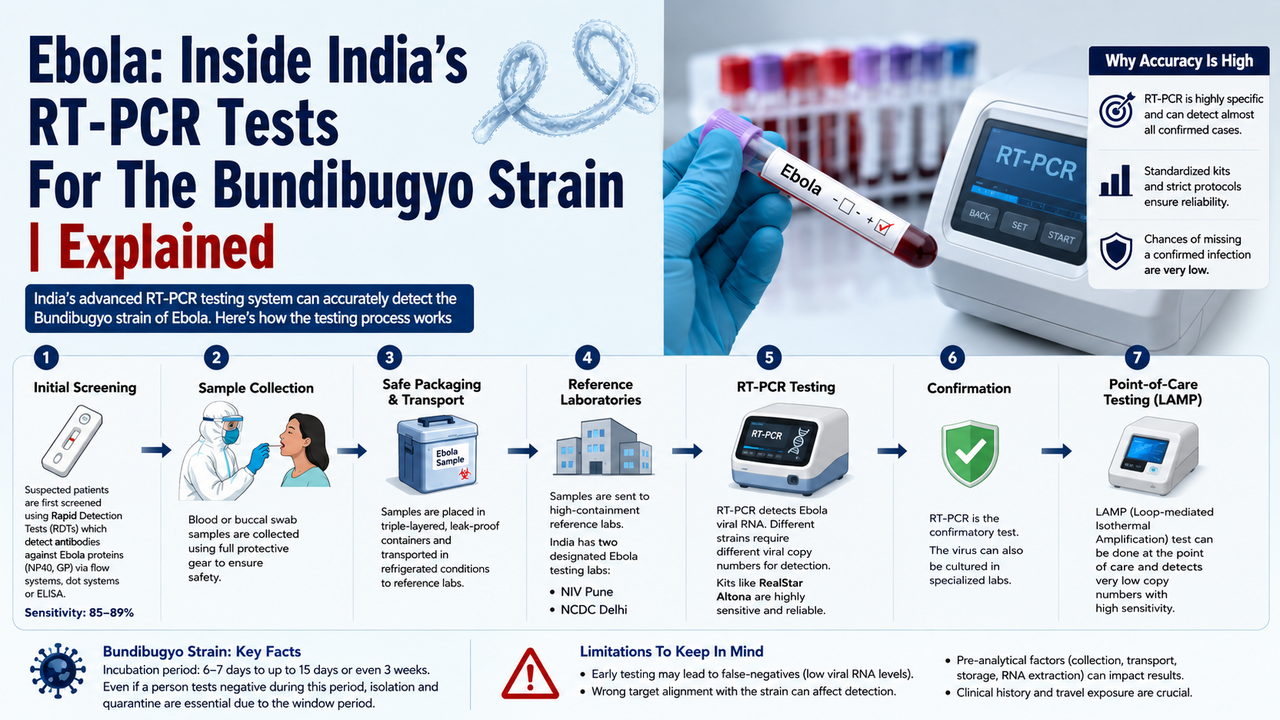
India’s RT-PCR testing system is capable of detecting the Bundibugyo strain of the Ebola virus, and the chances of missing a confirmed infection are very low when standardized protocols are followed, said health experts after the suspected Ebola case in Bengaluru involving a Ugandan woman tested negative.The woman, who arrived in Bengaluru from Kampala, Uganda, on May 23, was suspected of Ebola infection after developing mild symptoms including body ache. She was shifted from a hotel to the state-run Epidemic Diseases Hospital on May 26, and her samples were sent to the National Institute of Virology (NIV), Pune. The tests today returned negative. India currently has no reported case of Ebola, the Health Ministry said.Let’s take a look at how testing for Ebola takes place in India’s virology labs.Speaking to HealthandMe, Dr. NK Ganguly, former Director General of ICMR, said that RT-PCR remains the confirmatory test for Ebola infection, while rapid diagnostic tests (RDTs) are mainly used for initial screening with limited sensitivity — of around 85-89 per cent.According to him, the World Health Organization recommends that RT-PCR should only be carried out in specialized reference laboratories due to biosafety requirements. India currently has two designated Ebola reference laboratories — the National Institute of Virology (NIV), Pune, and the National Centre for Disease Control (NCDC)."The Altona RT-PCR kit is the real star and is highly standardized. It rarely misses Ebola cases when proper protocols are followed,” Dr Ganguly said. Can India Detect The Bundibugyo Strain?Bundibugyo is one of the strains of the Ebola virus currently linked to outbreaks in parts of Africa, including Uganda and the Democratic Republic of the Congo (DRC). The rare strain has caused over 900 cases and more than 200 deaths.Dr. Ganguly said the incubation period for the Bundibugyo strain can range from six to seven days up to 15 days or even three weeks.“If a person tests RT-PCR negative during this period, the chances of being infectious are lower. However, isolation is still necessary because there may be a short window period during which the infection may not be detected,” he said.The expert added that travelers arriving from outbreak-hit countries should remain under quarantine even if their initial Ebola test is negative.Why Ebola Testing Is Complicated Dr. Ganguly explained that Ebola belongs to the filovirus family, which includes several strains such as Bundibugyo, Sudan, Taï Forest and Zaire viruses.He noted that Ebola has a high fatality rate, with nearly 50 per cent of infected individuals dying from the disease. He added that the virus can spread through several body fluids including tears, saliva, milk and urine.In the early stages, Ebola symptoms can resemble flu, malaria or other viral illnesses, including fever, cough, sore throat, headache, diarrhea, skin rashes and body ache, making early diagnosis difficult.Dr. Ishwar Gilada, a Mumbai-based infectious disease expert, told HealthandMe that the Bengaluru patient’s symptoms were similar to common viral infections, which is why epidemiological history and travel exposure become critical in suspecting Ebola infection.“The symptoms of Ebola can be a little confusing because they are just like any other flu,” Dr. Gilada said, adding that travelers arriving from Ebola-affected countries should remain under observation for up to 21 days.Are There Any Limitations In India’s Ebola PCR Testing?Dr. Jatin Ahuja, Consultant, Infectious Diseases, Indraprastha Apollo Hospital, Delhi, told HealthandMe, there are no major loopholes in India’s Ebola PCR testing system, but there are certain limitations common to all diagnostic tests."One key limitation is the timing of testing. If RT-PCR is performed very early in the infection, there is a possibility of a false-negative result because the viral RNA levels may still be too low for detection," he said.Dr. Ahuja also pointed out that test accuracy depends on whether the PCR targets are correctly aligned with the specific Ebola strain being tested. Improper alignment may reduce sensitivity.He added that pre-analytical factors such as sample collection, storage, transport and RNA extraction also influence the final test outcome.“Negative Ebola PCR substantially reduces concern, but interpretation always depends upon the clinical picture, travel history and exposure risk,” Dr. Ahuja said.