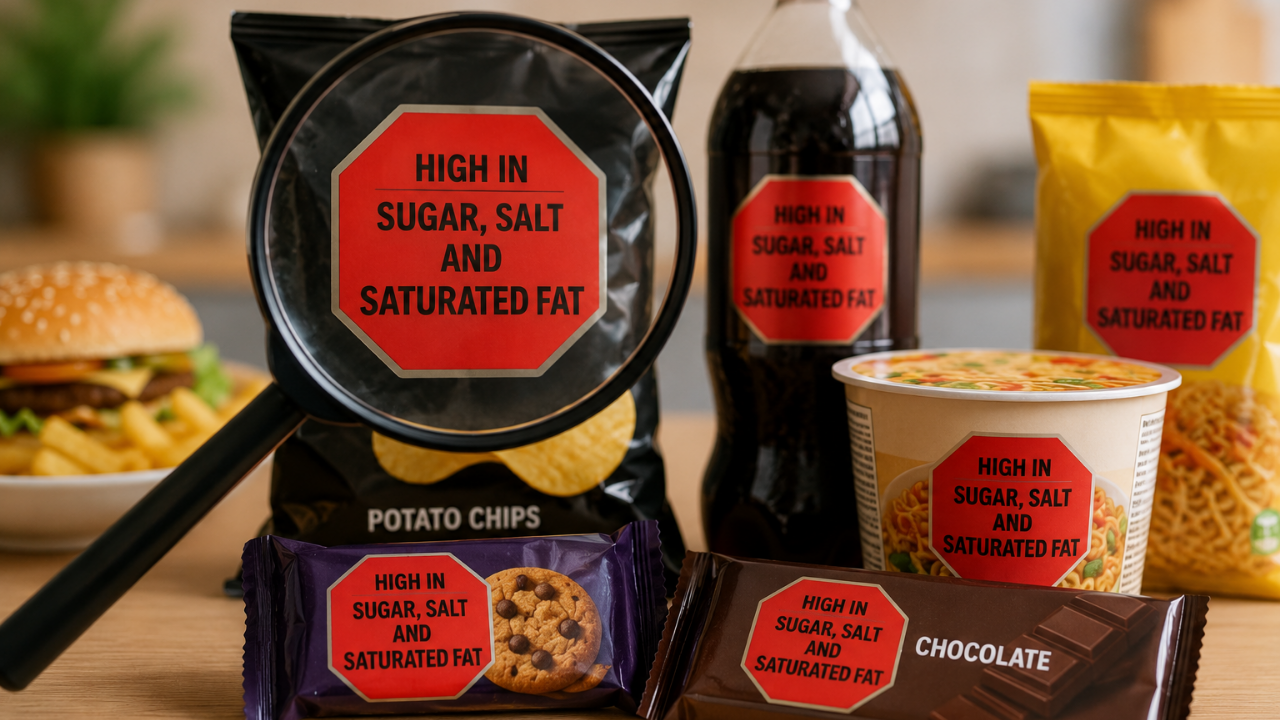
The Food Safety and Standards Authority of India (FSSAI) has proposed putting prominent red, hexagonal warning labels on the front of packaged junk foods and beverages that are high in saturated fat, sugar or salt. The proposal was submitted to the Supreme Court on August 28, marking a major update after years of debate over front-of-pack labelling. The proposed labels would carry warnings like “HIGH FAT”, “HIGH SUGAR”, “HIGH SALT” or “HIGHLY SWEETENED BEVERAGE”, allowing consumers to identify products high in nutrients of concern without having to turn the packet around and decipher the nutrition panel. Packaged Junk Foods To Carry Red Warning Labels Soon At present, packaged foods generally provide nutritional information on the back or side of the package. For many shoppers, comparing the sugar, salt or fat content of several products can require some additional work of flipping and searching.FSSAI said in the filing on Friday, "The warning label shall indicate the applicable declaration, such as 'HIGH FAT', 'HIGH SUGAR', 'HIGH SALT' and/or 'HIGHLY SWEETENED BEVERAGE' ... to enable consumers to readily identify products high in the specified nutrients."The proposed design is a red-coloured hexagonal symbol placed prominently on the front of the package. The first phase is expected to apply to products that are high in any two or more of the specified nutrients, according to the proposal reported by Reuters. The proposal also includes exemptions for certain foods that have single ingredients.Also read: FSSAI Flags Food Firms For Misleading ‘100%’, ‘Energy Drink’, Immunity ClaimsHow Could The Red Label Help Consumers?A prominent warning on the front of a packet could make it immediately obvious that a product contains high amounts of certain nutrients. This could be particularly useful when consumers are choosing between similar products.It could also help parents make quicker decisions when buying packaged foods for children, who are increasingly being exposed to processed and ultra-processed foods.The idea is not necessarily to tell consumers “never eat this”. Instead, the warning provides information before the purchase, allowing people to decide how frequently one should consume a type of packaged food.A warning label, however, cannot compensate for an overall unhealthy diet, and consumers may still choose products carrying a warning. Its value lies in making important nutritional information harder to overlook.The proposal comes after growing pressure from health activists and the Supreme Court, which has pushed the government to act on front-of-pack warnings amid concerns over rising obesity and chronic lifestyle diseases in India.Also read: Centre Bans Cough & Cold Medicines For Children Under 4: What Parents Need To KnowThe push for front-of-pack warnings is not coming only from health advocates. A recent LocalCircles survey of more than 83,000 consumers across 314 districts found strong support for prominent warnings on packaged foods and beverages high in sugar, salt or saturated fat.80% of consumers said FSSAI should mandate such warnings, while another 11% wanted them specifically on ultra-processed foods. That means 91% supported front-of-pack warnings in some form, while only 4% felt existing format of nutrition information was more than enough.Consumers also appeared to favour a warning that could be understood at a glance. 44% preferred a red warning symbol stating that a product was high in sugar, salt or saturated fat, while 27% chose traffic-light colour coding. Only 2% preferred a conventional black-and-white numerical nutrition panel.But perhaps the most striking finding was what consumers said they would do with that information. 94% said a prominent warning would influence their buying decision. Of these, 44% said they would avoid the product altogether, 26% would compare it with healthier alternatives and 24% would buy it less frequently. Only 6% said the warning would not affect their purchase.Also read: ₹5 Crore Fake Medicine Racket Busted Near Bengaluru: Why Counterfeit Drugs In ICUs Are A Major Health RiskFood Companies Have Opposed These Labels The move has faced resistance from parts of the food and beverage industry. Companies and industry groups have argued that warning labels could be confusing or ineffective and that consumers should instead be encouraged to practise portion control. Reuters reported that Coca-Cola India executive Mili Bhattacharya described it as “very simplistic” to believe that a symbol alone would significantly change people's diets. Health advocates, however, have argued that consumers deserve clearer information about products that are high in nutrients linked to chronic disease.Just a day before FSSAI proposed the red warning labels, Nestlé CEO Philipp Navratil said food manufacturers should be consulted as India develops its front-of-pack labelling rules.According to Reuters, Navratil said the rules should be developed through a scientific approach and with input from food manufacturers.The industry has previously pushed back against some proposals for warning labels, arguing that nutrition information needs to be presented in a way that gives consumers sufficient context rather than simply flagging individual nutrients.