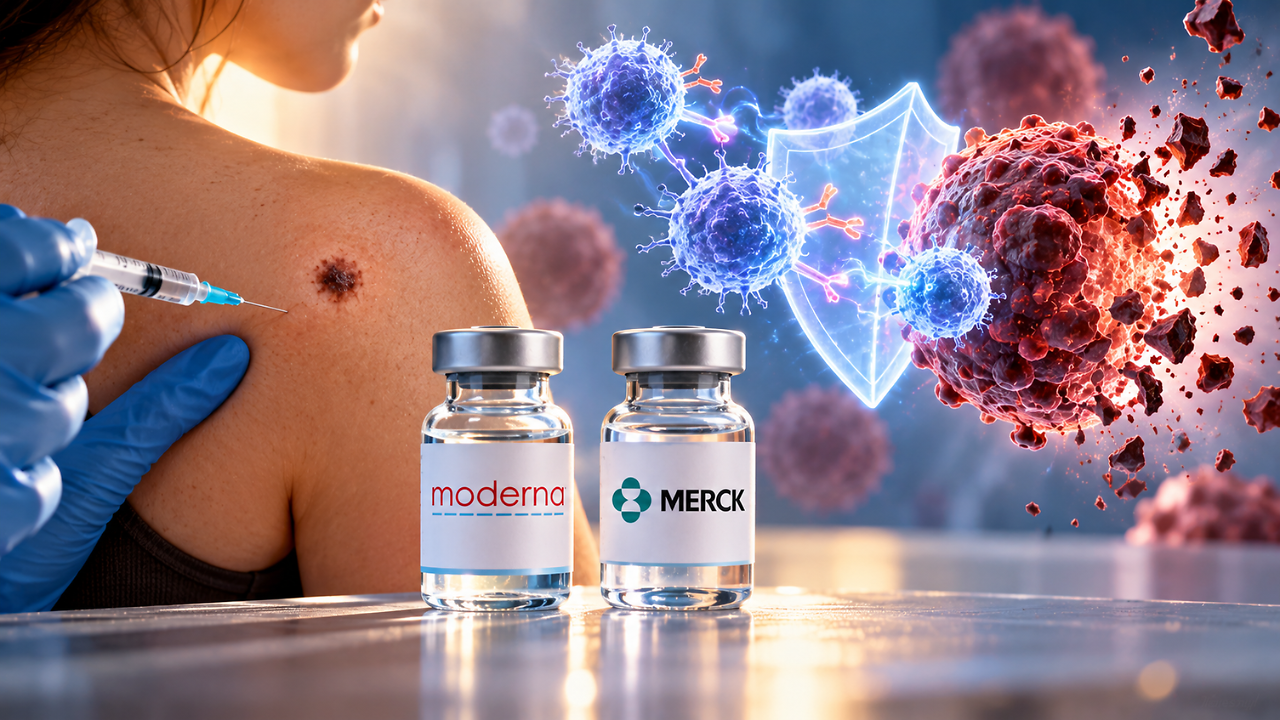
Pharmaceutical giants Moderna and Merck have been developing a personalised cancer vaccine that differs according to the patient's tumour characteristics. According to results from a Phase 3 clinical trial, the vaccine has reportedly reduced the risk of melanoma returning or death by 42% and the risk of cancer spreading by 38% when combined with standard immunotherapy.The findings, reported on October 22, build on evidence that messenger RNA (mRNA) technology could play a pathbreaking role in treating cancer. The experimental vaccine, intismeran autogene, was tested alongside Keytruda, Merck’s immunotherapy drug, in patients whose melanoma had been surgically removed. Latest Trial ResultsThe Phase 3 INTerpath-001 trial was based on 1,137 patients with high-risk stage IIB, IIC, III or IV melanoma who had undergone surgical removal of their cancer.Participants received either intismeran autogene alongside Keytruda or Keytruda alone. The researchers compared how effectively the treatments helped prevent the cancer from returning or spreading.After two years, 82.2% of patients who received the vaccine combination remained cancer-free, compared to 70% of those who received Keytruda alone, according to the trial results. The combination also reduced the risk of recurrence or death by 42% and the risk of metastasis or death by 38%. The study achieved its primary endpoint of recurrence-free survival and its key secondary endpoint of distant metastasis-free survival.Also read: Norah O’Donnell’s Skin Cancer Journey: Her Dermatologist Warns Against Tanning Beds & Sunburns What Is Intismeran Autogene And How Does It Work?Unlike conventional vaccines that prevent infections, intismeran autogene is a personalised cancer vaccine. It is developed using a sample of the patient’s tumour to identify mutations that distinguish cancer cells from healthy cells.The treatment uses mRNA to encode up to 34 tumour targets, known as neoantigens. Once administered, these targets help the immune system recognise those targets and generate an immune response against cancer cells.The vaccine is designed to be used with Keytruda. The vaccine and immunotherapy therefore have complementary roles in the treatment strategy.Also read: Could A Daily Pill Help Prevent Breast Cancer Recurrence? Roche's Promising Experimental Drug Awaits FDA Approval What Did Researchers Say? Professor Georgina Long, the trial’s principal investigator and medical director of Melanoma Institute Australia, said the results are a significant development for treatment after surgery.“'This is a coalescence of an mRNA platform, personalised, and the use of algorithms and data in a way that we've never seen before. These results show that patients with earlier-stage melanoma can be treated after surgery in a fundamentally new way,” Professor Long said. The combination’s safety profile was consistent with previous studies, and the companies said no new safety signals were observed in the Phase 3 trial. Detailed findings are being presented at the European Society for Medical Oncology meeting in Madrid.She added, “Intismeran in combination with pembrolizumab has the potential to establish a new treatment paradigm in the adjuvant melanoma setting, helping patients remain cancer-free for longer,” Long said in the companies’ August announcement of the trial’s positive topline results. Moderna and Merck have said they will engage with regulators about submitting the treatment for approval. Further FD review will be needed before it can become a treatment option.