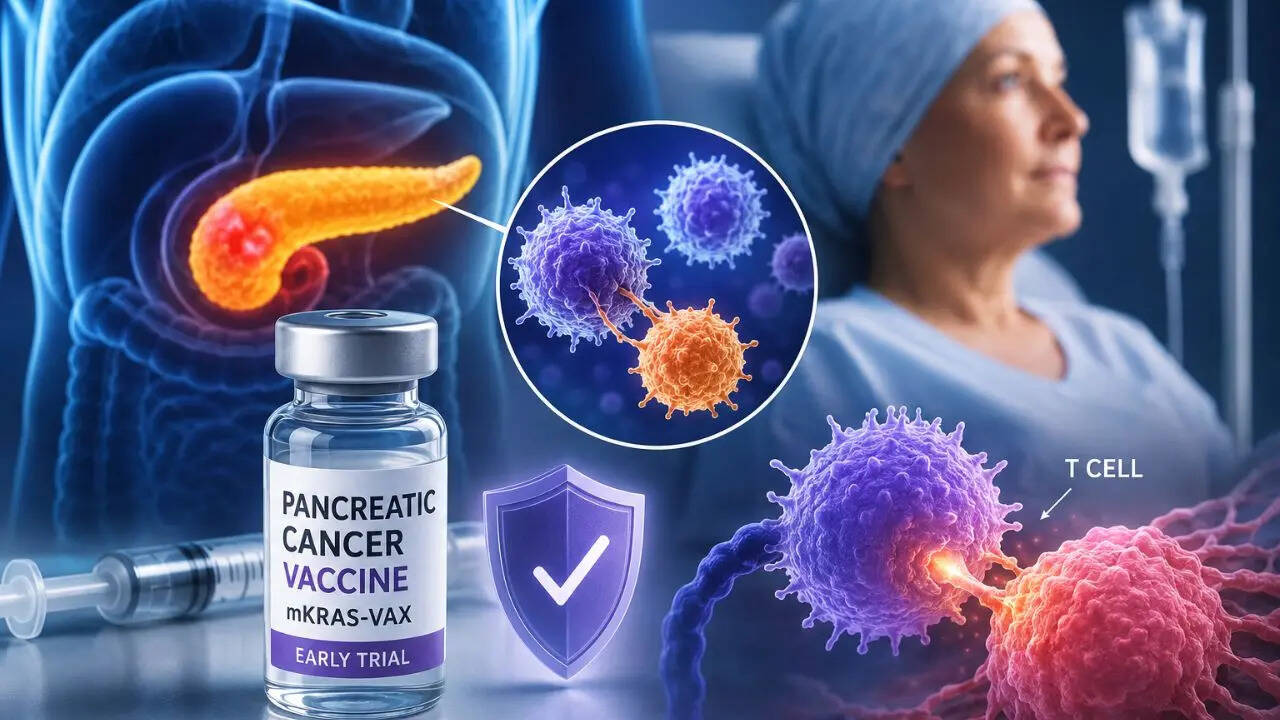
A new experimental vaccine targeting one of pancreatic cancer's most common genetic mutations has shown encouraging results in an early-stage clinical trial. Strong immune responses in most participants were observed, sparking fresh hope against one of the world's deadliest cancers. About The Study The Phase I study, published in Cancer Discovery, examined an investigational mutant KRAS-targeted vaccine (mKRAS-VAX) in patients who had undergone surgery for pancreatic ductal adenocarcinoma (PDAC), the most common form of pancreatic cancer. The trial enrolled 12 patients with resected KRAS-mutant pancreatic cancer who received the vaccine alongside two immune checkpoint inhibitors, nivolumab and ipilimumab, after completing standard treatment. Researchers observed vaccine-induced T-cell responses in 91.7% of patients, with immune cells remaining detectable for up to two years in some participants. Importantly, patients who mounted stronger immune responses also appeared to remain disease-free for longer, although the study was not designed to prove that the vaccine directly improves survival.Also read: Broadcaster Lauren Laverne Shares 'Smoldering Myeloma' Diagnosis After Cancer Recovery Milestone Results Show Strong Immune ResponseAccording to the researchers, pancreatic cancer has always been difficult to treat because it suppresses immune responses. "The significant increase in vaccine-generated T-cell responses demonstrates that the immune system can be trained to recognize KRAS-mutant pancreatic cancer," the researchers said, noting that higher T-cell responses were associated with longer disease-free survival. The researchers said that these findings support continued evaluation of KRAS-targeted vaccination strategies in larger clinical trials.Also read: Postpartum Breast Cancer May Be Biologically More Aggressive; Here’s Why Parallel Research Shows Potential TooThe promising study follows another recently published Phase I trial in Cancer Discovery that tested a KRAS-targeted vaccine in individuals at high risk of developing pancreatic cancer. That study found the vaccine safely stimulated KRAS-specific T-cell responses in about 90% of participants, suggesting such vaccines may eventually help prevent pancreatic cancer in selected high-risk groups. Dr. Neeha Zaidi, associate professor of oncology at Johns Hopkins University and one of the corresponding authors of the prevention study, said, "Individuals at high risk due to hereditary predisposition or to the presence of a concerning pancreatic lesion detected on imaging usually undergo surveillance to monitor for changes over time."Also read: Cancer Is Not A Death Sentence Anymore: How Early Detection & Modern Treatment Are Changing Outcomes In Tier-2 Cities She noted that surgery remains the standard treatment when cancer or high-risk lesions are detected, but recurrence remains common, highlighting the need for preventive strategies. Elizabeth Jaffee, another author, said, "The goal of this study was to test the safety of the vaccine and induction of durable immune responses." She added that the clinical trial was built on existing evidence showing KRAS-targeted vaccination could prevent progression of early precancerous lesions in animal . Importance Of KRAS KRAS is one of the most frequently mutated cancer-driving genes in pancreatic cancer, with mutations present in roughly 90% of pancreatic ductal adenocarcinomas. These mutations continuously prompt cancer cells to grow and divide. However, scientists have spent decades trying to develop therapies capable of effectively targeting the protein. Rather than attacking the cancer directly, the new vaccine teaches the immune system to recognize mutated KRAS proteins as abnormal and launch T-cell attacks against cancer cells. Pancreatic cancer remains one of the most aggressive cancers worldwide because symptoms often appear only after the disease has spread beyond the pancreas.While experts caution that the current findings come from an early-stage study, they say the results provide promising evidence that cancer vaccines can successfully activate the immune system against pancreatic tumors.