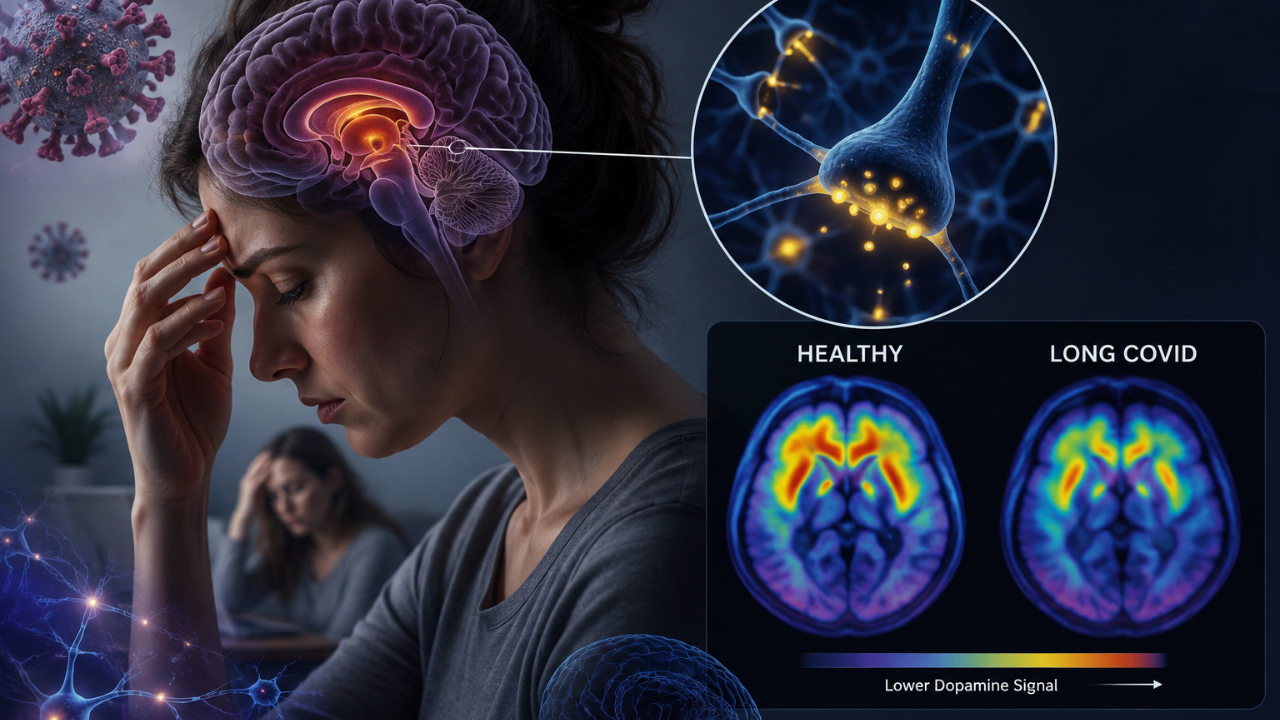
For years, people living with Long COVID have described a strange combination of symptoms: severe fatigue, brain fog, memory problems, slowed thinking and a loss of motivation. Researchers may have found an important clue behind at least some of these brain symptoms.A new study published in eBioMedicine found that people with Long COVID had 16% to 20% lower markers of dopamine nerve endings in key regions of the brain, with the average reduction of around 18%. The findings suggest that the brain's dopamine system may be affected long after the initial COVID-19 infection has passed.What Are The Study's Findings? Researchers from the Centre for Addiction and Mental Health (CAMH) and the University of Toronto used PET brain scans to examine 24 adults with Long COVID and 24 healthy, age-matched individuals.They focused on VMAT2, a protein found in nerve terminals that release dopamine. VMAT2 stores and packages dopamine inside nerve cells. Lower VMAT2 on the scans indicated reduced dopamine nerve-terminal density. However, it does not prove that dopamine neurons have permanently died.The reductions appeared across three important regions of the striatum, which is involved in motivation, movement and thinking. Lower dopamine markers in the ventral striatum were associated with reduced motivation. Changes in the putamen were linked with slower movement, while changes in the caudate were associated with memory difficulties.Also read: Can Long COVID Be Prevented Before It Starts? Study Suggests Early Paxlovid May HelpThe Dopamine FactorDopamine is often called the brain's "feel-good" chemical, but its role is much broader. It helps regulate motivation, movement, learning, attention and memory. When dopamine production is disrupted, people can experience problems that go far beyond mood swings or low motivation.The changes were also detected in people who had been living with Long COVID for as long as 4.6 years. This could help explain why some Long COVID patients report that even simple tasks feel unusually difficult or that they struggle to find the motivation to do things they previously enjoyed.Long COVID is already known to involve a wide range of neurological symptoms, including fatigue, headaches, cognitive problems, anxiety and depression. A 2026 review in Nature Reviews Neurology noted that approximately 6% of people who have experienced acute COVID-19 may develop this post-COVID condition.Also read: Are Women More Likely To Experience More Severe Neurological Symptoms Of Long COVID Than Men? New Study FindsScope Of TreatmentThe study does not mean that people with Long COVID have Parkinson's disease, nor does it establish that dopamine loss causes all Long COVID symptoms. The researchers also acknowledge that the study was small and that the findings show an association rather than proving cause and effect.Still researchers say that the findings suggest that medications which enhance dopamine function, including dopamine precursors and drugs that reduce dopamine breakdown, could be investigated as potential treatments. They plan to launch a clinical trial targeting dopamine function in people with Long COVID. More About Long COVIDLong COVID is a debilitating condition that can persist for months or even years after a SARS-CoV-2 infection. Long COVID is an infection-associated chronic condition marked by fatigue, cognitive impairment, exercise intolerance, and multisystem dysfunction. It has affected an estimated 400 million people worldwide and continues to have significant health, social, and economic consequences. Despite the ongoing risk, prevention strategies have received relatively little attention.