
- Health Conditions A-Z
- Health & Wellness
- Nutrition
- Fitness
- Health News
- Ayurveda
- Videos
- Medicine A-Z
- Parenting
Parkinson’s Mystery Cracked? Study Finds Brain Cells May Be Burning Themselves Out

Credits: Canva
A new study published in eLife has shed light on why dopamine-producing neurons, the brain cells crucial for motor control, die off in Parkinson’s disease. Researchers from the Gladstone Institute for Neurological Disease in the US found that these neurons may essentially be burning themselves out due to overactivity, potentially triggering or accelerating the condition.
Neurons Working Overtime
Parkinson’s disease is marked by the progressive death of dopamine-producing neurons in the substantia nigra, the part of the brain that controls movement. Building on earlier research in animal models, the Gladstone team explored whether the surviving neurons overcompensate for lost cells by becoming hyperactive, ultimately causing damage to themselves.
To test this theory, scientists used genetically modified mice and stimulated their dopamine neurons with drugs for several days. The result: the neurons gradually degenerated and died, particularly in the substantia nigra, mirroring what happens in human Parkinson’s patients.
“An overarching question in the Parkinson’s research field has been why the cells that are most vulnerable to the disease die,” says neuroscientist Ken Nakamura from the Gladstone Institute. “Answering that question could help us understand why the disease occurs and point toward new ways to treat it.”
Calcium Changes and Gene Shifts
The study went a step further by examining changes inside these overworked neurons. Researchers found alterations in calcium levels and shifts in the expression of genes involved in dopamine metabolism and calcium regulation. These findings were mirrored in brain samples from people with early-stage Parkinson’s disease, suggesting that the mechanism seen in mice is relevant to humans.
“In response to chronic activation, we think the neurons may try to avoid excessive dopamine, which can be toxic, by decreasing the amount of dopamine they produce,” explains neuroscientist Katerina Rademacher, lead author of the study. “Over time, the neurons die, eventually leading to insufficient dopamine levels in the brain areas that support movement.”
A Vicious Cycle
The research suggests a troubling cycle: as some neurons die, the remaining ones become even more active to compensate, which may in turn accelerate their demise. This process is similar to lightbulbs burning too brightly and eventually blowing out.
Scientists have long debated why these vulnerable cells die, with previous theories focusing on faulty mitochondria, toxic protein clumps, and genetic mutations. This new study adds another potential cause to the list, overactivity itself.
Hope for Future Therapies
If confirmed in further studies, this discovery could open the door to new therapies. Adjusting the firing patterns of dopamine neurons with medication or deep brain stimulation might help prevent them from overworking and prolong their survival.
“It raises the exciting possibility that adjusting the activity patterns of vulnerable neurons could help protect them and slow disease progression,” Nakamura notes.
The findings represent a step forward in understanding Parkinson’s disease, offering fresh clues for researchers seeking ways to halt or slow its devastating impact.
Noida Launches A 10-day Measles-Rubella Vaccination Drive

Credits: Canva
Noida administration has launched a 10-day measles-rubella (MMR) vaccination drive with an aim to cover students from Classes 1 to 5 across government and private schools. UP State Health Department officials noted that the sessions are also being conducted within the school premises under this campaign to ensure a wider vaccination coverage and ease of access for students and parents.
The initiative is part of the state government's ongoing efforts to strengthen immunity against measles and rubella. It is a highly contagious viral disease that primarily affects children.
Under the Measles-Rubella elimination campaign, the Central government aims to reach 100 per cent immunization coverage by ensuring children receive both doses of the vaccine. According to the 2024–25 Health Management Information System, India’s MMR coverage is currently 93.7 per cent for the first dose and 92.2 per cent for the second.
“The objective is to ensure that no eligible child is left out. Children will be administered an additional dose of the MR vaccine during the campaign. The vaccine is safe and is being provided for free of cost,” Dr Narendra Kumar, Chief Medical Officer of Gautam Buddha Nagar, told the media persons.
What Is Measles?
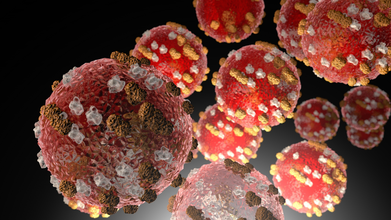
Measles is a highly contagious disease. It spreads by coughs or sneezes or by touching things that someone with measles has coughed or sneezed on.
Measles, also known as rubeola, is an extremely contagious viral illness that typically causes high fever, cough, runny nose, red and watery eyes, and a characteristic rash that begins on the face and spreads downward across the body. It spreads through respiratory droplets and can lead to severe and sometimes fatal complications, including pneumonia and inflammation of the brain known as encephalitis.
Symptoms include high fever, sore or red and watery eyes, coughing, sneezing, and small white spots in the mouth.
What Are The Symptoms Of Measles
Measles has a high transmissibility, and high measles immunity levels are required to prevent sustained measles virus transmission.
This is why herd immunity for measles could be easily breached.
It easily spreads from one infected person to another through breathes, coughs or sneezes and could cause severe disease, complications, and even death.
Symptoms include:
- High fever
- Cough
- Runny Nose
- Rash all over the body
The most unique symptom or the early sign of measles in the Koplik spots. These are tiny white dots that look like grains of salt on red gums inside the cheeks that appear before the red rash starts to appear on a person's face and then the body.
Read: Measles Outbreak In UK: Virus Spreads Among Unvaccinated Children In London
Furthermore, the symptoms of measles are also characterized by the three Cs:
- Cough
- Coryza or runny nose
- Conjunctivitis or red and water eyes
How Long Does The Infection Last?
The progression of the symptom comes in two stages, first is the prodromal stage or Days 1 to 4, where one would notice high fever, cough, runny nose, red and watery eyes, sore throat, fatigue, and Koplik spots.
The second stage is called the rash stage or the days 5 to 10 or even more where rash start to appear on the hairline, and then it runs down the body. It lasts for several days and fades in the same order.
The first symptoms, notes the Centers for Disease Control and Prevention (CDC), appear 7 to 14 days after a measles infection. Often, it could also lead to ear infection, or even diarrhea. Though these complications happen in every 1 in 10 children or individual with measles.
US FDA Asks Drugmakers To Set Time Limits For Antibiotic Use In Livestock

Credit: Canva
The US Food and Drug Administration (FDA) has issued new guidance urging veterinary drug makers to define the duration of antibiotic use in livestock.
The February 2026 guidance, published by the FDA’s Center for Veterinary Medicine (CVM), aims to mitigate the development of antimicrobial resistance and protect public health. It is consistent with previous recommendations by the federal agency that promoted the judicious use of medically important antimicrobial drugs in animals.
The FDA said that the guidance is intended for sponsors of approved new animal drug applications (NADAs) and abbreviated new animal drug applications (ANADAs) containing antimicrobial drugs.
The guidance provides recommendations on how to add duration limits to medically important antibiotics used in or on the medicated feed of food-producing animals.
"The framework outlined in this guidance is intended to facilitate voluntary changes to have all medically important antimicrobial new animal drugs administered in alignment with the principles of judicious use,” the FDA said.
"This guidance provides specific recommendations on how sponsors may facilitate changes to the approved conditions of use of affected products in support of ongoing efforts to mitigate the development of antimicrobial resistance,” it added.
The New FDA Recommendations
Currently, no limit has been set for the approved treatment in food-producing animals. As a result, farmers can use the antibiotics in animal feed for extended periods of time.
The proposed guidelines for “appropriately defined duration of use” labelling will ensure that the drug is used only when animals need it.
The regulator also called the industry to “revise the labeling to include appropriate criteria regarding when to begin and end feeding of the antimicrobial drug.”
The nonbinding guidance also suggests sponsors avoid instructions like “feed until market weight” to define the duration of use.
"The scope of this guidance is limited to those drugs that are approved for use in or on animal feed because all the approved uses of medically important antimicrobial drugs in other (non-feed) dosage forms already have appropriately defined durations of use," the FDA said.
Why Misuse of Antibiotics In Animals Is A Concern
Antibiotic use in livestock and poultry globally is intended to treat, control, and prevent bacterial infections.
However, their overuse and misuse in food-animal production threaten both animal and human health. It is because these promote the emergence and spread of antimicrobial resistance (AMR).
AMR in livestock is a major driver of the 700,000 to over 1 million annual human deaths linked to drug-resistant infections globally.
With roughly 70 per cent of global antibiotics used in agriculture, this misuse contributes to food-borne resistant pathogens and is projected to drive up to 10 million annual human deaths by 2050, as per the World Organisation for Animal Health.
FDA On Antibiotic Use In Livestock
The 2017 guidance issued by the FDA limited the over-the-counter use of medically important antibiotics on livestock.
It also required a prescription and veterinary oversight for all antibiotic use.
Later in 2018, the CVM called for all antibiotics used in the feed and drinking water of food -producing animals to have “an appropriately targeted duration of use”.
UK Faces Shortage Of This Common Pain Medicine Till June

Credits: Canva
A shortage of prescription-strength co-codamol is set to continue until at least June, leaving thousands of chronic pain patients across the UK uncertain about how they will manage daily symptoms. The Scottish government has confirmed limited availability of the strongest 30/500mg tablets, while health boards warn alternative medicines may not fully cover demand.
The shortage is linked to delays in authorization by the Indian government for exporting key codeine-based ingredients needed to manufacture the drug.
Patients Told To Taper Use
Many patients say they first learned of the disruption through calls from local health services. Some have already been advised to slowly reduce their dose to avoid withdrawal symptoms.
Jocelin Harrison, who has relied on the medication for more than three decades after five spinal surgeries, said she was contacted by NHS Lanarkshire and instructed to cut down gradually.
“The only advice I’ve been given so far was to reduce the tablets and try to manage my withdrawal symptoms,” she said, as reported by the BBC.
“I was not offered any other advice or possible replacement pain killers and it’s a great worry for me and other chronic pain sufferers throughout Scotland and the UK.”
Doctors warn that abruptly stopping co-codamol can trigger headaches, nausea, sweating and a sudden increase in pain, particularly for long-term users.
Why Does This Drug Matter So Much?
Co-codamol combines paracetamol with the opioid codeine and is commonly prescribed after surgery or for persistent musculoskeletal conditions. It comes in three strengths: 8mg, 15mg and 30mg of codeine with 500mg paracetamol.
The lowest strength is available over the counter, but the stronger forms require a prescription and are widely used by patients with chronic pain. Because codeine can cause dependence, tapering rather than stopping suddenly is considered essential.
Health boards say supplies of alternative strengths are also limited, making it difficult to simply switch everyone onto another version.
Guidance issued locally states patients, except those undergoing cancer treatment, should gradually reduce usage until stopping completely. No new patients will be started on the medication until supplies stabilize.
What Are The Alternatives?
NHS Grampian has urged pharmacists to prioritize existing stock carefully. However, it stopped short of telling patients to immediately begin cutting back, highlighting variation in local guidance.
Officials acknowledge substitutes exist, but warn they cannot meet the expected rise in demand from patients switching medicines.
Authorities Now Work On Solution
Scotland’s chief pharmaceutical officer Alison Strath said the issue ultimately sits with UK-wide medicine supply systems but confirmed discussions are ongoing.
“Supply issues are expected until June 2026 and we are in regular contact with the UK government to seek assurances they are doing all they can to resolve this,” she said, adding that affected patients will be contacted directly about alternative treatment options.
The UK Department of Health and Social Care said most medicines remain readily available and manufacturers are working to restore production.
The shortage highlights the global nature of generic drug manufacturing. Medicines such as co-codamol 30/500mg are typically produced using ingredients sourced from India and China, meaning regulatory or production delays overseas can quickly affect patients at home.
For now, patients are being urged not to contact GP practices unless advised and to wait for further instructions from their health providers.
- Follow Us :


© 2024 Bennett, Coleman & Company Limited