
- Health Conditions A-Z
- Health & Wellness
- Nutrition
- Fitness
- Health News
- Ayurveda
- Videos
- Medicine A-Z
- Parenting
Scromting: Is It A New Medical Slang Of 2025? Here's What Experts Are Saying
Credits: Canva
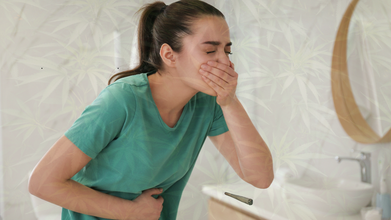
Scromting: the blend of two nightmares - screaming and vomiting. It sounds surreal, but it is as real as it could get. In an interview with the New York Post, Sydni Collins, 23, shared that she was "puking all morning." "I would let out yells or cries because nothing would come out. I was just dry heaving," she shares. This is how she ended up in the hospital with a feeding tube. What she was experiencing is called cannabis hyperemesis syndrome (CHS), a debilitating condition that triggers episodes of relentless nausea, abdominal pain, and severe vomiting in chronic weed users. She has been smoking weed daily as a teenager, since she was 16.
In the US, there are more than 2.5 million teens and 1 in 10 of them are casual cannabis users, with an additional of 600,000 teens considered to be addicted to it. Emergency rooms in the country have seen a steady rise in CHS cases over the last decade. In fact, the World Health Organization (WHO) and the Centers for Disease Control and Prevention (CDC) have also added CHS in its official diagnostic codes.
Also Read: President Trump Says Media Reports On His Health Are All 'Fake, Seditious, Treasonous'
In Collins story, she became the trendsetter, because during her first hospital visit, she did not receive the diagnosis. However, her inability to eat a full meal afterward is what led to 7 ER visits in just one month. When she was finally admitted, she was only 87 pounds. She shared she would be in fetal position on the beds for hours, because that was the only way her stomach did not hurt. This is when she was finally diagnosed with 'superior mesenteric artery syndrome', which is a rare digestive disorder.
Misdiagnosis is common because there had been an absence of a diagnostic code for CHS.
What Are Experts Saying?
Dr David Streem, medical director of the Cleveland Clinic's Alcohol and Drug Recovery Center told USA TODAY that he has treated a range of patients with CHS over the years. He said that the condition is so severe that even the strongest anti-nausea medication that are given to chemotherapy patients, like Ondansetron, did not stop it.
Also Read: Inside The 'Flu-Nami' Surge: Why 2025 Is the Worst Flu Year For UK
However, there is a debate on CHS patients, and marijuana advocates like Paul Armentano, who is the deputy director of cannabis reform organization NORML, tells USA TODAY that CHS is actually "very rare" and that a lack of research on the syndrome has led to its misunderstanding. Armentano says, "The very fact that we're rebranding what was known for two decades as cannabinoid hyperemesis syndrome as scromiting. Scromiting is clearly sensational." It is made up, non-scientific, and sensational, says the cannabis advocate.
What is CHS or Cannabionoid Hyperemesis Syndrome, also known as the slang Scromting?
It is a side effect of prolonged use of marijuana. This results in nausea, vomiting, and abdominal pain.
As per Rome Foundation, a patients must meet the following criteria:
- Cyclical vomiting
- Presentation after prolonged marijuana use
- Relief of vomiting after the cessation of marijuana use
CHS was first reported in Australian medical literature in 2004. This is when a small study, published in BMJ analyzed 19 patients with cyclical vomiting after prolonged marijuana use.
Also Read: Scromting: Is It A New Medical Slang Of 2025? Here's What Experts Are Saying
While the research on what actually suddenly causes this syndrome is very limited, Armentano asks questions on if synthetic cannabis products, or a specific type of it leads to such a medical condition.
Stream said for treatment, IV drip of substance such as droperidol and haloperidol are often used in emergency rooms for CHS. Stream also said that Capsaicin, commonly referred to as hot pepper cream could also be rubbed on the abdomen for some temporary relief, along with hot showers or baths.
Cancer Postcode Lottery: What Is It And Why Is UK Govt Putting An End To It?
Credits: Canva
Cancer Postcode Lottery will soon be put to an end by the UK Government. Reports say that it will enable the rural population access to cancer specialists and treatments. Before getting into how it will help the rural population and people living in coastal areas to find it easier to see a cancer doctor, let us first understand what postcode lottery means.
What Is Cancer Postcode Lottery?
The term cancer postcode lottery refers to a situation where a cancer patient’s access to the latest and most effective treatments depends on where they live or which hospital they are treated at, rather than purely on medical need.
Based on the information you shared, senior cancer doctors in England are warning that this is happening because of bureaucratic hurdles within the NHS. Even though cancer care is supposed to be equitable across the country, in practice, not all hospitals can easily offer the same treatments.
How Does This Postcode Lotter Work?
Doctors say that some cutting-edge cancer treatments such as advanced radiotherapy techniques and newer immunotherapy drugs require separate funding approvals. Individual cancer centers often have to apply to NHS England for permission and money to use these treatments.
Larger, better-funded hospitals with more administrative resources are often able to navigate this complex system more easily. Smaller or less well-resourced units may struggle, meaning patients treated there may not get access to the same options.
For instance, Stereotactic Ablative Body Radiotherapy (SABR). SABR is a highly precise form of radiotherapy that delivers strong radiation doses directly to small tumors in areas such as the lungs, liver, brain and lymph nodes. Although SABR is a well-established treatment and can be life-saving for certain patients, the Royal College of Radiologists (RCR) says some cancer units still have to apply for special funding to use it. This leads to situations where a patient in one area can receive SABR, while another patient with the same cancer elsewhere cannot.
What Is The Government Planning To Do With Postcode Lottery?
As per the official website of UK Government, this will allow people "living in rural and coastal communities will find it easier to see a cancer specialist as part of plans to tackle the current postcode lottery."
The website notes that most deprived parts of the country have fewer cancer consultants, which leaves patients waiting longer for essential care. These same areas also face highest economic inactivity, with long waits for diagnosis and treatment keeping people out of work and holding back local economies. This is why the government is now introducing "new training places targeted at trusts with biggest workforce gaps, prioritising rural and coastal areas".
Working with the Royal Colleges, the government will encourage more doctors to train in clinical and medical oncology to increase the number of cancer specialists in underserved areas.
These steps will be outlined in the upcoming National Cancer Plan, which aims to speed up diagnosis and treatment, reduce inequalities, and support the goal of making England a global leader in cancer survival, while building a future-ready NHS.
Could Red Light Therapy Help Protect Football Players From CTE

Credits: Canva
A treatment already popular in the US for skin care, pain relief, and faster healing may soon be known for something far more serious. A new study suggests red light therapy could help protect football players’ brains from chronic inflammation caused by repeated hits to the head.
Experts say the findings are early but promising, especially in the ongoing search for ways to reduce long term brain damage in contact sports.
What Is CTE?
Chronic traumatic encephalopathy, or CTE, is a degenerative brain disease linked to repeated head injuries. It is commonly found in former football players, boxers, and military personnel exposed to blast injuries. Over time, the condition can cause memory loss, confusion, mood changes, aggression, and eventually problems with movement, speech, swallowing, and breathing. There is currently no cure, and doctors still do not know how to slow its progression.
Why inflammation matters in CTE
For now, the only proven way to lower CTE risk is to reduce repeated brain trauma through better helmets, rule changes, and fewer hits to the head. But with more than 100 former NFL players diagnosed with CTE after death and many more suspected cases, experts agree that prevention tools alone are not enough.
Researchers believe chronic inflammation in the brain plays a major role in how CTE develops and worsens over time. If that inflammation can be reduced early, it could potentially limit long term damage.
Red light therapy, also known as photobiomodulation, has already been shown to reduce inflammation in other parts of the body. It works by stimulating energy production inside cells and improving blood flow, which helps tissues repair and recover.
Inside the football study
To see whether the therapy could help the brain, researchers at the University of Utah Health studied 26 collegiate football players during a full season. Half received active red light therapy using a light emitting headset and a small device placed inside the nose. The other half used an identical looking device that did not emit light.
Players completed three 20 minute sessions each week over 16 weeks. Brain scans were taken before and after the season.
Read: 21-year-old Billy Vigar Of Chichester City Dies Of Sustaining Brain Injury
The results were striking. MRI scans showed that players in the placebo group experienced a significant increase in brain inflammation by the end of the season. In contrast, those using red light therapy showed little to no increase, with protection seen across most brain regions.
Why experts are paying attention
Specialists who reviewed the findings say the results align with what scientists already understand about inflammation and brain injury. Reducing the inflammatory response after repeated impacts could help limit the damage that builds up over time.
Another advantage is that the therapy is non invasive and does not involve medication. Most users report no major side effects, which makes it especially appealing for athletes.
That said, experts caution against buying over the counter red light devices. The therapy requires very specific wavelengths that can penetrate skin and tissue effectively. Many consumer products do not meet those standards.
Researchers stress that more studies are needed to confirm long term safety and effectiveness. A large Department of Defense funded trial is already planned, involving 300 people with persistent concussion or traumatic brain injury symptoms, including veterans and first responders.
If future research continues to show benefits without harm, red light therapy could one day become part of how teams protect athletes’ brains, not just in football, but across many sports.
Nicole 'Snooki' Polizzi Says Doctors Found Cancerous Cells In Her Cervix

Credits: Wikimedia Commons
Nicole "Snooki" Polizzi opened up about a cancer scare. Now, 38, the Jersey Shore star, posted on her TikTok an emotional video, where she explained that she has been dealing with abnormal pap smear results. She said that it has been about four year since the precancerous cells were found. Because of that she had to undergo an "uncomfortable" colposcopy and biopsy.
She said that when the results came back, the doctor informed her that her cervix is "Not looking great". The doctor had found cancerous cells on the top of her cervix. She said that she would soon need a cone biopsy under anesthesia for further testing. "I am terrified. It is scary, but we have to get it done because cervical cancer is nothing to joke about."
She said, "But whatever to keep me healthy and safe to be here for my kids that I have now," referring to her three children with her husband Jionni LaValle.
In her TikTok video, she said that she is scared and freaking out. She also said that she hopes to find community on social media with other women who have been through the same.
She also agreed to delaying her routine examination because of fear. "I waited on my appointments because I knew I might not get great results but also because I didn't want to feel the pain. I didn't want to deal with the stress of having to deal with all of this," she said.
Talking about her TikTok video, she said, “Just making this video to spread awareness to make sure you get your pap smears. And if your doctor calls you to do it again, do it, Make sure you are fine and prevent all the bad things that could happen, like cervical cancer." She said she was nervous but also shared that she received a lot of support from her friends and family. "Being a woman is not easy and is definitely a scary thing. I know I am going to be fine. It is just scary."
Read: Oncologist Reveals 5 Subtle Cervical Cancer Signs That You May Miss
What Is Cervical Cancer?
Cervical cancer develops in a women's cervix (uterus opening) due to abnormal cell growth, primarily caused by persistent HPV infection, a common infection that's passed through sexual contact.
When exposed to HPV, the body's immune system typically prevents the virus from causing damage however, in a small percentage of people, the virus can survive for years and pave the way for some cervical cells to become cancerous.
Treatment involves surgery, radiation, and chemotherapy, with early detection significantly improving outcomes, though it remains a major cancer in low-income countries. Cervical cancer can also be prevented through vaccination and regular screening (Pap/HPV tests).
Dr Ninad Katdare told News18: "In its early stages, it is often more of a whisper than a shout. As a cancer surgeon who has treated hundreds of women with gynaecological cancers, I can say with confidence that recognizing these subtle cues can lead to earlier diagnosis and significantly better outcomes."
- Follow Us :


© 2024 Bennett, Coleman & Company Limited