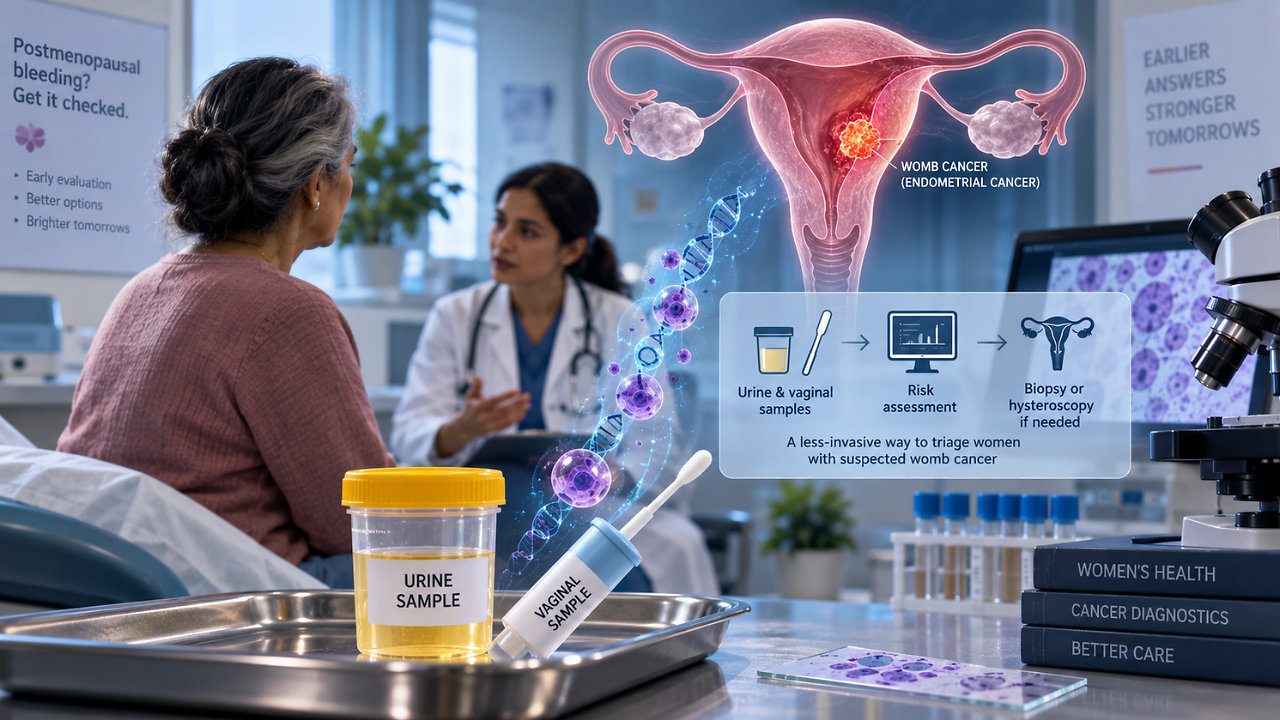
Postmenopausal bleeding is one of the key warning signs that needs medical intervention as it can be an indicator of endometrial, or womb, cancer. But most women who develop postmenopausal bleeding do not have cancer but still are required undergo several invasive tests to get a clean bill of health. According to a new study published in The Lancet Obstetrics, Gynaecology & Women’s Health, cells from urine and vaginal fluid could help identify women who need further investigation and reduce the need for unnecessary and uncomfortable invasive procedures. However, the test is not yet accurate enough to replace biopsies or other standard tests these types of cancers. Cells From Endometrial Tumour May Show Up In Urine And Vaginal SamplesDoctors usually recommend women with postmenopausal bleeding to undergo transvaginal ultrasound, endometrial biopsy and hysteroscopy. These procedures can be uncomfortable, painful and costly, and some women may need repeat these tests. In the study, only 5.3% of women had endometrial cancer, despite all of them being referred for these tests due to postmenopausal bleeding. The researchers said that cells shed by an endometrial tumour can travel into the lower genital tract and could be collected through vaginal fluid or urine. Previous research has already indicated that cancer cells could be detected in these samples. The DETECT study was designed to determine how accurately this approach could detect cancer.Also read: Endometriosis Can Take Years To Diagnose But This AI Tool Can Identify Its Signs In 18 MillisecondsAbout The Study The study is based on 1,864 women with postmenopausal bleeding from seven hospitals in northwest England between September 2018 and March 2021. The participants gave their urine and vaginal fluid samples before their routine cancer investigations. Specialist cytopathologists, who were not aware of the women's cancer diagnoses, examined the samples for malignant cancerous cells. The results were then compared to the women's clinical diagnoses and, where available, tissue histopathology. Among them, 99 had endometrial cancer and 16 had other pelvic cancers, including cervical, ovarian, bladder and colorectal cancers. The test also detected about 8 in 10 womb cancers When urine and vaginal cytology were combined, the test detected 80.8% of endometrial cancers and correctly identified 92.6% of women who did not have the disease. Its negative predictive value was 98.8%. In this particular study population, that means a woman with a negative combined result was highly unlikely to have endometrial cancer. But the test was not equally effective at detecting every type of cancer. It detected 95.8% of high-grade cancers and 96.4% of stage 2 or more advanced cancers. It was more likely to miss low-grade, early-stage tumours. According to the researchers, the urine and vaginal fluid samples may miss early-stage tumours as they may shed fewer cancer cells. The sensitivity of the test was lower than that of transvaginal ultrasound and endometrial biopsy when sufficient tissue was obtained.Also read: Urine Leakage When You Cough, Sneeze Or Exercise? It Could Be Pelvic Floor Dysfunction, Say ExpertsThis May Reduce Invasive Tests For Cancers The study does not suggest that this test could replace conventional methods of diagnosis. It is merely an effective triage tool that could help screen patients and help healthcare providers decide who should actually get invasive tests done. In the study, 99.1% of women underwent an attempted transvaginal ultrasound, 61.1% underwent an attempted endometrial biopsy and 48.2% underwent hysteroscopy. The failure rate was 25.7% for endometrial biopsy and 17.8% for hysteroscopy, with cervical stenosis and intolerable pain among reported reasons. The test also produced false positives. Its positive predictive value for endometrial cancer was 38.1%, meaning a positive result would still require further investigation. The researchers say further studies will establish how the test performs in standard healthcare systems, different populations, and other relevant settings. They also note that highly trained specialist cytopathologists interpreted the samples and helped provide diagnoses, so it remains uncertain whether the same accuracy can be achieved elsewhere. Another interesting finding from the study is that among 10 women whose initial cytology missed cancer and who underwent repeat sampling, four tested positive on repeat testing, suggesting repeated sampling could improve detection. The researchers also propose exploring artificial intelligence and image-recognition technology to supplement cytological analysis.