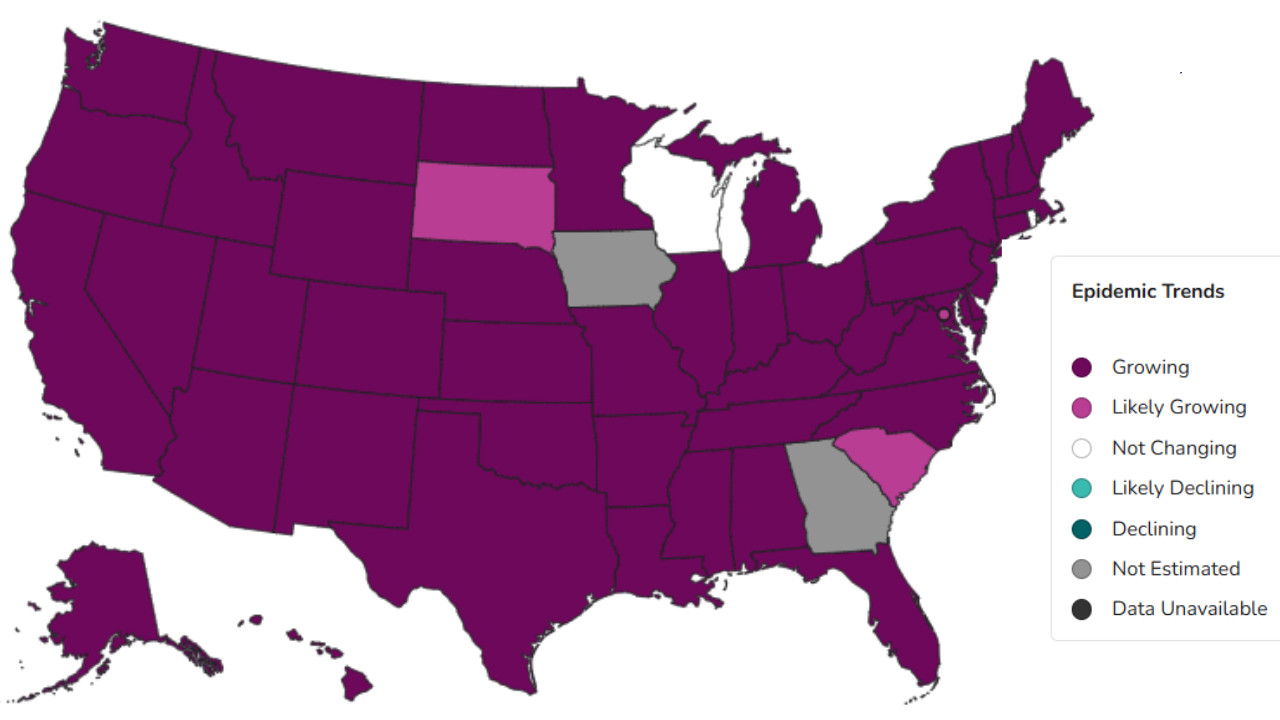
Almost all states in the US are reporting a growing summer wave of COVID-19 cases, according to a report by the Centers for Disease Control and Prevention (CDC).While the numbers aren’t especially high and there aren’t many hospitalizations or deaths, the test positivity rate for the week ending August 8 rose above 3% for the first time since March, with numbers climbing in every state. Emergency department visits related to COVID-19 are also “very low.”Wastewater Data Offers Closer Look At COVID ActivityAccording to the CDC, wastewater data can be a key tool for tracking where the virus may be circulating. Testing sewage can detect the presence of COVID-19 in a community and “can pick up signs of infection even from people who feel perfectly healthy,” the CDC said.COVID-19 Activity By StateHawaii and Mississippi show signs of elevated viral activity.Both states have “moderate” levels of COVID-19.Wastewater data for Mississippi is limited.The West and South are seeing higher COVID-19 activity than other regions.Low wastewater levels: Alabama, Alaska, California, Florida, Georgia, Nevada, Oregon, Texas and Washington.Very low levels: The remaining states.In Alabama, COVID-19 is not reflected in hospitalizations or mortality data yet, but cases are registering an “uptick” rather than a surge.“It is going up. We don’t know how to describe these numbers that we’re seeing in terms of what the denominator is anymore,” Dr. Scott Harris, state health officer for the Alabama Department of Public Health, told the media.“Now we just know when we get a positive test, and we don’t even have clinical data sometimes to put that in context.”‘August Is Solidly Covid Season’“August is solidly Covid season,” Dr. Caitlin Rivers, an expert in outbreak science and senior scholar at the Johns Hopkins Center for Health and Security, told CNN.“Right now, the South and the West are sort of the leading edge of this Covid season. In the past, it almost always starts in Florida, Texas and Georgia, which is exactly what we’re seeing this year.”Who Is At Higher Risk?COVID-19 can still be serious and even deadly, especially for people who remain vulnerable to severe disease. These include:Elderly individualsPregnant womenPeople with chronic heart diseasePatients with COPD or interstitial lung disease (ILD)Those with chronic kidney or liver diseaseImmunocompromised individualsHow To Prevent COVID-19?To reduce the risk of infection, people should:Stay up to date with COVID-19 vaccinations.Wear masks in crowded indoor settings.Maintain hand hygiene.Ensure good ventilation.Avoid close contact with others when unwell.Anyone experiencing symptoms such as fever, cough or breathlessness should get tested and seek timely medical advice.If you didn’t get a COVID-19 vaccine last year, you may want to talk to your healthcare provider or pharmacist about getting one, including the vaccine formulated for last season, Dr. James McDonald, commissioner of health for the New York State Department of Health, told CNN.