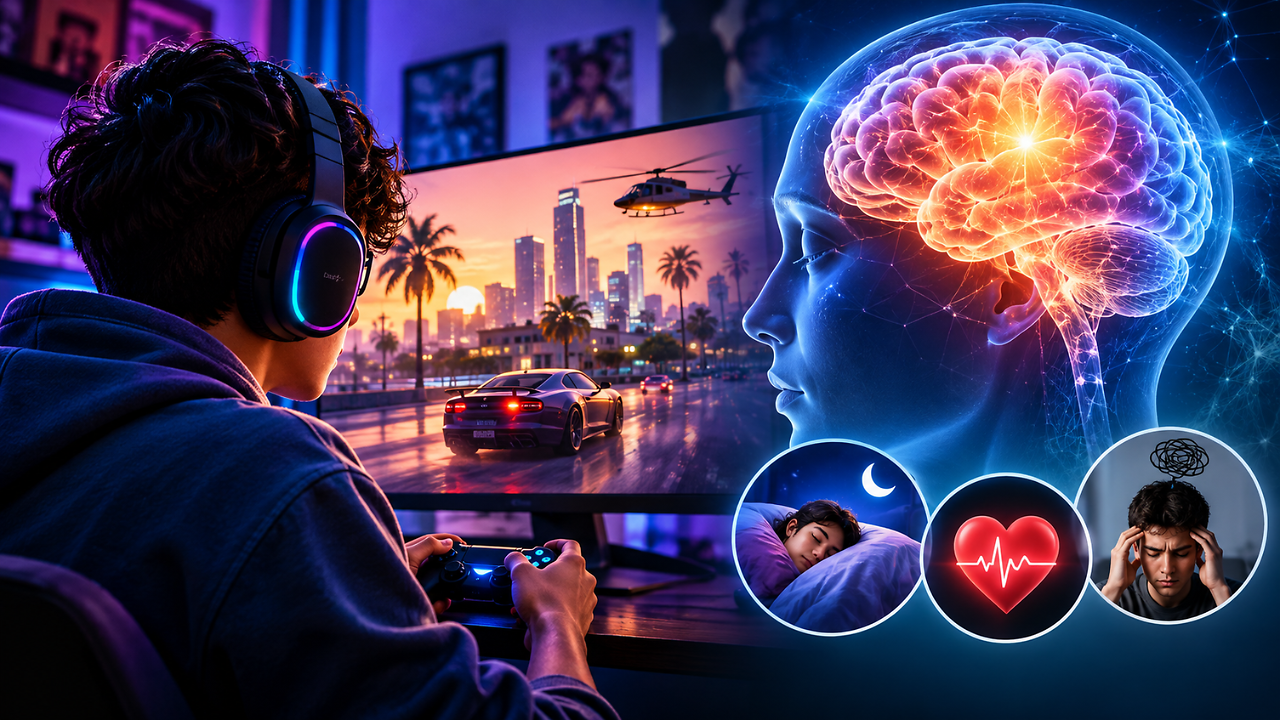
Grand Theft Auto VI (GTA 6) launched globally on November 19, following years of anticipation and delays, and is already generating enormous excitement among fans worldwide.Some players have reportedly booked time off work to play it, while schools in the UK have warned students against skipping classes. The game carries an 18 rating from the Pan European Game Information (PEGI) system for stronggraphic violence, sexual themes and references to illegal drugs.Set in the fictional US state of Leonida, GTA 6 follows two protagonists, Lucia and Jason, as they navigate the criminal underworld after an easy score goes wrong.But as players spend hours exploring its virtual world, health experts explain how prolonged gaming can affect brain health, sleep and everyday functioning.When Does Gaming Become An Addiction?Playing video games for long hours does not automatically mean someone has a gaming addiction. However, gaming becomes a concern when a person loses control over the behaviour and continues despite its negative consequences.Dr Shiv Prasad, Professor and Head of the Department of Psychiatry at Lady Hardinge Medical College and Smt. Sucheta Kriplani Hospital, told HealthandMe that gaming disorder is characterised by impaired control over gaming, increasing priority given to gaming over other activities, and continuation despite significant negative consequences."When gaming begins to compromise occupational, academic, social or interpersonal functioning, it warrants clinical attention," he said.Red Flags: When Should You Be Concerned?According to Dr Shiv, warning signs include:Loss of control: Being unable to regulate how long or how often you play.Neglecting responsibilities: Prioritising gaming over work, studies or relationships.Continuing despite harm: Playing even when it causes problems in everyday life.Failed attempts to cut down: Repeatedly trying but failing to reduce gaming time.Neglecting sleep and self-care: Sacrificing rest and daily routines to continue playing.The defining concern is not simply the number of hours spent gaming, but whether it leads to a loss of control and interferes with everyday functioning.What Happens To Your Brain When You Play For Hours?Video games do not necessarily have negative effects on the brain. They activate networks involved in attention, visual processing, decision-making, reward and motor coordination.Dr Sudhir Kumar, neurologist at Apollo Hospitals, Hyderabad, explained that these processes can improve reaction time, hand-eye coordination and certain cognitive skills.A 2024 study published in Alzheimer's Research & Therapy, involving 471,346 UK Biobank participants, found that frequent computer gaming was associated with better memory, reaction time and fluid intelligence, as well as greater grey-matter volume in the hippocampus, a brain region involved in memory.Dr Sudhir cautioned that prolonged gaming without breaks may contribute to mental fatigue, sleep disruption, eye strain and reduced physical activity. "The key determinant of brain health is balance," he told HealthandMe.Can Prolonged Gaming Affect Your Sleep?A 2021 systematic review and meta-analysis of 51,430 participants across 26 countries found that problematic gaming was associated with twice the odds of poor sleep quality, 1.57 times the odds of daytime sleepiness and 2.6 times the odds of sleep problems.People with problematic gaming behaviours also reported shorter sleep duration. Regularly sacrificing sleep to play video games could affect memory, emotional regulation and overall health.How Can Gamers Protect Their Health?Dr Sudhir recommends balancing gaming with other daily activities. Some healthy habits include:Taking regular breaks, ideally every hour.Avoiding gaming at the expense of adequate sleep.Maintaining daily physical activity.Staying hydrated.Ensuring gaming does not interfere with work, studies or relationships.If gaming becomes difficult to control or starts affecting everyday functioning, seeking professional help is important.