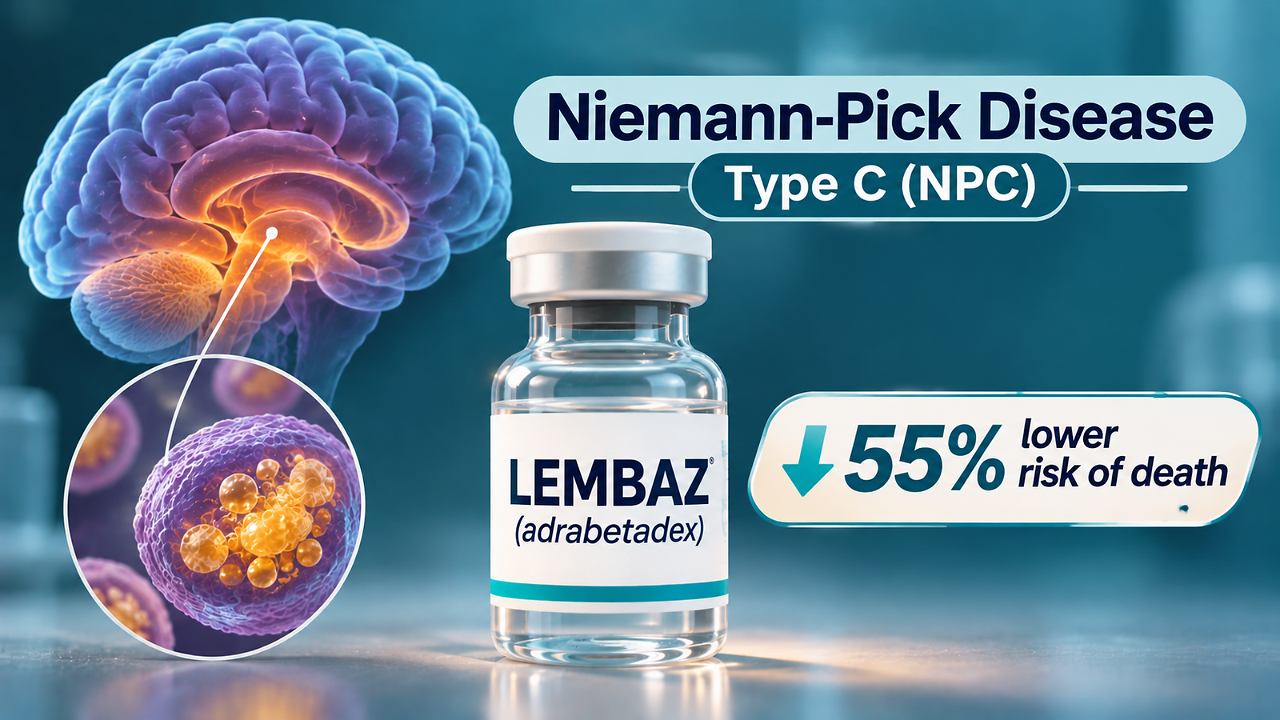
The US Food and Drug Administration (FDA) has granted approval to a new drug that could help patients with a rare and life-threatening genetic disorder live longer. The treatment, Lembaz (adrabetadex), is the first drug proven to reduce the risk of death in patients with infantile-onset Niemann-Pick disease type C (NPC).Announced on November 17, 2026, the approval marks an important development for families affected by the rare disease, which causes progressive neurological damage and can significantly shorten life expectancy.Lembaz is approved for adults and children weighing at least 7 kg (approximately 15 pounds) whose neurological symptoms began before the age of six. It is administered as an injection directly into the fluid surrounding the spinal cord, a procedure known as an intrathecal injection, every two weeks."For the first time, there is a treatment shown to help adults and children with this serious disease live longer," said Acting FDA Commissioner Kyle Diamantas.Lembaz Reduces Risk Of Death By 55% In Niemann-Pick PatientsAlso read: Trials For Deadly Childhood Brain Cancer Stalled After Trump Administration Shuts Down 27-Year Research ConsortiumThe FDA's approval was based on data from 36 patients treated with Lembaz across three clinical studies. Their outcomes were compared to an external control group of patients who had not received the treatment.The analysis found that patients who received Lembaz had a 55% lower risk of death compared to the control group.The median overall survival was 8.5 years among patients treated with Lembaz compared to 4.9 years in the control group.The benefit was observed regardless of whether patients were also receiving miglustat, another medicine used to manage NPC.What Is Niemann-Pick Disease Type C?Also read: Childhood Obesity: Wegovy Cuts BMI By 10% In Children As Young As 6; What Are The Risks?Niemann-Pick disease type C is a rare inherited disorder that affects the body's ability to process cholesterol and other fatty substances inside cells.The condition is caused by changes in either the NPC1 or NPC2 gene. These genes produce proteins that help move cholesterol and other lipids within cells. When these proteins do not function properly, fatty substances accumulate inside cells, affecting organs like liver, spleen and brain. Over time, this causes progressive damage to the nervous system.Patients may experience difficulties with movement, balance, coordination, speech and swallowing. Some may also face seizures, cognitive difficulties and problems controlling eye movements.The disease affects approximately one in 150,000 people, according to the FDA. Its symptoms and severity can vary depending on when the disease begins.Infantile-Onset Niemann-Pick Disease Can Be SevereAlso read: 112 Pregnant Women, 13 Newborns Infected With Measles In US Since 2025: CDCInfantile-onset NPC refers to cases in which neurological symptoms start before the age of six. These patients experience a more aggressive disease as they face rapid progressive neurological deterioration and a shorter life expectancy.As the disease advances, children may gradually lose the ability to walk, speak and swallow independently. Difficulties with swallowing can also increase the risk of respiratory complications.There is currently no cure for NPC, making treatments that can slow disease progression or improve survival important.More About Lembaz Lembaz contains adrabetadex, a cyclodextrin-based medicine made to address the underlying cholesterol processing defect in NPC.In simple terms, the drug helps move cholesterol trapped inside cells, especially brain cells, so that it can be transported to areas where it is needed.By targeting this underlying problem, the treatment aims to reduce the cellular damage that comes with the disease.According to the FDA, hearing impairment, including permanent hearing loss, could be one of the side effects of Lembaz. Hence, patients must undergo hearing assessments before starting the drug and regularly throughout the course. Other common side effects include balance and coordination problems, fatigue, vomiting, back pain, headache, fever, diarrhoea, nausea and cough.