
- Health Conditions A-Z
- Health & Wellness
- Nutrition
- Fitness
- Health News
- Ayurveda
- Videos
- Medicine A-Z
- Parenting
What Is Leucovorin? The Drug Trump Suggests As A Treatment For Autism?
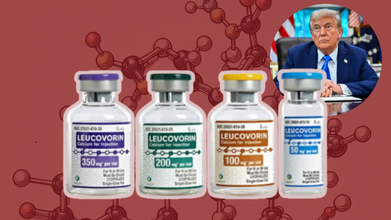
Credits: AP, TradeIndia
US President Donald Trump held a press conference to announce the connection between the use of Tylenol, a popular pain and fever relief medicine during pregnancy and autism. Trump in the press conference also suggested Leucovorin, as a potential treatment for autism symptom.
Read: Tylenol And Autism: Trump Announces Link Between The Two, Science Does Not Back Him
What Is Leucovorin?
It is known as folinic acid, a form of folate, also an essential B vitamin or B9, which has been approved by the US Food and Drug Administration (FDA) for counteracting the toxic effects of certain cancer drugs. It can counteract methotrexate that blocks body's use of folate.
The drug is also used to enhance the effects of chemotherapy drugs and to treat specific types of anemia.
How Is Leucovorin Administered? Who Makes Leucovorin?
The drug can be administered orally or intravenously. While it is manufactured by dozens of companies, notes US FDA, on Monday itself, FDA published a notice to the Federal Register ahead of Trump's press conference to approve a version of Leucovorin manufactured by GlaxoSmithKline or GSK.
GSK had previously withdrawn from FDA's consideration when it stopped making the drug. However, as per the FDA notice, "The FDA is working with GSK, the innovator of Wellcovorin (leucovorin calcium), on a process to include the essential scientific information needed for the safe and effective use of these drug products for adults and pediatric patients with CFD (cerebral folate deficiency)."
Is Leucovorin Effective For Autism?
As per the FDA notice, leucovorin calcium, branded as Wellcovorin by GSK is sent for approval for patients with cerebral folate deficiency, which is a neurological condition that affects folate, an essential vitamin for brain health, transport into the brain.
The FDA notice mentions that individuals with CFD have been "observed to have developmental delays with autistic features".
FDA Commissioner Marty Makary, MF, MPH said that in over two decades, the US has "witnessed a tragic four-fold increase in autism". He further noted: "Children are suffering and deserve access to potential treatments that have shown promise. We are using gold standard science and common sense to deliver for the American people.”
George Tidmarsh, MD, PhD, Director of the FDA's Center for Drug Evaluation and Research said that FDA is collaborating with GSK to broaden the existing Wellcovorin label and is committed to "finding and treating the root causes of autism".
Read: Trump's Claim On Linking Tylenol And Autism Is Unscientific, According To Doctors
Why Leucovorin Is Considered To Treat Autism?
Doctors have been using leucovorin off-label for autism, repurposing the drug beyond its original approval, reported Reuters.
Research from SUNY Downstate Medical Center and others suggests that as many as three-quarters of children with autism may have genetic variations or autoimmune issues that interfere with folate processing in the brain.
Smaller studies have linked these problems to more severe autism symptoms and found that leucovorin treatment may help improve speech, social interaction, and irritability. Still, the Autism Science Foundation cautions that the research is in its early stages, and more evidence is needed before firm conclusions can be drawn.
Read: Trump Suggests Changes In Childhood Vaccines, Says It Is Based On What He Feels
A 2016 study published in Molecular Psychiatry, which was a randomized controlled trial suggested that this specialized form of folate can improve communication and language skills in some children with Autism Spectrum Disorder (ASD).
A June 2020 study published in the Seminars in Pediatric Neurology suggests folate (vitamin B9) plays a vital role in brain development and function, helping with DNA synthesis, methylation, and neurotransmitter production. Some children with autism struggle with folate metabolism, particularly in transporting folate into the brain, a condition known as cerebral folate deficiency.
Another 2020 study published in October in Seminars in Pediatric Neurology suggests that in many cases, the immune system produces antibodies that target the folate receptor alpha (FRα) on brain cells. These folate receptor autoantibodies (FRAA) block folate entry into the brain, resulting in low brain folate levels even when blood levels are normal. While only about 5–10% of the general population carries these antibodies, research suggests that 50–70% of children with autism may have them. This disruption is thought to significantly affect speech and cognitive development.
However, Dr. David Mandell, a professor of psychiatry and autism expert at the University of Pennsylvania, told Reuters that leucovorin might well be a possible treatment for some children with autism, "but the evidence we have supporting it... is really, really weak."
Liverpool Legend John Toshack Diagnosed With 'Terrible Disease' Dementia

Credit: FAWales/X
John Toshack, the Wales and Liverpool legend, has been diagnosed with dementia, his son Cameron has confirmed to the media.
After a glittering playing career with Liverpool, the now 77-year-old Toshack went on to manage several leading clubs across Europe, including Real Madrid, Real Sociedad, and Besiktas.
His son and ex-Leeds United assistant Cameron, now coaching in Thailand, told the Daily Mail that his father has "good days and bad days".
"It's a terrible disease," he added.
Cameron noted that while his father's memory of his glory days remains intact, his short-term memory is more affected. And his father often tends to forget matters they spoke about in short periods.
"It’s the short-term memory where we’re seeing it – I speak to him most days, and if we chat in the afternoon, he might not remember that we also spoke in the morning," the report said.
"But if I ask him about the Liverpool days, or Sociedad or Madrid, the detail is amazing; his memory was so clear".
Meanwhile, Football Association of Wales in a post on social media platform X shared: "Our thoughts are with former
@Cymru player and manager John Toshack and his family following his recent diagnosis".
What Is Dementia?
Dementia is an umbrella term used to describe a significant decline in mental function that is serious enough to affect everyday life. It commonly impacts memory, thinking, and reasoning skills.
Dementia itself is not a single disease but a collection of symptoms caused by underlying conditions such as Alzheimer’s disease or vascular dementia.
Common signs include memory problems, confusion, difficulty finding words, changes in mood or behaviour, and trouble completing familiar tasks.
These symptoms usually worsen over time and are not considered a normal part of ageing. Although there is no cure, treatment options can help manage symptoms, and early diagnosis plays an important role in care planning.
Alzheimer’s Disease: The Leading Cause of Dementia
Alzheimer's disease is one of the most common forms of dementia and mostly affects adults over the age of 65.
About 8.8 million Indians aged 60 and above are estimated to be living with Alzheimer's disease. Over seven million people in the US, 65 and older, live with the condition, and over 100,00 die from it annually.
Alzheimer's disease is believed to be caused by the development of toxic amyloid and beta proteins in the brain, which can accumulate in the brain and damage cells responsible for memory.
Amyloid protein molecules stick together in brain cells, forming clumps called plaques. At the same time, tau proteins twist together in fiber-like strands called tangles. The plaques and tangles block the brain's neurons from sending electrical and chemical signals back and forth.
Over time, this disruption causes permanent damage in the brain that leads to Alzheimer's disease and dementia, causing patients to lose their ability to speak, care for themselves, or even respond to the world around them.
While there is no clear cause of Alzheimer's disease, experts believe it can develop due to genetic mutations and lifestyle choices, such as physical inactivity, unhealthy diet, and social isolation.
Early symptoms of Alzheimer's disease include forgetting recent events or conversations. Over time, Alzheimer's disease leads to serious memory loss and affects a person's ability to do everyday tasks.
There is no cure for this progressive brain disorder, and in advanced stages, loss of brain function can cause dehydration, poor nutrition, or infection. These complications can result in death.
Drug Resistance Driving Severe Typhoid Disease, Death Among Children Under-5s in India: Lancet Study
Credit: Canva
Children under 5 in India remain at high risk of typhoid infections, hospitalization, and death due to growing antimicrobial resistance (AMR), according to an alarming study, which highlighted the urgent need to control drug resistance in the country.
Typhoid fever is a systemic illness caused by Salmonella enterica serovar Typhi (S. Typhi), and presents a significant health challenge in India.
The modelling study, published in The Lancet Regional Health – Southeast Asia, showed that typhoid fever caused an estimated 4.9 million cases and nearly 8,000 deaths in India in 2023.
However, more concerning was that a large proportion of infections were found resistant to fluoroquinolones — one of the main classes of antibiotics used to treat typhoid. They found that:
- Children aged 5–9 years had the highest number of typhoid fever cases and AMR cases
- Children aged 6 months to 4 years experienced the highest number of hospitalizations and deaths.
"Drug-resistant typhoid fever remains a serious public-health threat in India, with implications beyond national borders," said Dr Vijayalaxmi Mogasale, Joint PhD Candidate at the London School of Hygiene & Tropical Medicine and Nagasaki University.
"Tackling this problem does not lie solely in moving to newer antibiotics, but calls for timely preventive action, including responsible antibiotic use and the introduction of the typhoid vaccine into the national immunization program, prioritizing high-burden age groups and regions," she added.
Also read: Study Links Widespread Use of Antibiotics During COVID To Surge In AMR Cases
Typhoid: AMR A Major Concern In India
In Global Burden of Diseases (GBD) 2021, India contributed to 58 percent of global typhoid fever cases and 48 percent of global deaths.
The new study, including researchers from Christian Medical College in Vellore, estimated that more than two-thirds of typhoid cases in India are resistant to fluoroquinolones. This not only limits treatment options but also increases the risk of complications.
The major drivers of typhoid fever deaths were identified among those with no treatment and hospitalized cases with AMR-related complications. The highest burden of typhoid cases were reported from Delhi, Maharashtra, and Karnataka.
Further, the study found that drug-resistant typhoid infections accounted for at least 87 per cent of India's disease-related economic burden in 2023, the PTI reported.
The total economic burden due to typhoid fever was estimated at Rs 123 billion.
Children under the age of 10 incurred the highest economic burden, contributing to over half of the costs, researchers found.
In addition, they estimated that households bore 91 per cent of expenses, and 70,000 families faced "catastrophic" health expenditure.
A 2024 ICMR report also flagged that more Indians are developing antibiotic resistance against typhoid, pneumonia, and urinary infections. Over 95 percent of Salmonella typhi strains are now resistant to fluoroquinolones, making it difficult to treat infections caused by this bacterium.
Also read: Antimicrobial Resistance Explained: Why Is WHO Calling It A Serious Health Threat?
Typhoid: How Vaccines Can Help
Typhoid fever is a water- and food-borne infectious disease. Major symptoms include
- high fever,
- fatigue,
- headache,
- abdominal pain.
The World Health Organization (WHO) recommends TCV for children from six months of age and for adults up to 45–65 years, depending on the vaccine.
To achieve greater impact, the Lancet researchers suggested implementing:
- A broader catch-up or school-based vaccination campaigns
- controlling the broader strategy of antimicrobial stewardship
- Making improvements in water, sanitation, and hygiene.
US CDC Warns Of New Immune-Evasive COVID Variant In 23 Countries
Credit: iStock
The US Centers for Disease Control and Prevention (CDC) has raised concerns about a highly mutated variant of COVID-19 -- BA.3.2 -- which has been reported in at least 23 countries, including 25 states in America.
The BA.3.2 variant was first identified in a respiratory sample in South Africa in November 2024.
The World Health Organization (WHO) has designated BA.3.2 as a Variant Under Monitoring (VUM). It does not boost immunity from previous infection or vaccination.
What makes the BA.3.2 variant special is the “70 to 75 substitutions and deletions in the gene sequence of its spike protein”, according to the CDC’s latest Morbidity and Mortality Weekly Report.
“BA.3.2 represents a new lineage of SARS-CoV-2, genetically distinct from the JN.1 lineages (including LP.8.1 and XFG) that have circulated in the US since January 2024,” said the CDC researchers.
“BA.3.2 mutations in the spike protein have the potential to reduce protection from a previous infection or vaccination,” they added.
What Is The BA.3.2 Variant?
BA.3.2 is a descendant of the Omicron BA.3 lineage. It is genetically distinct from the previously circulating JN.1 lineages (including LP.8.1 and XFG).
BA.3.2 comprises two major branches, BA.3.2.1 and BA.3.2.2. BA.3.2.2 also has substitutions like: K356T, A575S, R681H, and R1162P, the CDC report said.
The first BA.3.2 lineage sequence was detected in a respiratory sample collected on November 22, 2024, in South Africa from a boy aged 5 years.
It was then identified in 2025, in Mozambique (March), the Netherlands (April), and Germany (April). It began to increase in September 2025, with the highest number of detections reported during the week beginning December 7, 2025.
As of February 11, 2026, BA.3.2 had been detected in at least 23 countries.
Between November 2025 and January 2026, the weekly BA.3.2 detections increased and reached approximately 30 percent of sequences reported in three European countries (Denmark, Germany, and the Netherlands).
BA.3.2 In The US
The strain was detected in the US on June 27, 2025, through the CDC’s Traveler-Based Genomic Surveillance program in a participant traveling to the US from the Netherlands.
The first US detection of BA.3.2 in a clinical specimen collected from a patient was reported on January 5, 2026. Since then, the CDC has detected the BA.3.2 variant from
- nasal swabs collected from 4 US travelers,
- clinical samples from 5 patients,
- 3 airplane wastewater samples,
- 132 wastewater surveillance samples from 25 states in the US.
- Till February 11, the strain has been prevalent among 2,579 total genetic sequences.
The CDC stressed the need for “continued genomic surveillance to track SARS-CoV-2 evolution and determine its potential effect on public health”.
BA.3.2 A Variant Under Monitoring
According to the WHO, BA.3.2 demonstrates antigenic drift and reduced neutralization in vitro from previously infected or vaccinated individuals.
However, the global health body noted that currently approved COVID-19 vaccines are expected to continue providing protection against severe disease.
Despite immune evasion, phenotypic data suggest BA.3.2 has reduced infectivity.
It shows resistance to some monoclonal antibodies (cilgavimab, bebtelovimab, sotrovimab) but increased sensitivity to tixagevimab-be, the WHO said.
- Follow Us :


© 2024 Bennett, Coleman & Company Limited