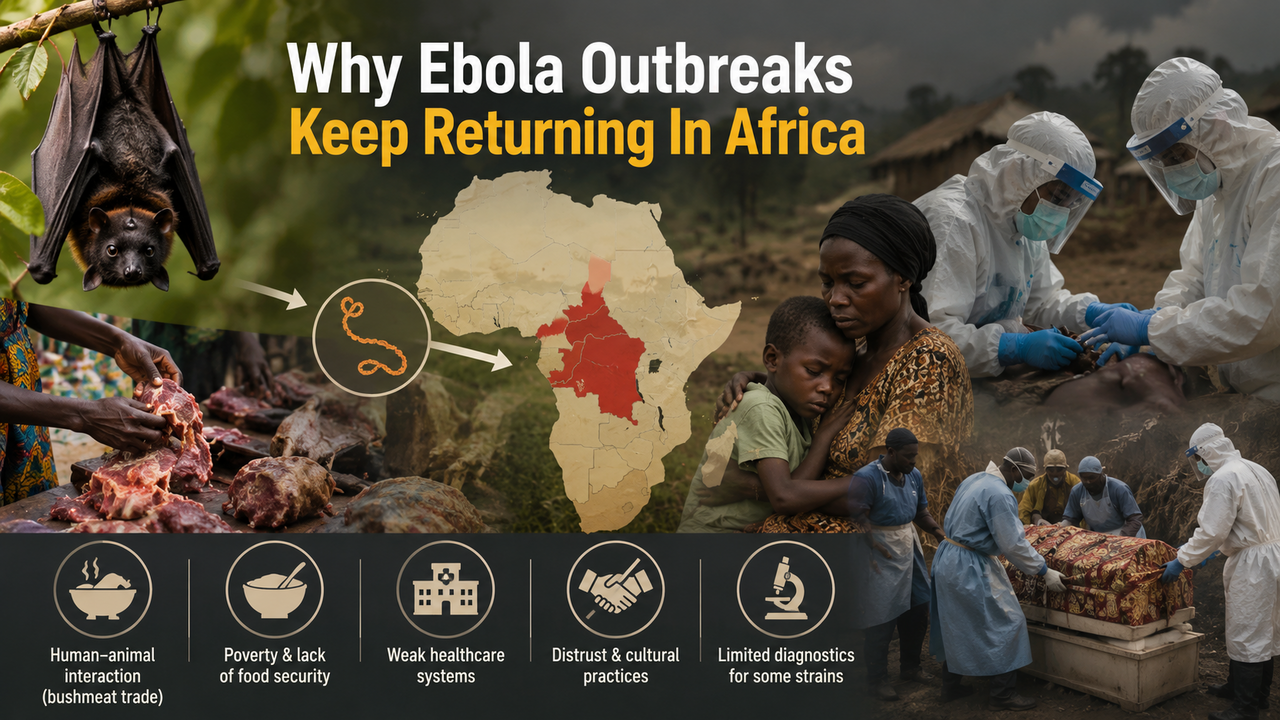
Ebola is a highly lethal viral hemorrhagic fever first identified in 1976. Over the last five decades, it has caused more than 30 localized and widespread outbreaks, primarily in Central and West Africa. The virus takes its name from the Ebola River in the Democratic Republic of the Congo (DRC). Three strains of the virus — Ebola virus, Sudan virus, and Bundibugyo virus — have caused the largest outbreaks in Africa. Among them, the Ebola virus is considered the deadliest, with fatality rates reaching up to 90% without treatment. The latest outbreak, caused by the Bundibugyo virus, is also highly dangerous, carrying a mortality rate of around 50%. Experts warn that the situation is more concerning because there is currently neither a vaccine nor a proven antiviral treatment specifically for this strain. These viruses have repeatedly emerged from animal reservoirs and infected humans across several African countries. In the Democratic Republic of the Congo alone, this marks the 17th Ebola outbreak and the third linked to the Bundibugyo strain. So far over 900 cases have been reported from DR Congo and Uganda. The deaths due to the virus has also crossed 200. But what actually is behind the periodic recurrence? HealthandMe spoke to two experts, who flagged several factors driving repeated Ebola outbreaks, including: Human-animal interaction Poverty and lack of food security Weak healthcare systems Traditional burial practices Limited diagnostic facilities Human-Animal Spillover Dr Rajeev Jayadevan, Co-Chairman of the National IMA COVID Task Force and Past President of the Indian Medical Association, Cochin, explained that Ebola is a zoonotic disease — meaning it spreads from animals to humans, similar to rabies, Nipah virus, and bird flu. He noted that the root of an outbreak is often an animal to human spillover event."All of these Ebola outbreaks are eventually tracked back to a spillover and the spillover is believed to be human-animal interaction as in bushmeat trading. These are impoverished areas of Africa which are also conflict-ridden and also short of medical facilities for many reasons, economically backward,” he told HealthandMe, adding that civil unrest often results in shortages of healthcare workers, medical supplies, and access to treatment. He noted that bushmeat remains a major food source for many communities living in forested regions, where animals such as bats, monkeys, and apes are hunted for survival, because of widespread poverty and food insecurity. Dr Subramanian Swaminathan, Director of Infectious Disease at Gleneagles Hospital in Chennai, added that this ability of the virus to skip from one group of animals to another entire species has happened again and this probably is because of humans venturing out into the forest and the bushmeat trade. Why Ebola Spreads Quickly In Communities The experts noted that Ebola spreads through direct contact with bodily fluids of infected individuals. Caregivers, family members, and healthcare workers are therefore among the groups at highest risk. Dr Rajeev pointed out that traditional burial practices in some affected regions continue to contribute to transmission. In many communities, relatives physically wash or touch the bodies of the deceased as a sign of respect and affection. He noted that health organizations have tried for years to educate communities about safer burial practices, but long-standing customs and social pressure often make behavioral change difficult. In some cases, refusing to touch the body of a deceased family member may be seen as disrespectful, forcing relatives into risky contact with infected bodies. "There are many forces at play here. conflict, war, ignorance, poverty, lack of food, distrust of health care facilities, customs and beliefs that refuse to go away. These are dangerous. And so it's a difficult situation for these people," the expert told HealthandMe.Diagnostic Challenges With Bundibugyo Strain Another major concern is the lack of reliable diagnostic facilities for the Bundibugyo strain. Dr Rajeev explained that test kits designed for the Zaire strain may fail to detect Bundibugyo infections, causing infected individuals to test negative and continue spreading the virus unknowingly. Dr. Subramanian said the current outbreak strain appears to be genetically different from previous Bundibugyo outbreaks. “This is not the Bundibugyo variants which have caused outbreaks in the past, this is completely new,” he told HealthandMe. added that genomic sequencing suggests the virus may have crossed from animals to humans again due to increasing human activity in forest regions and bushmeat exposure. Why Ebola Is Considered So Dangerous Dr. Subramanian described Ebola as one of the world’s most feared infectious diseases because mortality rates can range from 50% to 80%, depending on the strain. He explained that symptoms initially appear non-specific, including fever, respiratory symptoms, body ache, and diarrhea, before progressing to severe internal bleeding and multi-organ complications in many patients. Although Ebola does not spread through casual airborne contact like COVID-19, it spreads efficiently through secretions and bodily fluids, making caregivers and healthcare providers particularly vulnerable. Religious and funeral gatherings can also become amplification points for transmission. Dr. Subramanian added that there is currently no “perfect treatment” for Ebola. While monoclonal antibodies are still being studied, treatment largely remains supportive and focused on symptom management, infection control, and preventing transmission. Travel Precautions And Global Risk The expert advised people to avoid travel to outbreak-hit areas in Zaire and Uganda, particularly border regions. Those who must travel should take strict precautions, while travelers returning from affected areas should remain under observation and quarantine if necessary. He also urged the public to closely follow updates from scientific organizations such as the World Health Organization (WHO). However, Dr. Subramanian stressed that Ebola is unlikely to become a global public health crisis on the scale of COVID-19 because it does not spread through airborne transmission. “It’s more likely to cause a lot of disruption in a small area,” he said. “As of right now there’s really no cause for alarm but there is cause for concern.”