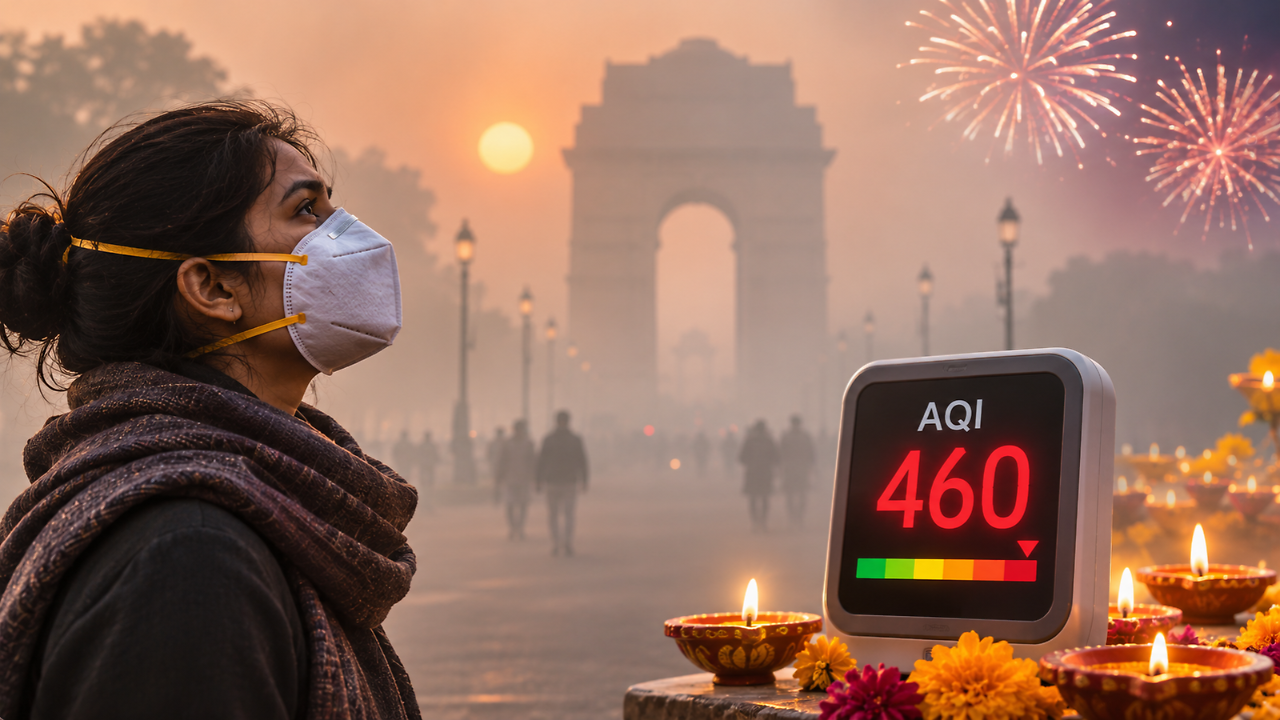
Delhi was ranked the world's most polluted major city on Saturday morning, November 7, 2026, by Swiss air-quality technology company, IQAir. The national capital has been grappling with worsening pollution ahead of Diwali.IQAir placed Delhi at the top of its live global ranking at 10:35 am, with an air quality index (AQI) reading of 581. The AQI was more than twice that of Lahore in Pakistan, which recorded an AQI of 285 at the time.However, India's Central Pollution Control Board (CPCB) reported different readings as it uses different scales than IQAir to calculate AQI. According to CPCB, Delhi's AQI was 363 at 10 am on Saturday, placing the city under 'very poor' category. According to reports, Friday's air quality was the worst recorded before Diwali in eight years.Why Delhi Grapples With Severe Air Pollution Every Year?Also read: High AQI and High Blood Pressure: Is There a Connection People Often Overlook?Several north Indian states including Delhi choke due to severe air pollution ahead of and during winter due to several reasons. Cold, dense air and slow winds can trap pollutants close to the ground, fueling rising AQI. Vehicular emissions, stubble burning, construction dust, and firecracker smoke from Diwali celebrations only compound to the hazardous environmental crisis. The Commission for Air Quality Management (CAQM) introduced restrictions as pollution levels have increased drastically. Schools in and around Delhi have been directed to switch to online classes, while residents have been encouraged to work from home. Authorities have also asked local governments to consider allowing half of public- and private-sector employees to work remotely.Delhi Environment Minister Manjinder Singh Sirsa warned that weather conditions could worsen further. “From tomorrow, the weather is going to become worse, winds will completely stop, which will worsen the AQI,” he said, according to Reuters.Experts Recommend Precautions Amid Severe Air Pollution In Delhi Also read: Delhi Air Pollution: Should You Move Your Morning Walk And Jog Indoors As AQI Nears 400?PM2.5, fine particulate matter, is a major health concern because its tiny particles can travel deep into the lungs and enter the bloodstream. Exposure to these pollutants can aggravate asthma and other respiratory conditions like COPD and bronchitis, irritate the eyes and airways, and increase the risk of cardiovascular and respiratory disease.In an X post, Dr. Sudhir Kr. Gupta (MD, Resp. MED), Senior Consultant Chest Physician & Bronchoscopist at Kailash Healthcare said, “Those who struggle with such respiratory problems should strictly avoid going out, especially when pollution levels are severe.”The effects are not limited to people with existing health conditions. Children, older adults, pregnant women and people with heart or lung diseases may be particularly vulnerable.As pollution levels remain high, health experts advise limiting strenuous outdoor activity, especially during periods of severe air quality. People who need to go outside can use a well-fitting N95 or N99 respirator. Dr Viny Kantroo, Senior Consultant, Respiratory Medicine, Critical Care & Sleep Medicine Indraprastha Apollo Hospital, New Delhi, told HealthandMe, “A well-fitted N95 mask filters at least 95% of airborne particles under standard testing conditions and can reduce exposure to PM2.5. Its protection depends on how closely it fits the face. There is no fixed number of hours for which it can be worn. Follow the manufacturer's instructions and replace it if it becomes wet, dirty, damaged or difficult to breathe through. A disposable N95 should not be washed.”Also read: With Delhi AQI Nearing 400, Pollution & Flu Loom Ahead Of Diwali: What Happens When Both Hit Your Lungs?Many opt for cloth masks while stepping. The doctor explained if cloth masks are as effective as N95 or N99 masks to protect yourself from toxic air. She added, “Cloth masks offer limited and inconsistent protection against PM2.5. Their effectiveness depends on the fabric, number of layers and fit, but they generally do not filter fine particles as reliably as an N95. A well-fitted N95 or equivalent respirator is a better choice when stepping outdoors during severe pollution. Even then, reducing time outdoors remains important.”Dr. Jeenam Shah, Consultant Pulmonology, Wockhard Hospital, Mumbai Central told HealthandMe that scarves, handkerchiefs and loose-fitting surgical masks are also not adequate substitutes for a properly fitted N95 or equivalent respirator. He said, "During severe pollution, an N95 mask is a better option when outdoor exposure is unavoidable."She also recommended not wearing masks for long hours and disposing them off when they get soiled. She said, “An N95 can be worn for several hours if it remains dry, clean, undamaged and fits properly. Replace it if breathing becomes difficult or the mask becomes wet or dirty. Disposable N95 masks should not be washed. If wearing one for long periods, take breaks in a cleaner indoor environment when possible. The mask should fit closely around the nose and mouth, as gaps reduce its effectiveness.” Indoor exposure can also be reduced by keeping windows closed when outdoor pollution is high, using an appropriately sized HEPA air purifier where available and avoiding indoor sources of smoke.Dr Kantroo said, “Polluted air can enter through gaps in doors and windows, while cooking fumes, incense, smoking and cleaning products can add to indoor pollution. A HEPA air purifier can reduce fine particles, provided it is suitable for the room size and its filters are maintained. During severe pollution, keep windows closed. Ventilate when outdoor air quality improves, rather than relying on a fixed time of day.”Dr Gupta also recommended using masks and keeping an air purifier at home to maintain indoor air quality. Dr Kantroo also spoke about morning walks and outdoor exercise when AQI is severe. She explained, “When AQI is Very Poor or Severe, strenuous outdoor exercise should be avoided."Dr Shah explained that physical activity increases your breathing rate, which means you inhale more pollutants and expose your lungs to higher levels of harmful particles. He advised, "Instead, opt for indoor exercises in a well-ventilated, air-purified environment. If outdoor activity is unavoidable, keep it brief and avoid high-traffic areas."