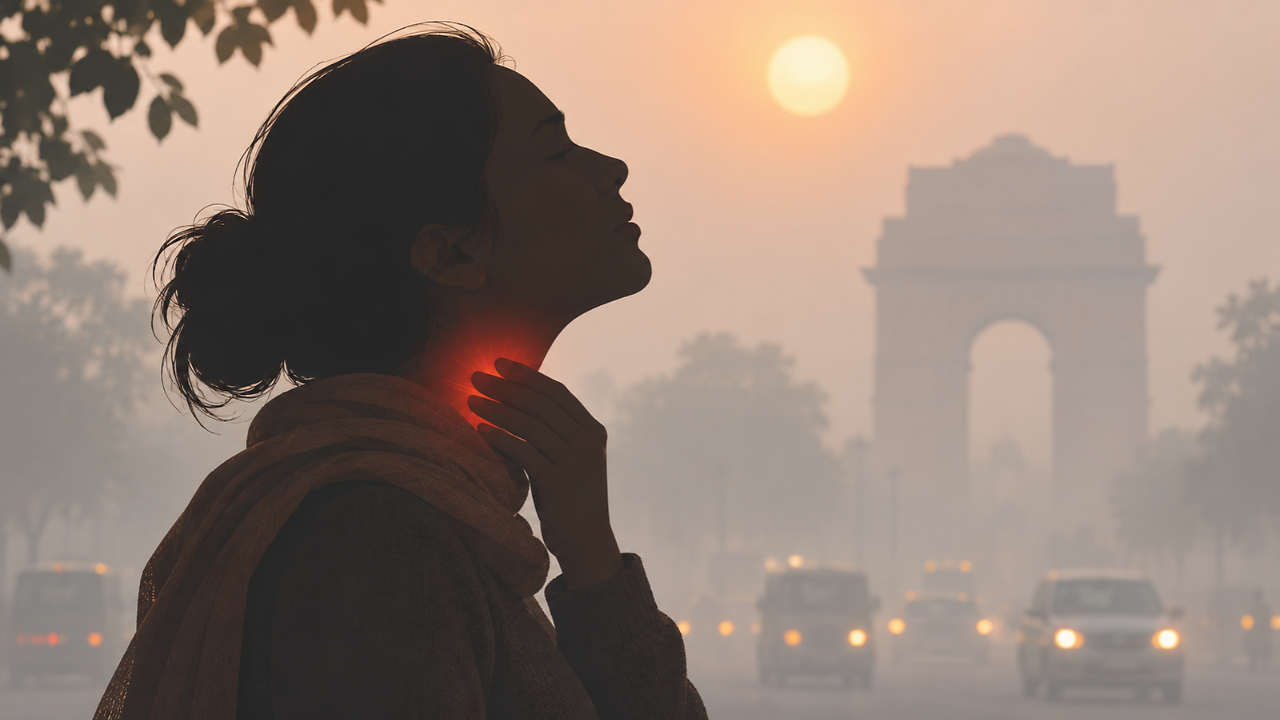
Delhi's air quality deteriorated significantly after Diwali. Several monitoring stations recorded ‘severe’ air quality on Monday morning (November 9) after a night of Diwali festivities which resulted in widespread emission of firecracker smoke. It worsened the situation in a city already grappling with soaring air pollution due to vehicular exhaust, construction dust and stubble burning in neighbouring states. Due to this, Delhi residents, who continue to breathe polluted air, may face symptoms like scratchy throat, coughing and irritation. But how can you tell whether your sore throat is caused by pollution or an infection that needs medical attention?How Does Air Pollution Cause A Sore Throat?Polluted air contains particulate matter, including PM2.5, as well as gases and other irritants. When inhaled, these pollutants come into contact with the lining of the nose, throat and respiratory tract, triggering irritation and inflammation. Dr. Rahul Sharma, Director, Pulmonology & Critical Care, Fortis Greater Noida told HealthandMe, “People exposed to high levels of pollution may experience throat irritation, dryness, a burning sensation, frequent coughing and discomfort while swallowing. These symptoms may be more noticeable in people who spend long hours outdoors and are difficult to control.”People with asthma, allergies or existing respiratory conditions may be more sensitive to these pollutants. Dr Sharma added, “Pollution can also aggravate existing respiratory conditions like asthma and allergic airway disease. It is important to remember that a sore throat is not always due to infection; environmental exposure can also be a cause.”Also read: El Niño Could Worsen Dengue, Malaria And Heat Illness: Why WHO Declared A Health EmergencyPollution-Related Sore Throat Or Infection?The symptoms can overlap, so a sore throat alone cannot establish its cause. However, certain accompanying signs may offer clues. Experts help us understand when a sore throat is a result of inhaling particulate matter. Dr. Sushil Upadhyay, Consultant Pulmonologist, Kailash Deepak Hospital, Delhi told HealthandMe, “Throat irritation as an early sign. A scratchy throat is the canary in the coal mine for lung inflammation. It is the first sign that your airways defenses are overwhelmed and deep inflammation is starting.” A pollution-related sore throat is more likely to involve dryness, scratchiness, coughing and irritation of the eyes or nose. Dr Samir Garde, Director of Dept of Pulmonology and Lung Transplant, Gleneagles Hospital, Parel, told us, “Pollution-related irritation usually causes a dry or scratchy throat, coughing and eye irritation, which may worsen outdoors or during periods of poor air quality.”An infection, on the other hand, may be accompanied by fever and other symptoms. They may include body aches, swollen lymph nodes, painful swallowing, tonsil inflammation or white patches on the tonsils. Viral infections can also cause a runny nose, cough and fatigue. Dr Upadhyay said, “The flu brings high fever, body aches, and extreme exhaustion. If staying inside an air-conditioned, filtered room clears your throat, it's pollution. Otherwise, think of it as flu.”A bacterial infection such as strep throat may cause sudden throat pain, fever and difficulty swallowing, sometimes without a cough.Also read: New COVID-19 Variant PJ.2.1 Spreads Globally: WHO Says Symptoms Resemble Cold, FluWhen Should You See A Doctor?A mild sore throat often improves within a week. However, medical evaluation is recommended if you have difficulty breathing, cannot swallow, are drooling because you cannot swallow, or experience rapidly worsening symptoms.Dr Upadhyay said, “Do not ignore a sore throat if it moves to your chest. If you develop wheezing, severe breathlessness or a fever, you need a medical evaluation immediately. Seek help right away if you are gasping for air or cannot finish a single sentence in one breath.” Persistent hoarseness, a lump in the neck or a mouth ulcer lasting more than three weeks should also be evaluated.Dr Garde recommended, “Seek medical attention if there is chest tightness, high fever or persistent symptoms. Severe breathlessness, bluish lips or difficulty speaking due to breathing problems require immediate emergency care.”Also read: Delhi AQI Crosses 2,000 Mark After Diwali: What Happens To Your Body Within Hours Of Exposure?How Can You Protect Your Throat During Severe Pollution?According to the doctors, while pollution levels remain high, reducing exposure is important. They recommend: Avoid outdoor exercise and limit unnecessary time outside.Wear a well-fitting N95 or N99 respirator when going outdoors.Keep windows closed during periods of high outdoor pollution and use a HEPA air purifier if available.Drink enough water to prevent throat dryness.Gargle with warm salt water to soothe irritation.Avoid smoking, incense and other indoor sources of smoke.Do not start antibiotics just because your throat hurts. Antibiotics do not treat throat irritation due to pollution or viral infections. They should only be used when prescribed for a confirmed bacterial infection under doctor’s supervision.Delhi AQI After Diwali The city's average Air Quality Index (AQI) reached 406 on November 9, placing it in the 'severe' category, according to the Central Pollution Control Board (CPCB). But private monitoring platform AQI.in reported an AQI of 2,283, classifying the air quality as ‘hazardous’. The reading showcased a grim post-Diwali pollution peak, an issue that has turned into an annual environmental crisis.The stark difference in readings is because India’s AQI scale is limited to 500 while other private air quality monitoring platforms measure higher readings. So even if CPCB’s data shows 500 AQI, it can mean that the amount of harmful pollutants could be much higher. The Supreme Court had implemented restrictions on celebrating Diwali with firecrackers by limiting time between 6 am and 7 am and 8 pm and 10 pm on November 7 and 8 and allowing only green crackers. However, firecrackers were reportedly burst beyond permitted hours.