
- Health Conditions A-Z
- Health & Wellness
- Nutrition
- Fitness
- Health News
- Ayurveda
- Videos
- Medicine A-Z
- Parenting
Endometriosis In Working Women: Gynaecologist Says Yoga, Stress Management Can Help
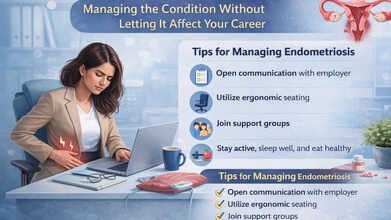
Long working and sitting hours can worsen endometriosis in women. (Photo credit: AI generated)
Are you a working professional? Have you been diagnosed with endometriosis? Worried about how this condition can impact your career? Well, don’t panic! We give you vital tips to manage the symptoms of endometriosis without compromising your professional aspirations. Dr. Kanika Gera Thakral, Consultant – Obstetrics & Gynaecology, Motherhood Hospitals, Greater Noida, spoke about the effects of endometriosis on working women and what women can do to not let the pain take a toll on their work life.
What is endometriosis?
Endometriosis happens when tissue similar to the lining of the uterus grows outside the uterus. These tissues commonly develop on the ovaries, fallopian tubes, or the pelvic lining. Endometriosis affects many women and can impact their daily lives, including their ability to work comfortably. Many women continue their professional responsibilities despite experiencing severe discomfort, fatigue, and pain.
Raising awareness about the condition and encouraging supportive workplaces can help women manage both their health and career more effectively. Since it is a progressive disorder, timely intervention remains key to managing it. In many cases, women live with symptoms for several years before receiving the correct diagnosis, which can delay treatment and affect their quality of life.
Read more: The Right Approach To Manage Endometriosis
The workplace challenge
Many working women who are diagnosed with endometriosis tend to experience symptoms such as pelvic pain, cramps, fatigue, nausea, and heavy menstrual cycles. These symptoms can make it difficult to maintain productivity at work, especially during flare-ups. Hence, women will be unable to concentrate on work or finish the tasks. Some may miss deadlines and meetings due to the painful symptoms. Women will have to skip going to work when the symptoms are intense and will have to rest at home. So, women living with endometriosis may face interruptions in their career growth and reduced working hours. But don’t worry, it is possible to manage this condition and give your best at work.
- Long working hours, prolonged sitting, workplace stress, irregular meals, and lack of adequate rest can sometimes worsen symptoms of endometriosis.
- Apart from physical discomfort, the condition can also affect emotional well-being. Living with chronic pain may lead to stress, anxiety, or frustration, which can indirectly impact workplace confidence and productivity.
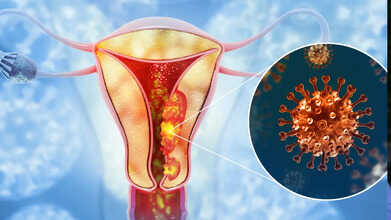
Strategies for managing work and endometriosis
It is necessary for women with endometriosis to go for regular check-ups and follow-ups with the doctor. Women can continue to pursue their professional goals by adopting practical strategies to manage the condition. Open communication with employers when it comes to flexible schedules can help overcome stress and anxiety. Women should have access to remote working to avoid unnecessary travel due to pain.
The work-from-home option can be given to the women when needed by them. Planning demanding tasks during times of higher energy and maintaining a balanced daily routine can also improve productivity at work. Women should make sure to keep essential medications, a heating pad, or comfort aids at their desk to be able to relieve sudden discomfort. Likewise, using ergonomic seating or maintaining good posture while working may reduce pelvic and even back discomfort. Women should also connect to support groups that help to provide emotional reassurance and useful coping strategies that include yoga and meditation.
Lifestyle habits also play an important role. Regular physical activity, adequate sleep, stress-management techniques such as yoga or meditation, and following an anti-inflammatory diet rich in fruits, vegetables, whole grains, and healthy fats may help reduce flare-ups.
Read more: Women With Endometriosis Are Earning Less, Reveals Study
Treating endometriosis
Treatment is particularly based on the severity of symptoms. Women will be advised lifestyle modifications such as regular exercise, stress management, and an anti-inflammatory diet. Non-steroidal anti-inflammatory drugs may help reduce discomfort. Hormonal therapies may also be used to control symptoms. Some women will be advised to undergo laparoscopy to remove endometriotic cysts. Minimally invasive surgery can help remove lesions and restore pelvic anatomy, which may also improve fertility in some cases. In advanced cases, surgery can be recommended to women.
With timely care and supportive workplaces, women can pursue their ambitions without letting endometriosis interfere with their careers.
High BP? This Ancient Chinese Practice May Be As Good As Brisk Walking
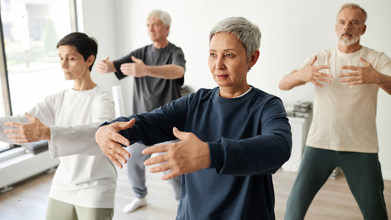
Credit: iStock
High blood pressure (BP) has become a public health problem that is driving cardiovascular diseases like heart attacks and strokes globally. While medications are important to keep hypertension under control, lifestyle changes and healthy practices are also crucial.
Several global health guidelines recommend regular physical activity, but adhering to exercise programs daily becomes a challenge for many people. But in the overtly busy schedules, sparing 10 minutes for an exercise regimen can be easier than travelling to the gym.
A large randomized clinical trial, published in the Journal of the American College of Cardiology (JACC), has proved that a traditional Chinese mind-body practice — baduanjin — may help lower blood pressure, that too, without any equipment.
Baduanjin is a slow, structured movement, focused on deep breathing and meditation.
Importantly, the clinical trial proved that the ancient Chinese technique could lower BP as effectively as brisk walking.
In people practicing baduanjin, BP reductions were seen after three months and were sustained for one year.
"Given its simplicity, safety, and ease with which one can maintain long-term adherence, baduanjin can be implemented as an effective, accessible, and scalable lifestyle intervention for individuals trying to reduce their blood pressure," said Jing Li, Director, National Center for Cardiovascular Diseases in Beijing, China.
Baduanjin: The 10 Minute Routine
Baduanjin is a standardized eight-movement sequence that integrates aerobic, isometric, flexibility, and mind-body components.
It has been in practice for centuries and commonly performed in community settings across China. The routine typically takes 10–15 minutes and requires no equipment and only minimal initial instruction.
Because it is low- to moderate-intensity, it is considered safe and accessible for many adults.
Also read: Cardiovascular Diseases Lead As India’s Top Killer: US Cardiologist Points Out Risk Factors
The Clinical Trial
A team of Chinese researchers led the first large, multicenter randomized trial to look at the impact of baduanjin on blood pressure.
They followed 216 participants, aged 40 years or older, across seven communities to determine changes in 24-hour systolic BP from baseline to 12 and 52 weeks.
Compared to people indulging in self-directed exercise, practicing baduanjin five days a week reduced
- systolic blood pressure by approximately 3 mg Hg
- systolic blood pressure by 5 mg Hg.
Notably, the benefits were sustained even without ongoing monitoring, a key challenge for many lifestyle interventions that struggle to maintain long-term adherence outside structured programs.
"Baduanjin has been practiced in China for over 800 years, and this study demonstrates how ancient, accessible, low-cost
approaches can be validated through high-quality randomized research," said Harlan M. Krumholz, Editor-in-Chief of JACC and the Harold H. Hines, Jr Professor at the Yale School of Medicine.
"The blood pressure effect size is similar to that seen in landmark drug trials, but achieved without medication, cost, or side effects. This makes it highly scalable for community-based prevention, including in resource-limited settings," they added.
Also read: AHA Cholesterol Guidelines 2026: How Indians Can Improve Heart Health
How To Practice Baduanjin
- Stand upright with your feet shoulder-width apart and keep your movements slow and controlled.
- Coordinate each motion with steady, deep breathing, inhaling and exhaling smoothly as you move.
- Move through the traditional eight postures in sequence, focusing on posture, balance, and relaxation rather than speed or force.
- Practice for about 10 to 15 minutes a day in a quiet space, maintaining calm attention throughout.
Know All About Stiff-Person Syndrome That Affected Titanic Singer Céline Dion

Credit: Instagram
Four years after suffering from a rare neurological condition known as Stiff-Person Syndrome, Céline Dion, known for power ballads like My Heart Will Go On and Because You Loved Me, has announced her return to the stage.
The incurable condition had affected her singing voice and even her ability to walk.
In a message on her Instagram page, the singer announced plans to play a 10-night residency at the 40,000-capacity Paris La Défense Arena in September and October.
Calling her comeback "the best gift of my life", 58-year-old Dion said: "I'm doing great, managing my health, feeling good. I'm singing again, even doing a little bit of dancing.
"I'm so ready to do this. I'm feeling good, I'm strong, I'm feeling excited, obviously, [and] of course, a little nervous," she said, while thanking her fans for the “prayers and support, kindness and love”.
What Is Stiff Person Syndrome
Stiff-Person Syndrome is a neurological disease caused by the signals from the nerves to the muscles not working properly. It affects an estimated 8,000 people worldwide.
It is also an autoimmune is a neurological disease caused by the signals from the nerves to the muscles not working properly. It affects an estimated 8,000 people worldwide.
It is also an autoimmune condition, that is linked to diseases such as type 1 diabetes, thyroiditis, vitiligo, and pernicious anemia.
For some, it can be debilitating. SPS is progressive, meaning it gets worse over time. There is no known cure.
Common symptoms may include:
- Stiff muscles in the torso, arms, and legs
- Greater sensitivity to noise, touch, and emotional distress, which can set off muscle spasms
The condition is also more common among women than men, and affects people between the ages of 20 and 60.
While there is no known cure for SPS, current treatments such as intravenous immunoglobulin (IVIg) can help manage the symptoms.
Stiff-Person Syndrome: Celine Dion’s Diagnosis
Dion announced her diagnosed with Stiff Person Syndrome (SPS) in December 2022 in an emotional Instagram video. The condition had affected "every aspect of my daily life", she told her fans.
The best-selling artists of all time began noticing her symptoms, such as feeling "a little spasm" while performing on stage. She found her “voice was struggling", BBC reported.
Even though she experimented with her singing to ease the stress on her vocal cords, her condition worsened. She also began facing difficulties while walking.
"It's like somebody is strangling you. It's like somebody is pushing your larynx [or] pharynx," she told NBC News.
Determined to get back on her feet and sing, worked "all my body and soul, from head to toe, with a medical team", French Vogue magazine reported.
"Five days a week, I undergo athletic, physical, and vocal therapy. I work on my toes, my knees, my calves, my fingers, my singing, my voice."
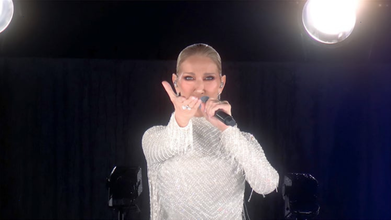
The intense workouts enabled her to make a comeback at the 2024 Paris Olympics, singing Edith Piaf's classic Hymne à l'Amour from the Eiffel Tower.
‘Kiss Of Death’: Can A Passionate Hickey Turn Fatal?
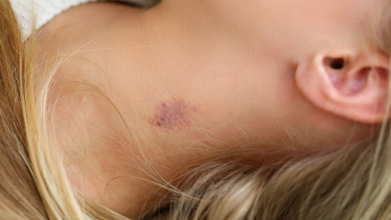
Credit: iStock
While a hickey is generally harmless, in several shocking incidents, it has led to strokes and even death.
A hickey is typically a dark red or dark purple mark on your skin caused by intense suction.
According to health experts, the strong suction from the passionate love bite leads to blood clots that travel to the brain. It then blocks a vital artery and causes a embolic stroke.
Embolic stroke is a type of ischemic stroke caused by a blood clot or debris (embolus) that forms elsewhere in the body—often the heart—and travels through the bloodstream to block a blood vessel in the brain.
The Independent reported the case of 17-year-old Julio Macias Gonzalez, who suffered convulsions while eating dinner with his family after hanging out with his 24-year-old girlfriend and later died.
In a similar case reported from New Zealand, a 44-year-old woman suffered a stroke following a hickey.
While non-fatal, the 2010 study published in the New Zealand Medical Journal reported the medical condition “a rare phenomenon.”
In yet another case, the Danish Medical Journal reported the incident of a 35-year-old woman who experienced a sudden onset of right-sided weakness due to a left middle cerebral artery stroke 12 hours after she had obtained a love bite on the left side of her neck.
“Generally speaking, hickeys are simply superficial bruising, and there’s no scientific evidence available that could inform our thinking about this situation as it relates to stroke,” Teresa Roncon, spokeswoman for the Heart and Stroke Foundation of Canada, was quoted as saying Global News.
Is It Lethal?
While it's generally harmless, in some extreme cases, it can raise the risk of damaging the carotid or vertebral artery due to extreme pressure.
The carotid arteries, one on each side of the neck, are responsible for supplying blood to the head, including the brain. Vigorous manipulation of the neck, including the action of a hickey, can cause the inner wall of the carotid artery to rupture. (This process is medically termed as carotid artery dissection).
Such a dissection is a nidus, a place where bacteria can multiply, for the formation of a blood clot. The blood clot can then get dislodged and enter the brain circulation, eventually causing a stroke.
How Can A Hickey Go Wrong?
While there is nothing wrong with giving or receiving love bites, it is imperative to note that one should not dig their teeth too deeply into the other person's neck to avoid injury and damage to sensitive structures like the carotid artery or the jugular vein (a vein that carries deoxygenated blood from the skull to the body).
While there are practically no ways to cure a hickey, you can speed up the healing process. These processes can help you expedite the process:
- Alternate Cold and Warm Compresses
- Avoid Worsening The Hickey
- Massage The Area
- Use Topical Creams.
- Follow Us :


© 2024 Bennett, Coleman & Company Limited