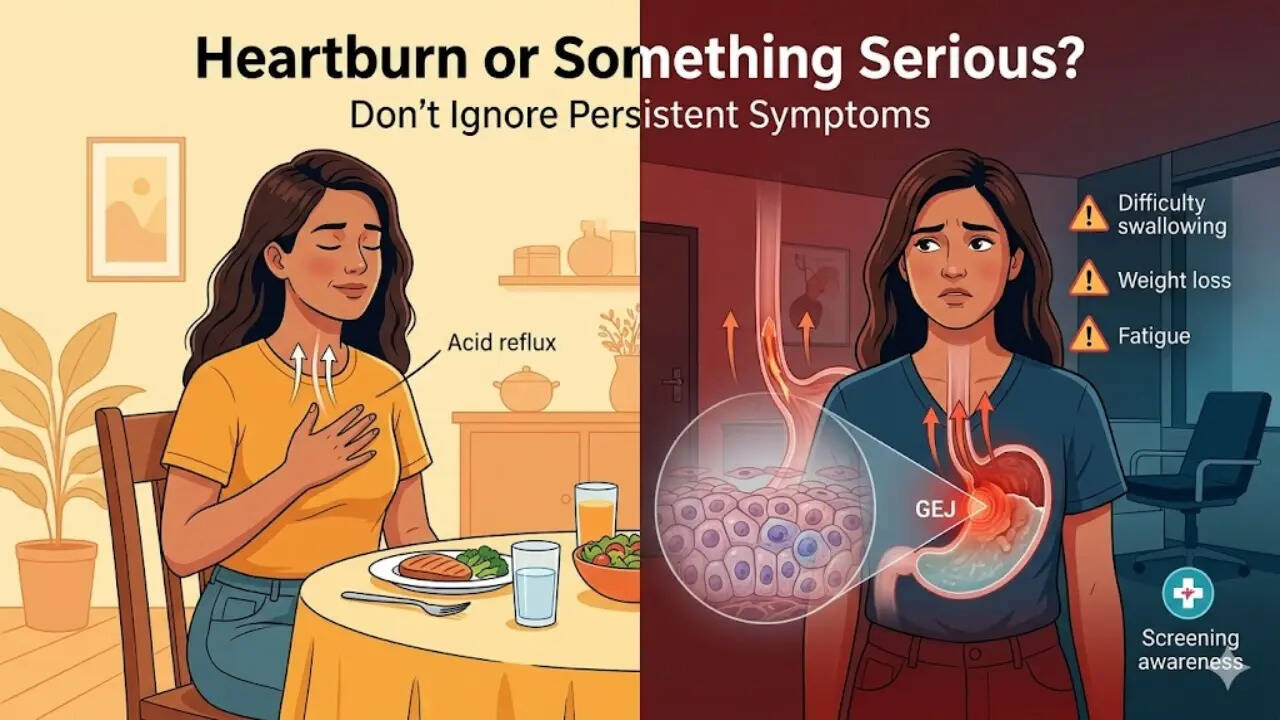
Most people treat heartburn the way they treat a bad day: they reach for an antacid and move on. But for some patients, that familiar burning sensation is not just a digestive nuisance. It can be an early sign of something far more serious. A type of cancer called gastroesophageal junction (GEJ) adenocarcinoma develops quietly at the point where the food pipe meets the stomach, and it is frequently mistaken for routine acidity—until it is not.Dr Ankit Jain, Senior Consultant, Medical Oncology, at Indraprastha Apollo Hospitals, in an interaction with Health and Me, spoke about the difference between cancer and heartburn symptoms.What Is the Gastroesophageal Junction, and Why Does It Matter?The gastroesophageal junction is simply the meeting point between the oesophagus and the stomach. When stomach acid repeatedly irritates this area over months or years, the lining can begin to change at a cellular level. This change, known as Barrett’s oesophagus, is a precancerous condition that often develops silently in people with chronic acid reflux. If left undetected, it can progress to GEJ adenocarcinoma. The tricky part is that this cancer does not behave exactly like oesophageal cancer or stomach cancer. It sits between the two, and that makes both diagnosis and treatment more nuanced.Signs That Go Beyond Ordinary HeartburnHeartburn is common across India, yet certain symptoms should not be brushed aside as routine acidity. If any of the following are present, a doctor’s visit should not be delayed:Difficulty swallowing that starts with solid foods and gradually worsensUnintended weight loss with no clear explanationChest or upper abdominal pain that does not improve with antacidsUnusual fatigue or anaemia, especially without another known causeBlood in vomit or black, tarry stoolsThese are not panic triggers; they are signals worth investigating promptly.The Case for Timely ScreeningFor patients over 40 with long-standing reflux, obesity, a smoking history, or a family history of upper digestive cancers, a baseline endoscopy is a reasonable and potentially life-saving step. GEJ adenocarcinoma caught early is far more treatable than the same cancer found at an advanced stage. The window for early detection exists, but it requires action before symptoms become severe. Persistent reflux deserves more than a repeat prescription. Sometimes, it deserves a closer look.