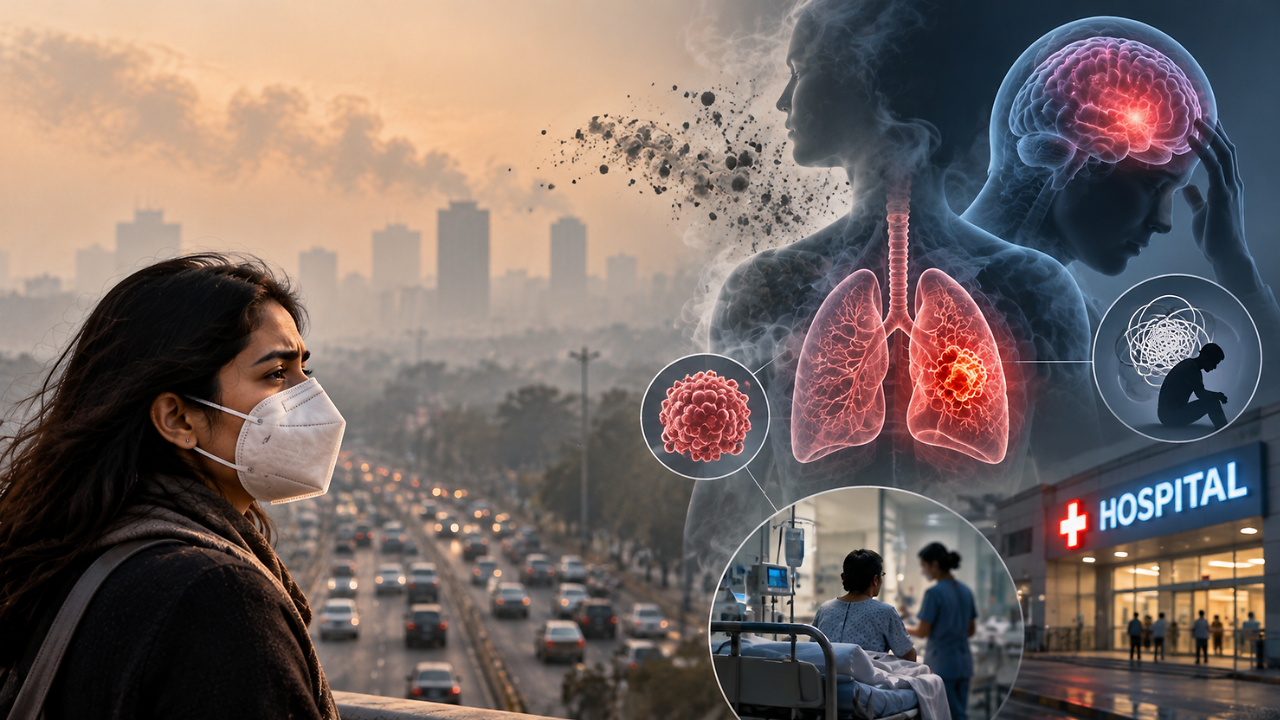
Short-term exposure to air pollution may increase the risk of hospitalisation for several serious health conditions, including cancers and mental disorders, according to a new landmark multicountry study published in The Lancet Planetary Health. Researchers analysed 346.5 million hospitalisation records from 949 communities across six countries and territories, which included Australia, Brazil, Canada, Chile, New Zealand and Taiwan. The study examined the relationship between short-term exposure to fine particulate matter (PM2.5) and hospital admissions between 2000 and 2019. The findings revealed that every 10 micrograms per cubic metre (μg/m³) increase in PM2.5 concentration was associated with an 8% higher risk of hospitalisation from any cause. It was the strongest for malignant neoplasms, or cancers, followed by mental disorders. The researchers also found that the increased risks associated with short-term exposure could persist for up to 21 days. Hospital Admissions Related To Cancer And Mental Health Increased Also read: Can Delhi’s Air Pollution Increase GI Cancer Risk? Doctors Report Patients As Young As 15Among the disease categories examined, malignant neoplasms showed the strongest association with short-term PM2.5 exposure, with a 10.8% higher risk of hospitalisation for every 10 μg/m³ increase in particulate matter concentration. It was followed by mental disorders, which showed a 10% higher risk. Other neoplasms were linked with a 9.6% increase, while nervous system diseases showed an 8.5% increase. Respiratory diseases, that were commonly prevalent with air pollution, showed a 6.7% increase in hospitalisation risk. These findings suggest that the health consequences of polluted air may not just be limited to lungs. They could affect people with a wide range of medical conditions. However, the researchers assessed hospital admissions, not the occurrence of new diseases. Hence, they found that increases in PM2.5 exposure could increase the likelihood of hospitalisation among people affected by these conditions. Decline In Hospitalisation Risks Also read: Delhi Smog: Can You Really Tackle Pollution Season With An N95 Mask And Air Purifier?The researchers found that hospitalisation risks related to pollution were lower during 2010-2019 than in 2000-2009. Using the World Health Organization's daily PM2.5 guideline of 15 μg/m³ as a reference, the estimated proportion of hospitalisations due to exposure declined from 8.9% to 3.9% between the two decades. Despite this improvement, the associations remained significant across all disease categories. The study had limitations, including substantial differences in effects across different countries and territories. Its findings also cannot automatically be generalised to regions that were not included, including India. The researchers concluded that reducing PM2.5 exposure remains an important public health measure to lower hospitalisation risks. Cleaner transport, stricter industrial emission controls and lower reliance on polluting fuels could help limit exposure and the significant health burden that comes with it.The researchers also said that the effects of short-term PM 2.5 exposure on hospital admissions could persist for up to 21 days after exposure. Effects Of PM2.5 PM2.5 refers to fine particulate matter measuring 2.5 micrometres or less in diameter. These particles can come from vehicle exhaust, industrial emissions, construction activities, power generation and the burning of fuels and biomass. Because of their small size, PM2.5 particles can penetrate deep into the lungs, with some components entering the bloodstream. Exposure can trigger inflammation and oxidative stress, potentially affecting multiple organs. Despite the observation, the study does not prove that short-term exposure to air pollution increases the risk of serious diseases like cancer. Stronger air-quality monitoring, improved cancer registries and studies linking data with clinical results could help researchers assess whether pollutants are associated with specific cancer types.Studies would also need to account for other risk factors and differences in exposure across populations.