
- Health Conditions A-Z
- Health & Wellness
- Nutrition
- Fitness
- Health News
- Ayurveda
- Videos
- Medicine A-Z
- Parenting
NHS Doctor Shares 5 Non-food-related Reasons That Could Spike Your Blood Sugar Levels
Credits: Canva and Instagram
Blood sugar spikes are dangerous as it could trigger inflammation, oxidative stress, and damage blood vessel linings. The most dangerous, risk of type 2 diabetes, cardiovascular diseases and cognitive decline. When people think of blood sugar spikes, they think of food, carbohydrates or sugary food items that should be avoided. However, there are other things too that are not food, but could spike your blood sugar.
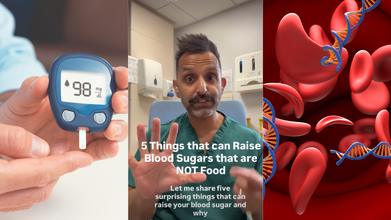
NHS doctor, Dr Amir Khan, who is a general physician with NHS England, resident doctor on ITV's Lorraine and Good Morning Britain, and host of the No Appointment Necessary podcast on his Instagram channel highlighted five non-food related reasons that could spike your blood sugar.
"Did you know your blood sugar can spike even if you haven't had a single bite to eat?" He starts his video with this disclaimer and goes on to say, "Let me share five surprising things that can raise your blood sugar and why it might not always be a bad thing."
Five Reasons Beyond Food That Could Spike Your Blood Sugar Levels
Stress
Dr Khan shares that stress triggers a rise in cortisol levels that activates the body's fight-or-flight response. This signals the liver to release stored glucose into the bloodstream to provide a quick boost of energy. This thus leads to a surge of glucose in blood and leads to the rise of blood sugar levels.
"When you're stressed, your body releases cortisol, the fight or flight hormone that tells your liver to release stored glucose to give you energy. Great if you're running from a tiger, less helpful if you're just stuck in traffic. Remember, chronic stress equals chronic glucose spikes and that is not good for long-term health,” he explains.
Poor Sleep
He also highlighted that even a single night of poor sleep could increase insulin resistance, which means glucose stays in the bloodstream for longer duration and could lead to elevated blood sugar levels. He said that chronic sleep deprivation could raise the risk of developing type 2 diabetes even in people who try to maintain otherwise a healthy diet.
"One bad night, your body becomes more insulin resistant. That means glucose hangs around in the blood for longer and over time, poor sleep can increase your risk of type 2 diabetes, even if you try your best to eat well," he says.
Exercise
To many people's shock, he says exercise could temporarily spike blood sugar. "Number three, exercise. Yes, even the good stuff. Certain types of exercises, especially intense or resistance training, can temporarily raise your blood sugars. Why? Well, again, it's your body releasing glucose for fuel, but really importantly, long-term, exercise improves insulin sensitivity, meaning lower blood sugars overall. So, this is not a bad spike,” he explains.
However, he does point out that it is not a bad thing. He notes that certain forms of physical activity, especially intense or resistance training could prompt the body to release more glucose in bloodstream to fuel the muscles. However, he also points out that regular exercise improves insulin sensitivity over time and helps the body regulate sugar more effectively.
Infections And Illnesses
“When you're fighting off a bug, your immune system has to ramp up, and that comes with a glucose surge. It's your body's way of fueling the immune response. People living with diabetes often notice higher blood sugar levels when they're unwell. That's totally normal and they may have to adjust their medication accordingly,” explains Dr Khan.
What this means is that when your body is fighting off infection, it releases more glucose in your bloodstream that works as a fuel for your immune system. This is why people with diabetes often notice higher blood sugar when they are unwell. However, he points out that this is body's normal response to combat illness.
Hormones
"Ladies, this one's for you because it's mainly around your periods or the menopause. In the second half of your menstrual cycle, that's the luteal phase, progesterone levels rise. This can make your cells more insulin resistant, meaning higher blood sugars. And of course, in perimenopause and the menopause, estrogen levels decline, and that comes with insulin sensitivity dropping. So you become more resistant to insulin, leading to more frequent spikes in blood sugar. That's why women in their 40s and 50s may notice weight gain, fatigue, or brain fog which can be linked to blood sugar shifts.”
Dr Khan notes that hormonal fluctuations during different phases of menstrual cycle could also influence blood sugar levels. Higher progesterone during luteal phase could make cells more insulin resistant. When estrogen is declining during perimenopause or menopause, it could further reduce insulin sensitivity.
Dr Khan concludes, “So remember, not all blood sugar spikes are bad. Context matters. But if you're seeing high readings and you're not sure why, it's always worth talking to your doctor and it’s not always about what you're eating.”
Note: This article is based on content available in public knowledge. Health and Me does not promote any user-generated content being as a substitute for medically verified information or prescription.
Sudden Fractures Could Signal Potential Cancer, Experts Say

Credits: Canva
A sudden bone fracture that seems out of proportion to the injury could sometimes signal an underlying life-threatening condition. Doctors say that while most fractures are caused by accidents or age-related bone weakness, certain cancers can damage bones and make them fragile enough to break with minimal force.
While this is still relatively uncommon compared to injuries or diseases such as osteoporosis, experts stress that unusual fractures should not be ignored.
How Cancer Can Weaken Bones
Bones are living tissues that constantly rebuild and repair themselves however, some cancers can start directly in the bone which are known as primary bone cancers., such as osteosarcoma, Ewing’s sarcoma, and chondrosarcoma. These cancers damage bone structure and make it fragile.
However, more often the problem comes from cancers that begin in other organs and then spread to the bones, also known as metastasis, which means cancer cells travel from their original location to another part of the body.
According to Dr Rakesh Kr Agrawal, Senior Consultant and Head of Radiation Oncology at Andromeda Cancer Hospital in Sonipat, cancers such as breast, prostate, lung, kidney, and thyroid frequently spread to bones. The spine, pelvis, ribs, and thigh bones are particularly common sites.
When cancer spreads to these areas, it can destroy bone tissue or create weak spots, increasing the chance of fractures.
Blood Cancer And Bone Damage
Another important condition linked to fragile bones is multiple myeloma, a type of blood cancer that affects plasma cells in the bone marrow.Bone marrow is the soft tissue inside bones where blood cells are produced. In multiple myeloma, abnormal plasma cells grow uncontrollably and interfere with normal bone rebuilding.
This often leads to lytic lesions, which are small areas where bone tissue has been destroyed. These weak spots can cause bones to break easily, sometimes without any obvious injury.
Doctors estimate that up to 80 percent of people with multiple myeloma already have fractures or severe bone damage when the disease is first diagnosed.
Warning Signs To Watch For
Apart from the type of cancer, doctors also say the context of a fracture matters. A break after a serious fall is usually straightforward but certain patterns may raise concern.
One major warning sign is a fracture after minimal trauma. This means a bone breaks even though the force involved was very small, such as stepping awkwardly or lifting something light.
Persistent bone pain is another signal. Pain that lasts for weeks, becomes worse at night, or appears before a fracture occurs may suggest that the bone was already weakened.
Swelling around the bone or a lump near the fracture site should also be evaluated carefully. These signs may indicate that the bone had an abnormal growth or tumor before the damage.
Doctors also look for systemic symptoms, which are symptoms affecting the whole body rather than just one area. These may include unexplained weight loss, fatigue, anemia, frequent infections, nausea or constipation.
Why Early Investigation Matters
Experts emphasize that most fractures are still caused by common conditions like osteoporosis or accidental injuries. Cancer is a much rarer explanation.
However, when something about a fracture seems unusual, doctors may recommend additional tests. These can include imaging scans such as X-rays, CT scans, or MRI scans to examine the bone more closely. Blood tests or specialised panels may also be done to look for conditions like multiple myeloma.
Early detection is important because many cancers can be treated more effectively when diagnosed sooner. Doctors advise adults, particularly those in middle age or older, to seek medical advice if a fracture happens with very little force or is accompanied by persistent pain or swelling.
In many cases the explanation will still be something simple like bone thinning. But identifying rare causes early can make a significant difference in treatment and recovery.
As specialists point out, paying attention to unusual symptoms and seeking timely evaluation is often the first step toward protecting long-term health.
Changing Color Of Light Could Help Treat Mental Illness

Credits: Trondheim Sleep Group/St Olav's hospital
Lights will guide you home, but will it treat your mental illness? It could. According to new findings, changing the color of light could help treat mental illness. A psychiatric unit in Trondheim, Norway is testing how light could be used as a potential treatment for mental health conditions like psychosis and depression. The approach is simple, yet innovative that aims on changing the ward's design to help patients in their recovery. As night falls, filters are lowered over windows and lights are changed. This creates a soothing ambiance and eliminates the blue wavelengths that could disrupt body's internal clock.
Also Read: Meningitis Outbreak: University of Kent Student Among Two Who Died of the ‘Invasive’ Disease
The findings have been published in PLOS Medicine, that looked on the patients who were treated in the circadian-adapted ward. The study showed that these patients showed greater clinical improvement and less aggressive behavior. "Just by changing the light spectrum, we can improve the quality of treatment," said Havard Kallestad, a researcher at St Olavs hospital who led the study.
Has This Approach Been Used In Other Areas Of Healthcare?
Researchers are now looking at its use for other healthcare areas, which means beyond the psychiatric wards. The UK's National Institute of Health and Care Research (NIHR) has also called for trials to see if this could "reset" the internal clocks of people who are living in care homes to reduce their behavioral disturbances, especially in dementia patients.
Professor Anthony Gordon of the NIHR said that it was about determining if light therapy could be used to reduce anxiety and improve sleep.
Read: Doctor Explains How Sleep Debt Is Becoming A Crisis In Urban Professionals
How Was The Study Conducted?
The psychiatric unit was divided in two identical halves with the same layout, staffing, and facilities. The key difference between the two was the evening light environment. One of the wards used blue-depleted lighting from 6pm onwards, where blinds and filters blocked similar light from windows and screens.
Whereas the other ward used standard hospital lighting and the unique design allowed researchers to study the impact of different lighting on patient recovery.
What Is Circadian Rhythm And How It Impacts Health?
Circadian rhythm is the body's internal 24-hour clock that regulated the sleep-wake cycle, hormones, digestion, and temperature, which aligns them with day and light. It is primarily controlled by light-sensitive brain cells, or what people commonly call the 'body clock'.
Disruption in the cycle could link to various health issues, which includes mental health problems like depression and cardiovascular diseases. This is why the test in Trondheim could prove beneficial in treating patients across the spectrum of illness.
Fish Oil Supplements Cut Heart Attacks And Strokes Risk In Dialysis Patients

Credit: Canva
Dialysis patients who took daily fish oil supplements had a 43 percent lower risk of major cardiovascular events, according to a large international clinical trial jointly led in Australia by Monash Health and the School of Clinical Sciences at Monash University.
Published in The New England Journal of Medicine, the study found that participants who took four grams of fish oil each day experienced significantly fewer major cardiovascular events, including heart attack, stroke, cardiac death and vascular-related amputations than those who received a placebo.
The supplement contained the omega-3 fatty acids EPA and DHA, which are naturally found in fish oil.
Adjunct Professor Kevan Polkinghorne, a nephrologist at Monash Health and adjunct in the School of Clinical Sciences, led the Australian portion of the trial said: "Patients on dialysis have extremely high cardiovascular risk, and very few therapies have been shown to reduce that risk," Professor Polkinghorne said. "In a field where many trials have been negative, this is a significant finding.
"Dialysis patients typically have much lower levels of EPA and DHA than the general population. This may help explain the magnitude of benefit observed in this group."
He also noted that results applied specifically to people undergoing haemodialysis for kidney failure and the findings should not be generalized to healthy individuals or to other groups of patients.
What Are Fish Oil Omega-3s?
Omega-3 fatty acids are polyunsaturated fats known for their crucial role in brain function and overall mental health. Fish oil is particularly rich in EPA and DHA, which are vital components of cell membranes and have strong anti-inflammatory effects in the body.
These omega-3s play a critical role in human development, and they are primarily found in fatty fish and fish oil. Since many people do not consume enough fish, supplementation is often recommended to ensure adequate intake of these essential fatty acids.
Although the body can convert another type of omega-3, alpha-linolenic acid (ALA), into EPA and DHA, this process is not highly efficient. As a result, fish oil supplements may provide a convenient way to ensure optimal levels of omega-3s.
Some popular sources of Omega-3 include:
- Salmon
- Cod Liver Oil
- Algae Oil
- Oysters
- Nuts and seeds, such as flaxseeds, chia seeds, and walnuts
- Plant oils, such as flaxseed oil, soybean oil, and canola oil
- Fortified foods, such as eggs, yogurt, juices, milk, etc.
Budget 2026: Cheaper Fish In India
Earlier this month, Finance Minister Nirmala Sitharaman announced a surprising tax reduction for India's fishers and marine industry, and experts say it is good news for you too.
Until now, fish caught by Indian vessels beyond territorial waters and brought back to the country for mass consumption has been treated as import, attracting customs duties and integrated goods and services tax (GST).
The combined tax burden raises costs and compliance issues, which discouraged people from deep-sea and exclusive economic zone (EEZ) fishing as well as
However, during her Union Budget 2026 presentation, Sitharaman proposed that fish caught in the EEZ and high seas by Indian fishing vessels are treated as duty-free when brought into Indian ports and treated as exports when landed at foreign ports.
This means that the market availability for Omega-3 packed fishes including salmon, mackerel, tuna, herring and sardines will significantly increase as their existing steep prices see a tremendous fall.
- Follow Us :


© 2024 Bennett, Coleman & Company Limited