
- Health Conditions A-Z
- Health & Wellness
- Nutrition
- Fitness
- Health News
- Ayurveda
- Videos
- Medicine A-Z
- Parenting
Study Claims Red Wine Vinegar Can Lower Cholesterol, Cut Cancer Risk!

Red Wine Vinegar For Health (Credit-Canva)
Vinegar is a solution that is often used as a taste enhancer in different types of dishes like chowmein, fried rice and many others. While it may seem like a normal addition to your food, a particular type of vinegar may have great health benefits for you like the red wine vinegar. While all vinegars offer some health advantages, red wine vinegar's unique properties come from its origin, red wine. This shared heritage means red wine vinegar inherits some of red wine's beneficial compounds, most notably resveratrol according to WebMD. Although the fermentation process reduces the amount of resveratrol the vinegar has, some still remains in the final product. A 2018 review in Biomedicines shows that resveratrol has the potential to be an antioxidant protection against heart problems as well as the development of cancerous tumors. This makes red wine vinegar a potentially functional food that gives you benefits that are beyond basic nutrition. It’s important to note that the concentration of resveratrol in red wine vinegar is likely less than in red wine itself.
Red Wine Vinegar Can Help Lowering Cholesterol Naturally
Now, here's where things get interesting, all vinegars contain acetic acid which is a natural result of the fermentation process, and this acid seems to be a big part of why red wine vinegar might help with cholesterol. But it is not just red wine vinegar, studies that were looking at how acetic acid affects cholesterol, are actually relevant to all kinds of vinegar. For example, a 2023 study in Frontiers in Clinical Diabetes and Healthcare looked at apple cider vinegar and found that people with diabetes who drank it daily for eight weeks saw their bad cholesterol go down. Scientists think this is because acetic acid can affect how our bodies make fat, based on earlier studies in animals. There was even a study back in 2010 in Lipids in Health and Disease where rabbits on a high-cholesterol diet were given vinegar, and they had less cholesterol buildup than rabbits who didn't get any. This is a promising result as it could mean many possible heart-health benefits, but it's important to remember that these were animal studies, so to understand it better, there needs to be human involvement.
Red Wine Vinegar May Have Potential Cancer Prevention Properties
Beyond cholesterol, there's also many other interesting studies done on red wine vinegar and its potential for cancer prevention, especially for melanoma which is a type of skin cancer. Studies show that resveratrol, which plays a huge role in the health benefits of red wine vinegar, might be a key player here too. A 2018 study in OncoTargets and Therapy looked at melanoma cells in a lab and found that resveratrol could actually stop them from multiplying. This suggests that it might have the potential for preventing or even treating melanoma. Another study from 2018 done by the International Journal of Molecular Medicine had similar results, which basically showed that resveratrol could suppress the growth of melanoma cells in lab dishes. Now, one thing you must remember is that these were lab studies and were not done on people, so we do need more research to know for sure how this works in real life. But these initial findings are definitely promising and should be explored more, as these diseases have plagued a lot of people throughout the world and any potential cure can become the real deal.
Why The Social Media Trend Of Parents Shaving Children's Facial Hair Could Go Wrong
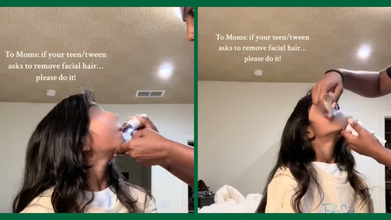
TikTok screengrab (@queencitytrends)
Across social media, videos of mothers shaving their daughters’ upper-lip hair have been going viral. In many clips, parents say they are trying to protect their children from bullying about facial hair, something many women recall experiencing during their own childhood. Some of these videos show girls as young as 10 or 12 getting their first facial shave at home.
The conversation gained major traction in 2023 when influencer Vidya Gopalan posted a video of herself shaving her 12-year-old daughter’s facial hair. The clip clocked millions of views and sparked strong reactions. While many viewers praised the mother for being proactive, others felt the practice introduces children to beauty pressures far too early.
Similar videos continue to trend today, often framed as an act of care from parents who want their children to feel confident. But dermatologists say the issue is more complicated than it looks online.
Children’s Skin Is More Sensitive Than Adults’
Experts point out that children’s skin is very different from adult skin. The protective barrier is still developing, which means it is more vulnerable to irritation and injury.
When shaving is done too early or too frequently, it can cause redness, cuts, razor bumps and sometimes infections. Using adult razors, dull blades or harsh products can make the situation worse. Even small nicks on delicate facial skin can lead to inflammation or long-lasting irritation.
Dermatologists note that shaving itself is not inherently dangerous if done correctly and occasionally. However, it should not become a routine practice for very young children simply because it is trending online.
Instead, any decision about hair removal should be taken carefully, with proper hygiene and supervision.
The Myth About Hair Growing Back Thicker
One reason many parents feel comfortable allowing shaving is the belief that hair will grow back thicker anyway, so removing it early does not change much.
Experts say this idea is a long-standing myth.
When hair regrows after shaving, the blunt edge of the cut hair can make it appear darker or thicker. In reality, the hair shaft itself has not changed. Studies in dermatology have repeatedly shown that shaving does not alter hair thickness, color or growth rate.
However, frequent shaving may still irritate sensitive skin, which is why dermatologists recommend caution when it comes to young children.
Cosmetic Treatments Raise Bigger Concerns
The debate intensified further after reports surfaced about an eight-year-old undergoing laser hair removal. That revelation shocked many people online and pushed the conversation beyond simple grooming.
Dermatologists stress that laser hair removal is generally designed for teenagers or adults whose hormones have stabilized. During childhood, hair growth patterns can still change significantly as the body develops. Because of this, such procedures are rarely recommended for younger children.
The concern is not only medical but also psychological. Starting cosmetic treatments too early may reinforce the idea that natural body features need to be “fixed.”
The Real Issue May Be Body Image
Experts say the larger conversation should not revolve only around hair removal techniques. It should also address how children learn to view their bodies.
Facial hair during puberty is normal, and it varies widely depending on genetics and hormones. In countries like India, where darker hair is common, many children may notice upper-lip hair earlier than their peers.
Instead of immediately removing it, dermatologists encourage parents to talk openly with their children about body changes. Helping children build confidence and understand that these changes are natural can be just as important as addressing appearance concerns.
If a child feels genuinely uncomfortable, gentler options such as a soft facial trimmer or consulting a dermatologist may be considered. But experts say the goal should not be to rush into grooming habits simply because social media has normalized them.
Sometimes, the most important step is helping children realize that their bodies are not a problem that needs fixing.
AI-powered Screening Tool To Boost Glaucoma care: The Lancet
Credit: Canva
An international team of researchers has developed an artificial intelligence (AI)-based tool that can significantly improve care for glaucoma -- a leading cause of irreversible blindness worldwide, according to a study published in The Lancet Primary Care journal today.
Researchers led by those from the University of Lisbon in Portugal found that the AI-based screening tool halved the number of unnecessary referrals for glaucoma.
The study, released during the Glaucoma Awareness Week, also showed an accuracy level at par with human eye doctors.
"The high accuracy at excluding people without glaucoma is especially important, as false alarms can lead to unnecessary hospital visits, patient anxiety, and added strain on healthcare services," the researchers said.
According to the researchers, AI-based screening could:
- support earlier detection,
- reduce unnecessary specialist referrals,
- prevent avoidable vision loss,
- can be integrated into routine primary care in a cost-effective way
Key Findings
The study was carried out at a single screening center in Lisbon, Portugal, in 2023.
The experts screened 671 adults aged 55-65 for glaucoma via the AI tool, analyzing images of the eyes. The images were then independently graded by six glaucoma experts.
The AI-tool:
- referred 66 people (9.8 percent) vs 118 referrals (18.0 percent) by the eye doctors,
- diagnosed glaucoma in 40 participants (6.4 percent).
- It correctly identified 78 percent of people who truly had glaucoma, vs 75 percent identified by the eye doctors
- Correctly ruled out the disease in 95 percent of people, vs 91 percent by eye doctors
While modelling studies suggest that screening could substantially reduce glaucoma-related visual impairment and blindness, barriers include the need for specialised diagnostic equipment and trained personnel, particularly in low- and middle-income countries, and the intrinsically low positive predictive value of screening tests.
In such a scenario, the new study showed that "AI may provide a more viable option than population-wide screening", which may seem impractical.
What Is Glaucoma?
Glaucoma is a chronic disease that affects an estimated 80 million individuals globally, according to the World Glaucoma Association.
It is a progressive, degenerative disorder of the optic nerve that produces characteristic visual field damage.
The disease stems from a long asymptomatic phase, resulting in substantial underdiagnosis and delayed treatment.
Even in high-income countries, up to 50 percent of individuals with glaucoma remain undiagnosed, frequently presenting moderate to advanced disease at first detection.
By the year 2040, it is estimated that there will be 22 million individuals worldwide who are blind from glaucoma.
When to see a doctor for glaucoma:
- Vision suddenly gets blurry
- Severe eye pain
- Headache
- Nausea
- Vomiting
- Rainbow-colored rings or halos around lights
Sleep Loss In Early Life May Increase Autism Risk, Researchers Say

Credits: Canva
In adults, long periods of sleep deprivation has been linked to problems such as weakened immunity, weight gain, depression, and an increased risk of dementia. However, scientists are now paying closer attention to how sleep affects the brain much earlier in life.
However, a new University of North Carolina School of Medicine study suggests that disrupted sleep during early childhood may interfere with key stages of brain development and asl well as increase the risk of developing autism.
Why Sleep Matters For The Developing Brain
From the moment babies are born, their brains are rapidly developing. During this stage, neurons form connections with one another through structures called synapses. These connections allow brain cells to communicate and are essential for learning, attention, working memory, and long term memory.Sleep plays a crucial role in helping these synapses form and strengthen. During sleep, the brain organizes and stabilizes these neural connections, shaping the foundation for future brain function. If sleep is repeatedly disrupted during this delicate stage of development, the process may be affected.
Frequent waking or sleep disturbances could interfere with how these neural connections are formed, potentially influencing behavior and cognitive abilities later in life.
The Link Between Sleep And Autism
Sean Gay, a graduate student in the laboratory of Graham Diering, PhD, assistant professor in the Department of Cell Biology and Physiology at the UNC School of Medicine and lead author said that more research was needed to determine the exact link between sleep and the development of autism.“The unique effects of sleep loss during development are largely unexplored,” Diering said. “Our data show that babies and children are more vulnerable to the negative effects of sleep disruption. We also found that sleep loss during this crucial period of time can negatively interact with underlying genetic risk for autism spectrum disorder.”
Sleep problems are already known to be common in people with autism. In fact, sleep disruption has been reported in more than 80 percent of individuals with autism spectrum disorder. However, researchers have long debated whether these sleep issues are a cause of the disorder or a consequence of it. Understanding how sleep interacts with brain development could help scientists detect autism earlier and potentially develop new treatment strategies.
Studying Sleep Disruption In Early Life
In earlier work conducted in 2022, researchers examined how sleep disruption during early life might interact with genetic factors linked to autism. Using mouse models, they disrupted sleep during the third week of life, a developmental stage roughly comparable to ages one to two in humans.
The study found that sleep disruption during this period produced long lasting behavioral changes. Male mice that were genetically vulnerable to autism showed deficits in social behavior later in life. These results suggested that sleep disruption during critical stages of development may interact with genetic risk factors in ways that shape long term behavior.
Younger Brains Respond Differently To Sleep Loss
To investigate further, researchers studied how developing and adult mice respond differently to sleep deprivation.
Using specially designed housing systems equipped with sensitive sensors, scientists tracked the animals’ breathing and movement. This allowed them to determine when the mice were awake and when they were asleep.
The researchers observed that adult mice were able to compensate for lost sleep. After experiencing sleep deprivation, the adults increased their sleep later during their normal active period. This process, known as sleep rebound, allowed them to recover some of the lost rest.
Younger mice behaved very differently. They showed no sleep rebound at all, meaning they did not compensate for the sleep they had lost. This finding suggests that younger brains may be far more vulnerable to the effects of sleep disruption.
The consequences were also visible in cognitive performance. Sleep deprived young mice performed poorly on learning and memory tasks, while adult mice were significantly more resilient after losing sleep.
Changes At The Level Of Brain Synapses
The researchers also examined what was happening inside the brain at the molecular level. Synapses are the points where neurons communicate, and they play a central role in memory formation and learning. Because sleep is closely linked to how synapses function, the team analyzed how sleep deprivation affects these structures. Using advanced protein analysis techniques, researchers mapped changes in the proteins that regulate synapses.The results showed that sleep deprivation in young mice significantly altered the formation of synapses. These changes were not seen in adult mice. “This now provides one of the largest and most comprehensive datasets to examine the molecular effects of sleep loss across the lifespan,” Diering said.
Potential Future Treatments
The research team hopes their findings may eventually help guide the development of new treatments for autism and other neurodevelopmental conditions. One goal is to create sleep based therapies for children that work differently from traditional sleep medications. Instead of acting as sedatives, these treatments would target the biological mechanisms that regulate synapses and sleep function.“Development is not something that one can go back and do again,” Diering said. “Sleep is important for the entire life and especially during development. Understanding what we know now will place greater emphasis on understanding sleep issues in ASD and could lead to an important therapeutic avenue to treat ASD and other developmental conditions.”
The findings highlight an important message for parents and caregivers. During early childhood, healthy sleep patterns may play a critical role in shaping the brain for years to come.
- Follow Us :


© 2024 Bennett, Coleman & Company Limited