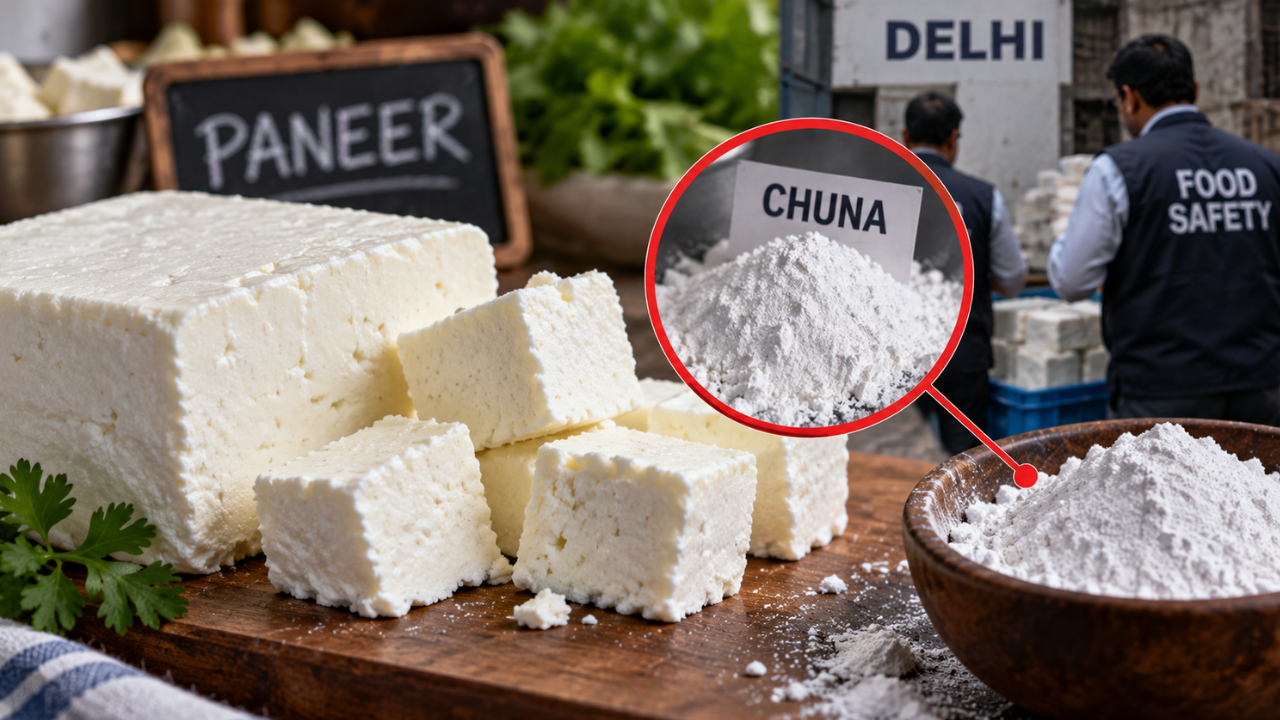
Multiple batches of synthetic paneer is making its way into Delhi-NCR kitchens, according to a recent investigation. It found that that some manufacturers were using slaked lime, commonly known as chuna, to whiten the non-dairy paneer. An recent investigation by The Times of India found that synthetic paneer was being produced in Gondola village in Nuh's Punahana block and supplied to Delhi, Gurgaon and Faridabad. Food safety officials reportedly found buckets of chuna during recent raids, which a food department source said was being used to artificially whiten the product. The investigation also found that synthetic paneer can be made using ingredients like soya paste, milk solids, palm oil and other vegetable fats rather than milk. Haryana has since imposed a one-year prohibition on analogue or non-dairy paneer, while several other states have also taken similar action. What Is Synthetic Paneer? Analogue paneer resembles dairy paneer but is made partly or entirely from non-dairy ingredients. It is not automatically illegal subject to certain conditions. They include properly labelled and meets applicable food regulations. The concern arises when it is sold as ordinary dairy paneer or produced without adequate food-safety controls. But the nutritional differences between the two foods can be significant.Also read: Ahead Of Raksha Bandhan & Janmashtami, FSSAI Destroys 490 Kg Sweets, 275 Kg Paneer In UP Due To Poor Hygiene Risks Of Consuming Paneer Laced With Chuna Chuna generally refers to calcium hydroxide, or slaked lime. The chemical has legitimate uses in certain food-processing applications when the appropriate food-grade material is used correctly. However, calcium hydroxide is alkaline and can be irritating or corrosive at sufficient concentrations. According to the US National Institute for Occupational Safety and Health, exposure can cause irritation or burns involving the eyes, skin and respiratory tract, while ingestion can cause burning, abdominal pain, vomiting and other gastrointestinal injury.HealthandMe spoke to Dr. Tushar Tayal, Associate Director, Internal Medicine, CK Birla Hospital, Gurgaon, about the risks of consuming synthetic paneer. Dr. Tayal says, "Consumption of adulterated paneer may lead to gastrointestinal symptoms such as nausea, vomiting, abdominal discomfort and diarrhoea, particularly if the product contains unsuitable or contaminated ingredients. Excessive or inappropriate exposure to substances such as slaked lime can also irritate the mouth, throat and digestive tract. The health impact, however, depends on the substance used, its concentration and the amount consumed, so it would be inappropriate to assume that every adulterated paneer product will cause the same level of harm."Dietician & Certified Diabetes Educator Ms Archana Batra told HealthandMe that fake paneer could interfere with one's daily protein intake. She also flags other health concerns. She says, "From a health perspective, the only concern is not that fake paneer has low nutritional value. The real concern is that adulterated paneer contains substances that are not approved for food use, if we consume it then it can cause gastrointestinal discomfort such as nausea, vomiting, abdominal pain or diarrhoea. If we repeatedly get exposed to unknown chemical adulterants then it can place an unnecessary burden on the body. Adulterated paneer cannot replace the protein and other nutrients that are present in real paneer."That does not mean that eating paneer whitened with chuna automatically causes chemical poisoning. The actual health risk would depend on the type and amount of calcium hydroxide used, its purity and how much remains in the food. The bigger concern is therefore unknown composition and lack of food-safety control, particularly when consumers are led to believe they are buying nutritionally equivalent dairy paneer.Also read: FSSAI Action Against Food Hygiene Lapses Intensifies; Regulator Slaps Notice To 2 Delhi Five-Star Hotels How To Identify Fake Paneer? Experts suggest that natural paneer, made from the milk curdling process, has a firm texture with a milky smell. While regular paneer turns brown upon heat, synthetic paneer crumbles and melts quickly. FSSAI mandates that products using non-dairy substitutes must mention terms like "analogue" or "imitation" on the packaging.Dr. Tayal further recommends, "Consumers should therefore be cautious about paneer that has an unusually bright white appearance, abnormal texture, chemical smell or an unusually low price. Buying dairy products from reliable sources and checking packaging, labelling and freshness can reduce the risk. If someone develops persistent vomiting, severe abdominal pain, breathing difficulty or other unusual symptoms after consuming suspected adulterated food, medical attention should be sought promptly."As per FSSAI, an iodine test can also help with identifying fake paneer. Take a pan and boil paneer in it. Add a few drops of iodine tincture to the boiled paneer. If it turns blue, it's artificial.Another trick to identify fake is the toor dal test. Allow the boiled paneer to cool in water. Add some toor dal to the water and let it sit for 10 minutes. If the water turns light red, then it is fake paneer.