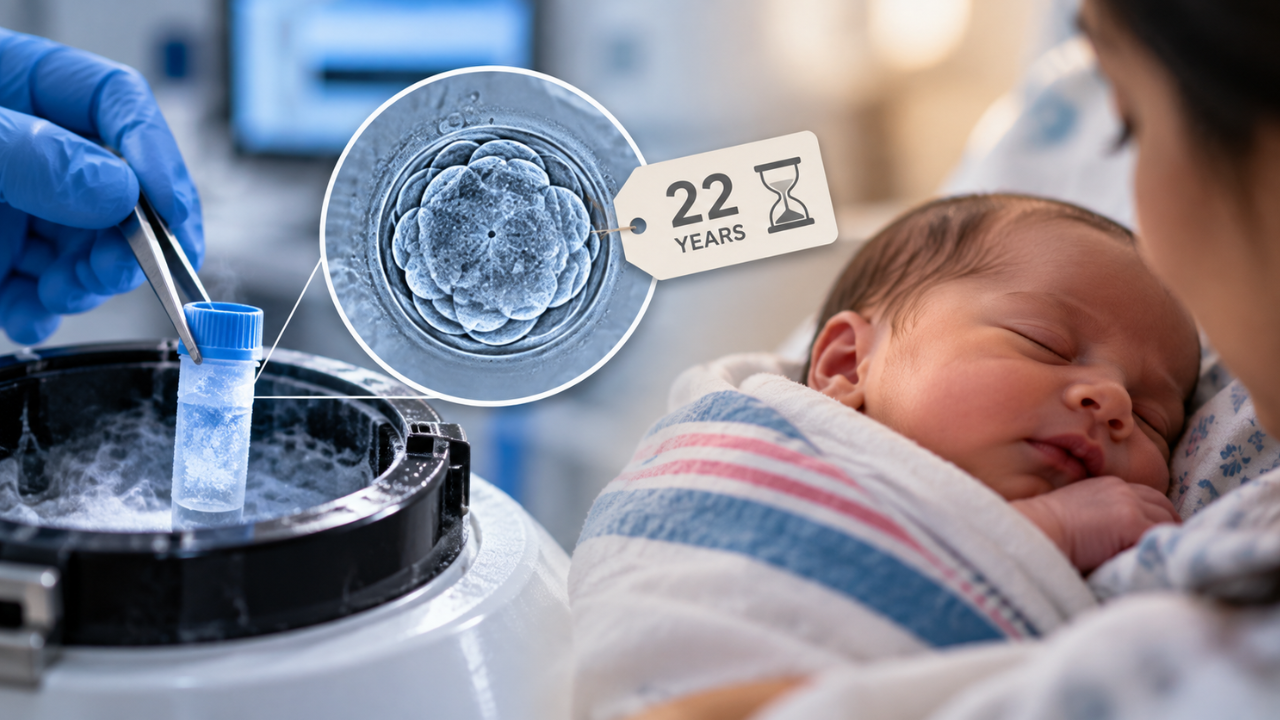
A 54-year-old woman in Greece recently gave birth to a healthy baby girl using an embryo that had been frozen for more than two decades. The case has marked a milestone in IVF, raising an intriguiging question: does a frozen embryo eventually have an expiry date? Cristina Rapti-Tzelepi and her husband, Constantinos Raptis, welcomed their daughter Georgia in Athens on September 9. The embryo was originally cryopreserved in March 2004 and was transferred in December 2025. The baby weighed 3.49 kg at birth. The couple decided to use one of their remaining embryos after their 21-year-old son, Giorgos, died in a road accident in October 2025. Their son had also been born following IVF using an embryo from the same original treatment. The case is remarkable as the embryo remained frozen for more than two decades. But scientifically, that does not mean the embryo continued ageing for 22 years. Does A Frozen Embryo Actually Age? A frozen embryo does not age in the way a an actual human person does. During cryopreservation, embryos are stored at extremely low temperatures, generally around -196°C in liquid nitrogen. At this temperature, biological processes that drive cellular ageing effectively stop. The key is maintaining stable cryostorage conditions. The American Society for Reproductive Medicine says cryopreserved embryos must be maintained under stringent conditions, with IVF laboratories monitoring liquid-nitrogen levels and storage systems. So, an embryo frozen in 2004 does not biologically become a 22-year-old embryo. Its chronological storage time increases, but its cells are preserved in the state they were in when frozen.Also read: Emma Barnett Reveals She Had A Hysterectomy After Endometriosis Battle: What To Know About Adenomyosis Long Storage Of Embryo & Healthy Pregnancy A recent systematic review and meta-analysis published in Human Reproduction Open examined 23 studies involving more than 250,000 embryo-transfer cycles. Researchers found that embryos stored for longer than five years appeared slightly less likely to survive thawing, with some reductions in pregnancy and live-birth rates. However, the outcomes stopped worsening after around two years of storage, with no further deterioration as storage continued for much longer periods. Longer storage was also not associated with increased risks of premature birth, high birth weight, or birth defects. Earlier research has similarly found no dose-response relationship between the duration of embryo cryostorage and pregnancy outcomes.Also read: Explained: What Is Posthumous Reproduction? Does An Embryo Have An Expiry Date? Scientifically, there is no established biological expiry date for a properly cryopreserved embryo. The bigger concerns are the quality of the embryo before freezing, the freezing and thawing technique, laboratory conditions, and whether the embryo survives thawing. There are also factors like biological limits and legal limits that affect IVF. In Greece, women currently have a legal age limit of 54 for completing IVF procedures. Rapti-Tzelepi had only a limited window in which to obtain approval and undergo treatment. Her case is therefore not proof that every embryo can remain viable indefinitely. But it provides another striking example of how modern cryopreservation can preserve reproductive potential for decades.