
- Health Conditions A-Z
- Health & Wellness
- Nutrition
- Fitness
- Health News
- Ayurveda
- Videos
- Medicine A-Z
- Parenting
Checkup Checklist For The First 6 Months Of Your Baby

Checkup Checklist for Infants (Credit-Freepik)
An infant needs a lot of check-ups when after birth, while it may seem tedious, they are necessary to see how well your child is adjusting here so make sure you do not miss the appointments set up by your healthcare provider.
In Hospital (within 24 hours of birth)
General health check: Your doctor will check your baby from head to toe, general health and reflexes. This is not just for the child but for the assurance of the parents and to give them basic advice on how to feed the baby and any other issues that may arise. While your general checkup is going on, the doctors will check whether your kid is hearing or not. They also check the oxygen level of your child. If there are any issues like one part of the body not receiving enough air, then they must prep for the next steps.
Jaundice and metabolic screening: Newborns undergo tests for jaundice, a condition where the skin appears yellow due to excess bilirubin in the blood. If detected, treatment is readily available. Additionally, a complete metabolic screening helps identify rare but treatable genetic disorders.
Before you leave the hospital, your baby will receive some preventive treatments. Antibiotic eye ointment helps protect against infections that could be contracted during birth. A shot of vitamin K, crucial for blood clotting, is given as newborns have low levels at birth. Finally, the hepatitis B vaccine provides vital protection against this serious liver disease, which can be unknowingly passed from mother to baby during birth.
3-5 Days Checkup
Within a few days of bringing your baby home, you'll have their first checkup with their paediatrician (the doctor who cares for children). This visit is important to make sure your little one is growing well.
The doctor will measure your baby, check it from head to toe, and ask about feeding, sleep, and diaper habits. They'll also be happy to answer any questions you have about caring for your newborn.
Some babies might need to see the doctor more often, like if they have feeding issues or jaundice (a yellowing of the skin). But most babies will have their first checkup around 3-5 days after birth.
This visit is a great opportunity to get advice on breastfeeding, formula feeding, safe bathing, and how to help your baby sleep soundly. The doctor will also check in with you to see how you're feeling as a new parent.
1-Month Checkup
Your baby's one-month checkup is around their first month, not the exact day they turn one month old. Relax, there's no need to stress about the date!The doctor will follow a similar routine as the first checkup: measuring your baby, checking them from head to toe, and asking about sleep, feeding, and how you're both doing. This visit is crucial to ensure your baby's growth and development are on track.
The doctor will also chat about how to help your baby's brain grow by talking, singing, reading, and playing with them. These activities are super important! They'll also be happy to answer any questions you have.
While vaccinations are a regular part of baby care, they typically don't happen at the one-month visit. However, this is the perfect time to discuss the recommended vaccination schedule. Don't hesitate to ask your doctor any questions you may have about vaccines.
2-Month Checkup:
Around your baby's first month (no exact date needed!), they'll have a checkup. It's like the first one, with measurements and a head-to-toe check. The doctor will ask about sleep, feeding, and how you're both doing. This helps them make sure your baby's growing well.They'll also talk about ways to boost your baby's brain development through talking, singing, reading, and playtime! These are key for your little one's growth. Shots usually don't happen at this visit, but the doctor can answer any questions you have about the vaccination schedule, which typically starts at two months. Don't be shy – ask away!
4-Month Checkup:
Your baby's four-month checkup is a big milestone! They've grown so much since their last visit and are starting to notice the world around them. This is also when they'll get important vaccines to help them stay healthy. (PCV, RV, Hib, Polio, DTaP)6-Month Checkup
The six-month checkup is all about your growing baby! The doctor will do the usual checks and chat about feeding. This is when you might start offering solid foods, and the doctor can give you tips. Teething might also start around this time, so ask about soothing sore gums.Your baby might get some shots at this visit, like the third dose of some vaccines they had before. Depending on the season, the doctor might recommend the flu shot, which is important for keeping your little one healthy. It's usually two doses for their first time.
Danish Parenting Rule Book: Children Always Make Sense

Credits: iStock
Too much about Danish parenting is already out in the discussion, but there is something new, yet again. The rulebook to Danish parent, and its first rule is: Children Always Make Sense.
The New Danish Parenting or NDP is based on a concept which relies on the Internal Family System or IFS, an attachment theory that in Denmark is called the New Child View. This is a shift from the old ways of parenting, to a new method, which follows equality, integrity, authenticity, and accountability.
The new child view is based on the work of Danish Family Therapist Jesper Juul, Family-lab, and Blackbird Institute.
Danish Parenting: Why Is It Important?
The Old paradigm of parenting was based on fear, control, abuse of power and inequality between the parent and child. Even though parents know how children behave, the old way is ingrained into our brains so much, that it is hard to follow through in practice. The new method thus compels parents to be with their own wounded parts or the inner child. This is when it becomes even more important to be with the actual child the parent is taking care of.
Also Read: What Is Denmark's 'Cry It Out' Method Of Putting Babies to Sleep?
Danish Parenting: Why Is It Unique?
At the foundation of New Danish Parenting is attachment. It is through the attachment of oneself from within can one take care of the actual child. The new way encourages to form a sense of safety, security and attachment between the self and parts of our inner children.
The system this bases focuses on healing modality. The focus lies on feeling safe, being the parent our child wants us to be. The new method has this New Danish Parenting, the first rule is: Children Always Make Sense. Let's talk a bit about that before moving on to the other rules.
Danish Parenting Rule No. 1: Children Always Make Sense
As human beings, we live on a spectrum between integrity and cooperation. Integrity means being true to what we feel on the inside and expressing it honestly on the outside. Cooperation, on the other hand, is about fitting in, belonging, and maintaining relationships with caregivers, family, and society. Both are essential for healthy living, but the balance between them can easily tip.
We are born deeply connected to our integrity. As babies, we cry when we are hungry, uncomfortable, or scared. We turn toward connection when we need it and turn away when we’ve had enough. This isn’t weakness. It’s competence. Babies instinctively know how to communicate their needs and boundaries.
The bond between a baby and caregiver is a two-way relationship. When a baby makes a sound or facial expression and a caregiver responds with a similar one, both are engaging, learning, and growing. These small moments shape the brain and nervous system of both child and adult, building connection and trust.
As we grow, we naturally adapt to our environment. This helps us survive, belong, and feel loved. We learn to share, wait, cooperate, and consider others. In supportive environments, children learn how to be themselves while staying connected to others.
But no environment is perfect. This is where over-cooperation begins. Over-cooperation happens when children learn that certain feelings, needs, or boundaries are not acceptable. A child may hide sadness behind a smile, ignore discomfort during unwanted touch, or eat past fullness because stopping isn’t allowed.
What often looks like “bad behavior” is actually a child struggling. Children are not being difficult; they are having a difficult time. Their behavior always has meaning and usually comes from a place of self-protection.
When adults meet children with curiosity instead of punishment, children feel seen and safe. This helps them understand themselves better and slowly return to a healthier balance between integrity and cooperation.
Meghan Trainor Opens Up About Choosing Surrogacy For Her Third Baby

Credits: Instagram
Meghan Trainor, an American singer-songwriter and television personality opened up about her third child through surrogacy. In an interview with PEOPLE she said, :"It wasn’t our first choice, but we had endless conversations with our doctors on this journey, and this was the safest way for us to be able to continue growing our family. We are forever grateful for that option."
Trainor, 32, and her husband Daryl Sabara, 33, welcomed their daughter Mikey Moon via surrogate on January 18, and are also parents to their sons Riley,4, and Barry, 2.
What Did Meghan Trainor Say About Surrogacy?
"Our surrogate is one of the most selfless, strong and loving people I’ve ever met. We felt so connected throughout the entire journey, and I’ll always be grateful for the care and love she showed our daughter. She gave us the greatest gift of our lives. She graciously answered our many check-in texts to make sure she was doing okay."
Meghan also said that she wants people to know that surrogacy is just another beautiful way to build a family. "It is not something to whisper about or judge. It is rooted in trust, science, love, and teamwork. Every family's journey looks different, and all of theme are extremely valid."
Read: Your Child’s 2026 Vaccine Checklist: What to Take, When, And Why It Matters, According To Doctor
Why Did Meghan Trainor Choose To Have A Child Through Surrogacy?
Trainor wrote Dear Future Mama, a pregnancy and parenting book in 2023, where she talked about her struggles during her first two pregnancies. She mentioned how traumatic was it for her after Riley's birth, when she also faced post-traumatic stress disorder, when her son was rushed to the NICU. At the same time, Trainor was being treated on the surgery table. "Usually when you're being sewn up for 45 minutes, you're like, 'Look at my gorgeous baby. We did it. This is everything.' But I was laying there alone."
She said in that very moment she was so drugged that she called her mother and cried. She had to learn how traumatic that was for her. She also told PEOPLE that she had reached a "breaking point" and struggled with her mental and physical health after Barry's birth. In an essay for Today.com, she wrote: "I was alone with Barry and he would not stop crying and then I was crying. I was having a panic attack and I was just over-exhausted, but I felt like I was dying. I felt if I stood up, I would pass out. I didn’t feel safe holding the baby and at the same time I felt like my body was giving up on me."
With the past medical reasons, especially the impact on her mentally, and other complication, after medical consultations, Trainor chose to go for surrogacy.
Also Read: Parents Are Now Preferring Girls Over Boys; What Led To This Shift?
What Is Surrogacy?
As per Yale Medicine, surrogate mothers are impregnated through the use of in vitro fertilization or IVF. In this process, doctors create an embryo by fertilizing eggs from the intended mother or an egg donor with sperm from the intended father or a sperm donor. Since the surrogate mother does not provide the egg, she is not genetically related to the child.
Emre Seli, MD, a reproductive endocrinologist and infertility specialist tells Yale Medicine, “Gestational surrogacy is a great option for people who really want to be parents but have faced long odds."
Fact Check: Is Weight Lifting Safe for Teens? An Expert Explains the Risks and Safer Alternatives
Credits: iStock
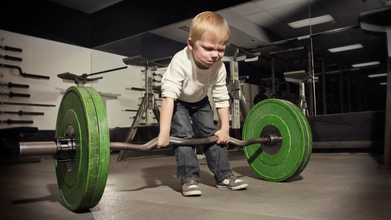
Should teens be lifting weights? This is a question many people wonder, and Cara Natterson, a pediatrician, finally has answers! "Tweens and teens should not be lifting heavy weights, but they absolutely can do resistance training. There is an important difference between the two," she says.
In an Instagram video, shared by the account @less.awkward, which is ran by Natterson, and Vanessa Kroll Bennett, Natterson explains that during puberty, "the body is flooded with hormones like testosterone, estrogen, progesterone, and growth hormone, which together trigger the release of IGF-1, a key driver of growth spurts and cartilage development".
Also Read: Measles Outbreak Confirmed In Two South Carolina College
So, What Happens When A Teen Trains?
“When kids are growing rapidly, the cartilage around their bones is actually weaker than the bone itself, which makes them more vulnerable to injury during weight lifting," she points out. She further explains that in peak growth phases, bones are still mineralizing. They form a scaffold first and fill in later, which means the bones are porous and easier to injure at this stage.
“The most vulnerable part of a growing bone is the growth plate, which sits at the ends of long bones and is the weakest point when it comes to fractures.” Natterson says that if a child gets injured during weight lifting or even sports, the growth plate is often where that injury occurs. This is why kids should not be bearing heavy weights until they are done with their growth spurts, she says. However, she points out that this "does not mean they should avoid strength-building altogether".
“Resistance training, where children use their own body weight, is not only safe but encouraged. Even five, six, and seven-year-olds can do it," she says.
Also Read: Have You Also Noticed Suddenly Becoming Lactose Intolerant? Nutritionist Explains Why
What Is Resistance Training?
Exercises like push-ups, pull-ups, sit-ups, squats, and anything that makes one use their own body weight is safe. Natterson says, “Exercises like push-ups and pull-ups strengthen muscles and improve bone density without putting excessive pressure on weak cartilage, thin bones, or growth plates.”
For more impact, one can use resistance bands. While people also use dumbbells, barbells, and kettlebells, Natterson recommends to avoid any weights during the growth spurt.
Here Are Some Examples Of Resistance Training That One Can Do Without Lifting Weights
Chest Press
- Wrap your resistance band behind your back.
- Hold both ends with your hands and start with your arms at your side.
- Bend your elbows and push the band in front of you.
Bicep Curls
- Stand on the resistance band and hold both ends in hands.
- With your arms extended by side, pull your hand up, keep elbow bent at side.
- Do it with one or both arms.
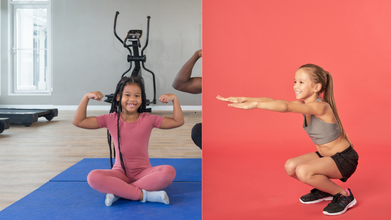
Squats
- Stand on your resistance band and grab both ends with your hands.
- In a squat position, hold the bands but do not lock your arms.
- Extend your knees until you are in a standing position.
Pull Ups

- Grip a bar with hands shoulder width apart.
- Start with a full hang, then pull your body up by squeezing your shoulder blades down and back until your chin clears the bar
- Then lower down the control and keep your core engaged.
Push Ups

- Start is high plank with hands wider then shoulders.
- Keep your core tight and body in a straight line from head to heels.
- Lower your chest towards the floor by bending elbows to 90 degrees.
- Push back up powerfully to the starting position, maintain a rigid core and straight back throughout.
- Follow Us :


© 2024 Bennett, Coleman & Company Limited