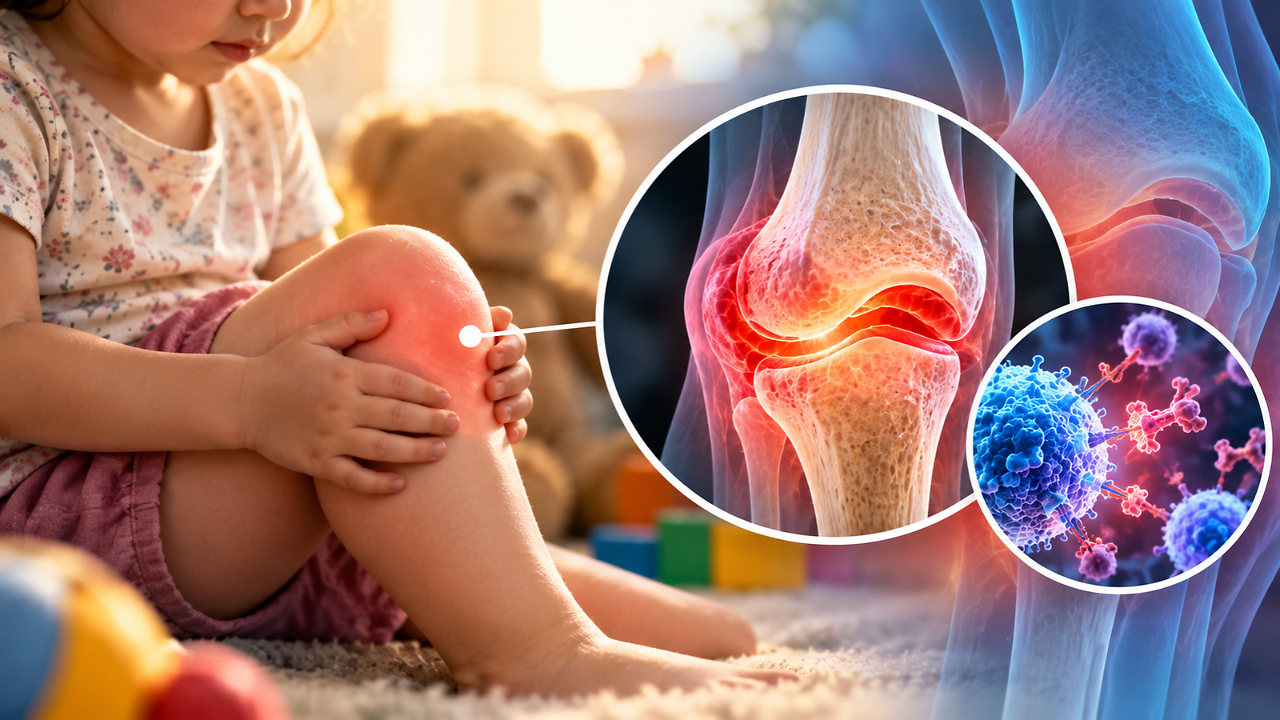
When Emily Hughes saw that her 18-month-old daughter, Scarlett, had a swollen knee in late 2023, she initially thought it might be an injury from the toddler’s routine playtime. Scarlett was energetic and adventurous, and the swelling did not appear to cause her pain.But the swelling did not improve, and further examinations eventually led to a diagnosis of juvenile idiopathic arthritis (JIA), a chronic inflammatory condition that affects children.Hughes, who lives in Australia, told Mamamia that several doctors initially found no cause behind her daughter’s symptoms. The situation changed in February 2024, when Scarlett’s knee became hot, painful and more severely swollen. She could no longer bear weight on the affected leg. “She wouldn’t bear weight, and it was even more swollen,” Hughes said.Scarlett was taken to the Royal Children’s Hospital in Melbourne, where doctors initially thought it was septic arthritis, a serious joint infection. Investigations failed but the family continued consulting specialists. By May, after other possible explanations got investigated, Scarlett was referred to a rheumatologist and diagnosed with juvenile arthritis affecting three joints.Now four years old, Scarlett is in remission and has returned to physical activities like climbing and doing cartwheels. Her experience highlights why stubborn joint swelling and changes in a young child’s movement deserve emergency medical attention, even when the child is not in pain.What Is Juvenile Idiopathic Arthritis?Also read: Women And Arthritis: Why Risk Increases After 40Juvenile idiopathic arthritis is the most common form of chronic arthritis in children. It refers to a group of several conditions in which the immune system triggers inflammation in the joints by mistake. Although genetic and environmental factors may contribute, the exact cause is unknown.The condition can affect children younger than 16 and may involve one or several joints. The knees, ankles, wrists and elbows are commonly affected.Unlike arthritis, JIA can begin during toddlerhood. Its symptoms may also be difficult to recognise as young children cannot always describe pain, stiffness or discomfort accurately.There is no single test that confirms JIA. Doctors start by assessing the child’s symptoms, medical history and physical examination, and may use blood tests and imaging to investigate inflammation and rule out other conditions.Signs Of Juvenile Arthritis Parents Should Not IgnoreAlso read: Arthritis Day: Stanford Researchers Explore Possibility To Treat Osteoarthritis Without Knee Replacement SurgeryAccording to the US National Institute of Arthritis and Musculoskeletal and Skin Diseases and the American Academy of Pediatrics, parents should watch for the following symptoms:1. Continued joint swellingA knee, ankle, wrist or other joint that remains swollen should be assessed on priority. In JIA, painless swelling may occur even when the child seems comfortable.2. Morning stiffnessChildren may struggle to move a joint after waking up or after sitting still for a long time. Stiffness may improve as they become more active during the day.3. Limping or reluctance to walkA toddler who starts limping, avoids putting weight on one leg or has difficulty walking may be experiencing joint inflammation.4. Difficulty bending or straightening a jointLimited movement is also one of the signs. A child may struggle to straighten an elbow, bend a knee or move a limb as freely as before.5. Changes in play and everyday activitiesA child who suddenly avoids climbing, running or playing, or struggles with activities they previously dud easily, may have pain or stiffness. Some children with JIA may also experience fatigue, fever, rash or reduced appetite, depending on the type of disease. Untreated inflammation can damage joints and interfere with a child’s movement and development. Early diagnosis and treatment aim to control inflammation, maintain joint function and help children maintain their usual activities.JIA can also affect the eyes. Some children develop uveitis, inflammation inside the eye that may cause no obvious symptoms initially but can threaten vision if left untreated. Regular eye examinations are therefore an important part of JIA.