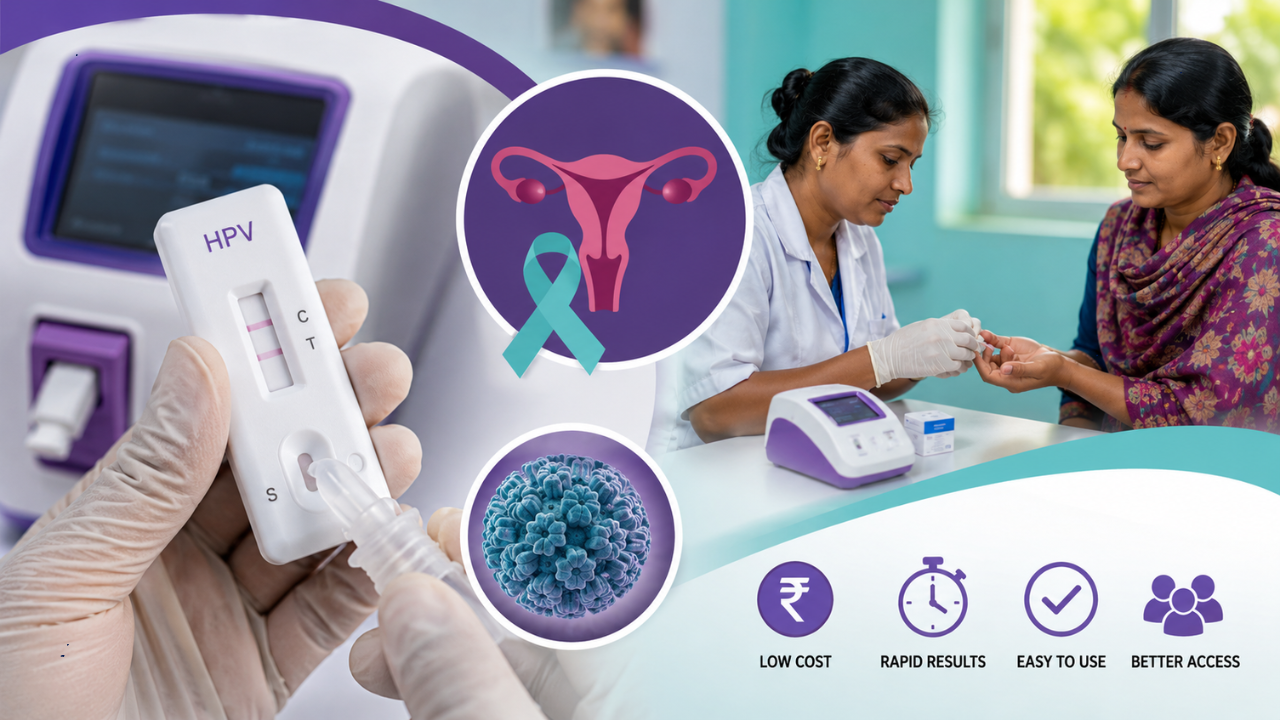
An indigenous low-cost point-of-care (PoC) testing approach has shown promise in making screening for Human Papillomavirus (HPV) more affordable and accessible, potentially improving the early detection of cervical cancer, according to a joint study led by researchers from AIIMS, ICMR, and the WHO's International Agency for Research on Cancer (IARC).The study, published in the International Journal of Cancer, found that PoC tests have the potential to become scalable, low-cost screening tools in India and other low- and middle-income countries (LMICs).The objective of the study was to evaluate indigenous HPV DNA testing platforms for use in primary cervical cancer screening.Four Indigenous Tests EvaluatedWhile several Indian HPV tests have been developed, many had not yet been validated against the international standards laid down by the WHO.The study evaluated four point-of-care tests developed by 3 Indian companies:Genes2Me – HPV-QMylabs India – PathoDetect HPV-7 and PathoDetect HPV-14Molbio Diagnostics – Truenat HR-HPV-PlusEach test was developed by repurposing existing COVID-19 RT-PCR platforms. HPV-Q and PathoDetect HPV-14 can detect all 14 high-risk HPV types, while PathoDetect HPV-7 detects seven high-risk types: 16, 18, 31, 33, 45, 52, and 58.How the Tests PerformedAlso read: PM Modi Launches Nationwide Free HPV Vaccination Drive; A Landmark Step, Says WHOTo assess performance, researchers analyzed 1,159 cervical samples collected from studies conducted in Argentina and Costa Rica.The results showed:Truenat HR-HPV-Plus: Sensitivity 80.4%, specificity 91.5% — met IARC validation criteria.PathoDetect HPV-7: Sensitivity 68.1%, specificity 89.0% — lower sensitivity.HPV-Q and PathoDetect HPV-14: Did not meet validation criteria.The study concluded that Truenat HR-HPV-Plus demonstrated robust clinical performance and higher specificity than 14-valent assays, supporting its potential to improve screening efficiency and reduce unnecessary referrals.Indigenous Platforms Can Be Game-Changers"This study demonstrates that indigenous platforms can achieve clinical validation, quality standards, and accuracy comparable to global gold-standard tests. It will be a game-changer for cervical cancer prevention and early detection in India," said lead author Dr Neerja Bhatla, Professor Emeritus, NCI and former Head of the Department of Obstetrics & Gynecology at AIIMS New Delhi.Dr Shalini Singh, Director of ICMR-NICPR, added that HPV DNA testing at age 35 and again at age 45 is central to WHO's cervical cancer elimination strategy, but high costs remain a major barrier in LMICs."Affordable indigenous solutions are essential to expand screening coverage and reduce disease burden," she said.High Burden Of Cervical Cancer: Why HPV Testing MattersRead More: HPV Vaccine Can Help Curb Rising Head And Neck Cancers, Says Top US DoctorCervical cancer continues to be a major public health challenge in India, with around 127,000 new cases and 80,000 deaths reported annually.Globally, cervical cancer is the fourth most common cancer in women. According to WHO data for 2022, there were approximately 662,000 new cases and 348,000 deaths worldwide.Regular screening of women over 30 years of age every 3-5 years can help detect precancerous and cancerous lesions early. However, screening coverage in India has remained low despite the inclusion of visual inspection with acetic acid (VIA) in the national screening program for breast, oral, and cervical cancers.Persistent infection with carcinogenic HPV types is the necessary cause of cervical cancer. WHO recommends a transition to HPV testing as the preferred strategy for cervical cancer elimination.Using validated HPV tests, only two rounds of screening — at ages 35 and 45 — may be sufficient to help achieve elimination targets. However, most existing HPV tests are expensive, require sophisticated laboratory infrastructure, and are not easily available at last-mile health facilities.The researchers said that the point-of-care HPV testing approach, thus, could be a major breakthrough, enabling affordable diagnostics and even same-day treatment for women who test positive.Potential for Nationwide RolloutThe researchers noted that while the recently introduced national HPV vaccination campaign will benefit younger generations, there remains an urgent need to expand HPV testing for women over 30 who are currently at risk of cervical cancer.Dr Showket Hussain of the ICMR-National Institute of Cancer Prevention and Research (NICPR), Noida, said the validated platform has strong potential for integration into national screening programs because district-level healthcare personnel are already familiar with similar testing systems."Future advancements such as self-sampling and high-throughput adaptations could further enhance accessibility," he said.The findings are expected to support India's cervical cancer elimination goals while offering a scalable model for other low-resource settings globally.