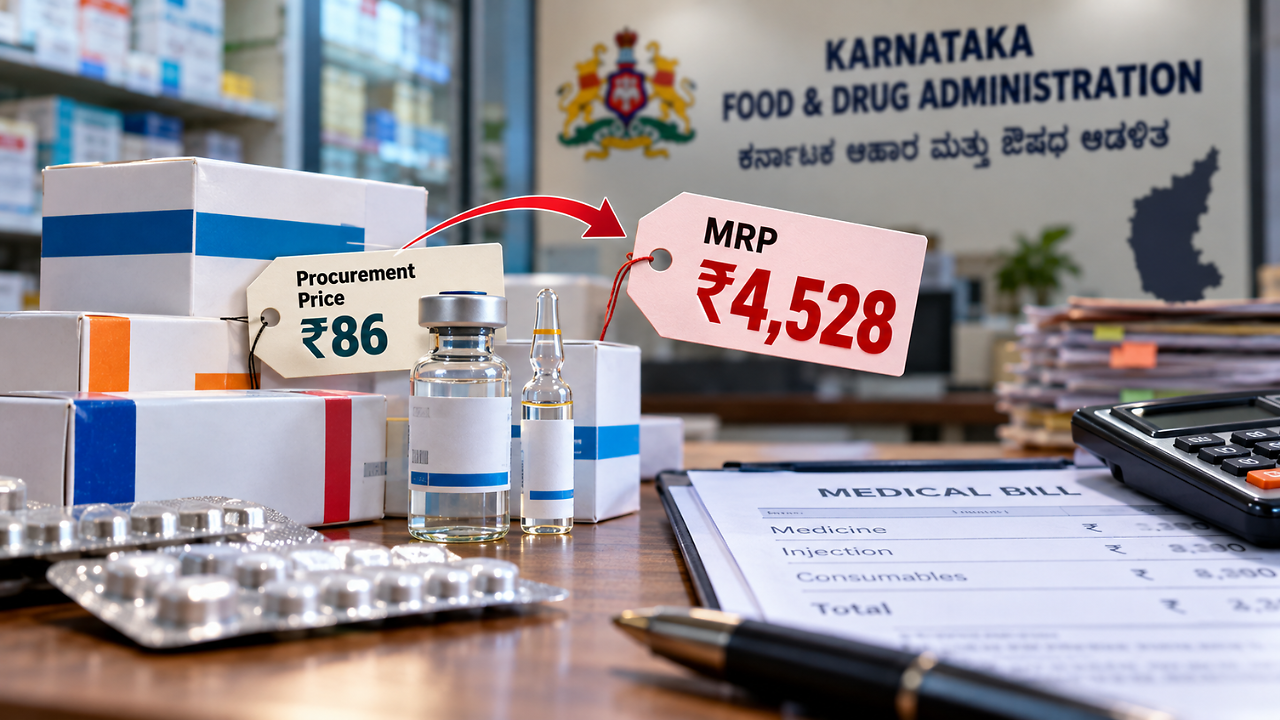
During a recent sweep of cancer hospitals in Karnataka where high-cost drugs are used, the Karnataka's Food Safety and Drug Administration (FSDA) found massive price disparity between institutional (landing) prices and the maximum retail price (MRP). The Karnataka Government urged Union Ministry of Health and Family Welfare and the National Pharmaceutical Pricing Authority (NPPA) to intervene and curb the large gaps between prices hospitals pay and what they charge patients. The concern is significant for patients admitted to hospitals who may have limited time and opportunity to compare and opt for cheaper alternatives. Difference Between Landing Costs & MRPs Also read: US To Face Nearly 28,000-Surgeon Shortfall By 2038: What Could This Mean For Patients?The food and drug regulator has spotted pricing discrepancies of 256 medicines, medical devices and hospital consumables and has asked the National Pharmaceutical Pricing Authority (NPPA) and the Department of Pharmaceuticals to intervene. It involves Gufipol, that has an institutional acquisition cost was ₹86, while its MRP was ₹4,528, making the MRP about 52.6 times the reported acquisition cost. Another example is Guficycline-50 injection, reportedly acquired for ₹160 but carrying an MRP of ₹7,110, or about 44 times the acquisition cost. The gap was also seen with expensive medicines. Taxocare 120 mg, a cancer drug, had a reported acquisition cost of ₹1,000 against an MRP of about ₹21,618. Across the 256 products examined, the average MRP-to-acquisition-cost multiple was 9.23 times, while the median was 7.58 times. Seventy-three products had MRPs at least 10 times their reported acquisition costs. The FSDA said, “MRP operates as a ceiling on retail sale to a consumer, but it does not by itself ensure that the MRP is a fair patient-facing price in an institutional setting.” The regulator added, “The issue is not merely a commercial discount. It is an information-asymmetry and captive-patient problem. The patient, who is generally unable to obtain an immediate substitute during admission, bears the entire benefit of the manufacturer-hospital discount being retained within the supply chain. The patient neither knows the institutional acquisition cost nor possesses an effective choice at the point of use.” This becomes relevant in emergency care, intensive care, cancer treatment, and other situations where patients may need medicines or medical consumables immediately.Also read: Chewing Tobacco Linked To 2.5 Lakh Deaths Globally: India Among Top 10 Worst-Hit CountriesWhat Has The State Proposed?The state has suggested a framework under which the amount charged to a hospital patient would take into account the actual net acquisition cost, a prescribed service margin and applicable taxes. It has also proposed that hospital bills disclose details like the MRP, institutional acquisition cost, permitted service margin, taxes and final amount charged to the patient. The proposal would also consider discounts, rebates, credit notes, free supplies, and other benefits when calculating the hospital's actual acquisition cost. Current Drug Pricing Rules In India Drug prices in India are regulated under the Drugs (Prices Control) Order, 2013. The NPPA fixes ceiling prices for medicines listed under the National List of Essential Medicines and monitors drug prices. Manufacturers cannot increase the MRP by more than 10% over the previous 12 months for formulations not covered by price control. The government also says no person can sell a formulation above the applicable current price or labelled MRP, whichever is lower.