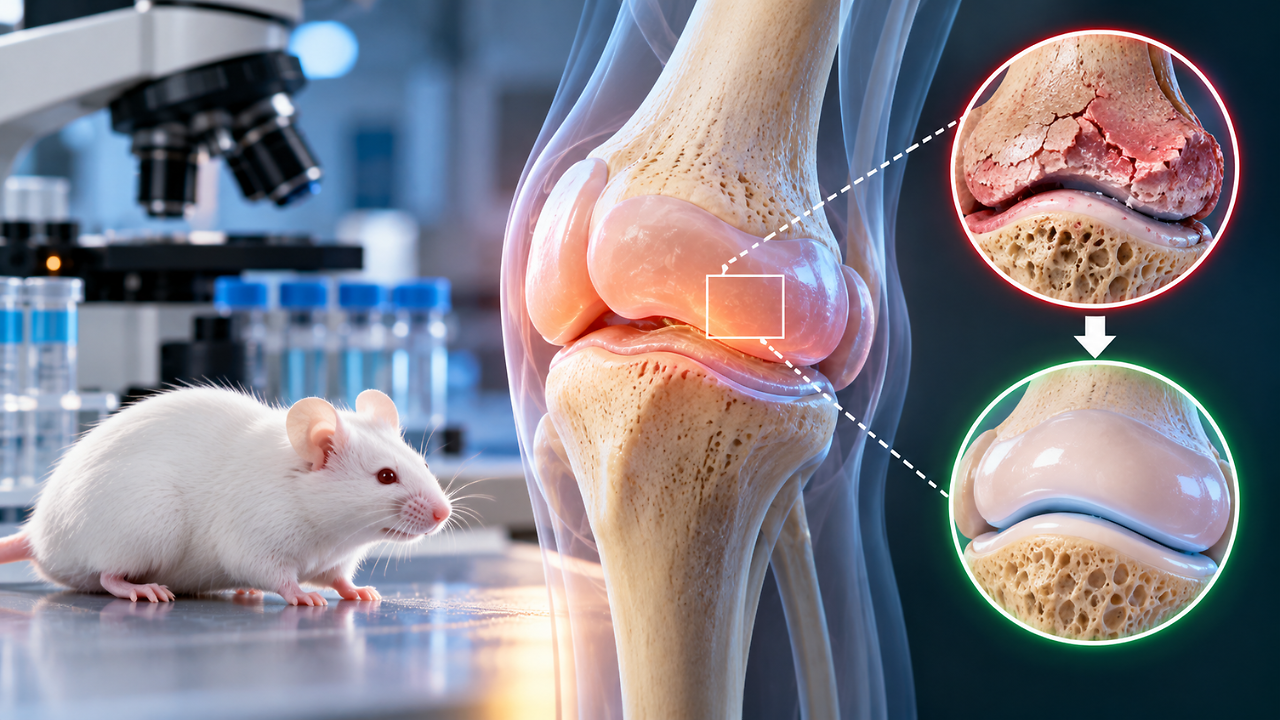
Damaged knee cartilage is often addressed with painkillers or knee replacement surgery. But scientists may have found a way to regenerate it by blocking a protein linked with ageing. The study has sparked hope for future treatments that could repair joints without painkillers or surgery. In a study by Stanford Medicine researchers, an experimental drug restored mice cartilage that had worn down with age. It also helped prevent osteoarthritis after knee injuries resembling anterior cruciate ligament (ACL) tears. Human cartilage samples exposed to the treatment also showed signs of regeneration in laboratory experiments. The findings offer a new strategy for treating osteoarthritis, a degenerative joint disease in which the protective tissue at the ends of bones gradually breaks down. However, it has not yet been proven and approved to regenerate cartilage in humans. How Did Scientists Regrow Knee Cartilage? The researchers focused on a protein called 15-PGDH, which increases with age and contributes to the loss of tissue function. The researchers describe it as a gerozyme, an enzyme linked with changes in the body related to ageing. The researchers found that levels of 15-PGDH in knee cartilage roughly doubled with age. Then they treated older mice with a small molecule that could inhibit the protein, administering it either throughout the body or directly into the knee joint. In both experiments, cartilage that had become thinner and barely functional grew thicker across the joint surface. Researchers also confirmed that the regenerated tissue was hyaline cartilage, the smooth, resilient type that is needed for normal joint function. “Cartilage regeneration to such an extent in aged mice took us by surprise,” Nidhi Bhutani, PhD, associate professor of orthopaedic surgery, and one of the authors said. “The effect was remarkable.” The researchers also found that the treatment changed the activity of existing cartilage cells, called chondrocytes. Rather than relying on stem cells to create new tissue, these cells shifted towards a more youthful pattern of gene activity associated with cartilage formation and maintenance. "This is a new way of regenerating adult tissue, and it has significant clinical promise for treating arthritis due to aging or injury,” said Helen Blau, professor of microbiology and immunology at Stanford Medicine. “We were looking for stem cells, but they are clearly not involved. It's very exciting."Also read: Joint Pain In Your 30s And 40s: When Should You Worry? Promise In Arthritis Prevention After A Knee Injury The researchers also tested the drug in mice with knee injuries similar to ACL tears. These injuries are common among those who play sports that involve stopping, jumping or changing direction suddenly. Those who suffer ACL tears are more likely at the risk of developing osteoarthritis years later. In the experiment, mice that received the inhibitor twice a week for four weeks after injury were much less likely to develop osteoarthritis. They also moved more normally and placed more weight on the injured leg. The findings are worth noting as repairing an injured ligament does not always prevent long-term cartilage damage. A treatment that protects cartilage after an injury could help reduce the risk of post-traumatic osteoarthritis. “Interestingly, prostaglandin E2 has been implicated in inflammation and pain,” Blau said. “But this research shows that, at normal biological levels, small increases in prostaglandin E2 can promote regeneration.”Also read: Lifestyle Modifications For Arthritis: A Guide For Health Care Providers Findings Related To Human Cartilage To investigate whether this might also work in people, the team treated cartilage samples collected from patients undergoing knee replacement surgery. After one week, the treated tissue showed changes in gene activity linked with reduced cartilage degradation and increased formation of healthy articular cartilage. The findings suggest that cartilage cells in people with osteoarthritis may still have some capacity for repair. “The mechanism is quite striking and really shifted our perspective about how tissue regeneration can occur,” Bhutani said. “It's clear that a large pool of already existing cells in cartilage are changing their gene expression patterns. And by targeting these cells for regeneration, we may have an opportunity to have a bigger overall impact clinically.” Impact In Osteoarthritis Treatment Osteoarthritis can cause persistent pain, stiffness and difficulty walking. Existing treatments simply aim to manage symptoms and preserve mobility through exercise, physiotherapy, medicines and, in severe cases, joint replacement. There is currently no established drug that reverses cartilage loss caused by osteoarthritis. A treatment that genuinely restores functional cartilage could therefore change how the disease is managed, allowing some patients to delay or avoid surgery. But these findings are an early step, not evidence that knee replacements can already be avoided. Researchers must ascertain safety and effectiveness in human clinical trials before the treatment can be considered.