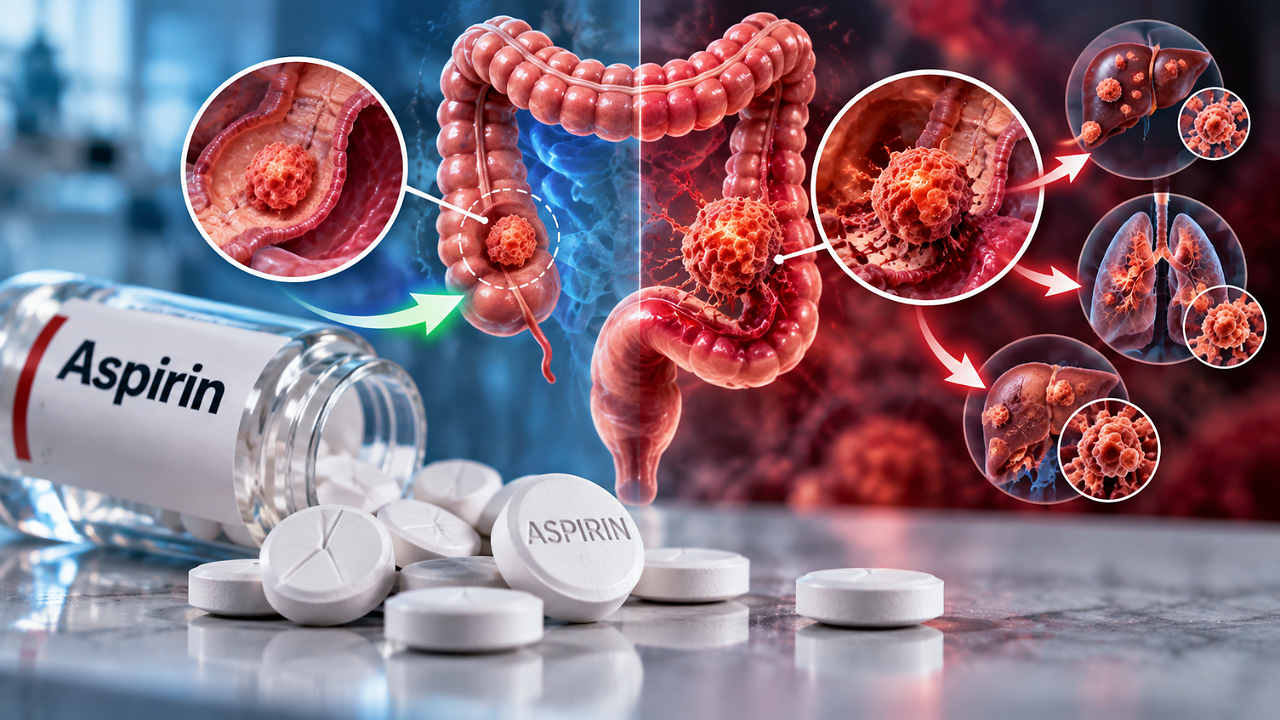
Aspirin has long been studied for its role in colorectal cancer prevention. But a new trial suggests that when aspirin is started may be of more importance compared to whether it is used at all.In the latest study, researchers discovered that aspirin did not prevent cancer recurrence or improve survival in people whose colorectal cancer had already spread to the liver.The study, published in The Lancet Gastroenterology & Hepatology, is based on 428 patients who were treated for colorectal cancer liver metastases at 14 hospitals across Norway, Sweden and Denmark. Participants were randomly assigned to receive either 160 mg of aspirin or a placebo every day for up to three years.Aspirin Did Not Help After Cancer Had SpreadAfter treatment for their liver metastases, patients taking aspirin did not have better results than others who took placebo.In fact, after three years, 76% of people in the aspirin group were alive compared to 85% in the placebo group. Researchers say that the overall survival was a secondary outcome. They also said that the trial was not designed to provide a definitive answer about that measure.Serious adverse events were also more common with aspirin, occurring in 8% of the aspirin group compared with 2% of the placebo group. Reported complications included heart attacks, nosebleeds, duodenal ulcers and cerebral haemorrhage.“Although aspirin has been shown to reduce recurrence rates in patients who have undergone surgery for a primary tumour in the colon or rectum, its effects still need to be evaluated in the specific patient group for which it is intended, in this case patients with colorectal cancer that has spread to the liver. We found no clear benefit in this group, while serious adverse events were more common,” said Ernesto Sparrelid, adjunct professor at Karolinska Institutet.Also read: Why Someone Days Away From Death May Start To See Loved Ones: End-Of-Life Doctor & Neurologist ExplainAspirin Works In Earlier-Stage CancerThe new findings contrast with results from the ALASCCA trial, which found that low-dose aspirin reduced colorectal cancer recurrence in patients whose tumours had alterations in genes related to PI3K.In that trial, the three-year recurrence rate was 7.7% with aspirin versus 14.1% with placebo among patients with specific PIK3CA alterations. This suggests that aspirin may not be a universal anti-cancer drug. Its benefit may largely depend on the biology of the tumour and how advanced the cancer stage is.“The anticancer effects of aspirin may depend on the biological and clinical context,” said co-principal investigator Kjetil Taskén of the University of Oslo.Another possible explanation is that aspirin's anti-inflammatory and anti-platelet effects may interfere with some of the biological processes involved in early tumour growth and recurrence. But once cancer has already spread, particularly to the liver, the biology becomes more complex.“Aspirin is a well-established, inexpensive and widely available drug, and there is considerable interest in whether it can also reduce the risk of cancer recurrence,” said lead author Sheraz Yaqub of the University of Oslo. “Our findings demonstrate why such treatments must be tested in rigorous randomized trials before being adopted for new patient populations.”Also read: Trump Says He ‘Psychologically’ Needs To Pop Aspirin Every Day: But Is It Actually Safe?Trump’s Recent Comments About Aspirin The findings come just days after President Donald Trump disclosed that he takes aspirin every day, adding that prefers a full-strength tablet.At an October 3 rally in Ohio, Trump said, “I take an aspirin a day. I don't know if it works, but psychologically I need it.” He also said doctors had wanted him to switch to a lower dose, but that he preferred the larger tablet.Trump's comments have reignited discussion about daily aspirin use, but they should not be interpreted as medical advice. Aspirin may reduce clot formation, but it can also increase the risk of serious bleeding. The American Heart Association says routine daily aspirin is generally not recommended for healthy adults without cardiovascular disease unless advised by a healthcare professional.And the new cancer findings add another reason not to assume that taking aspirin routinely will prevent cancer or improve outcomes after a diagnosis.