
- Health Conditions A-Z
- Health & Wellness
- Nutrition
- Fitness
- Health News
- Ayurveda
- Videos
- Medicine A-Z
- Parenting
Australia Issues Advisory Warning Travelers Of Counterfeit Rabies Vaccines Found In India
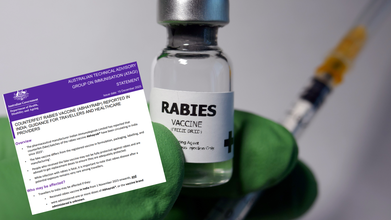
Credits: Canva and Australian Government, Department of Health, Disability and Ageing
Australia issued a health advisory warning travellers and healthcare providers about counterfeit batches of a rabies vaccine that have reportedly been circulating in India since November 1, 2023. The alert has raised concerns for anyone who may have received the vaccine while travelling or living in the country.
This Is What The Australian Advisory Says:
The warning was issued on December 22 by the Australian Technical Advisory Group on Immunisation. It flagged counterfeit batches of the rabies vaccine Abhayrab. While the vaccine is not supplied or used in Australia, the advisory notes that Australians or other travellers who were vaccinated in India could still be at risk.
The advisory clearly states that people who may have received the counterfeit vaccine might not be fully protected against rabies. As a precaution, it recommends that they receive replacement doses using a rabies vaccine that is registered and approved for use in Australia.
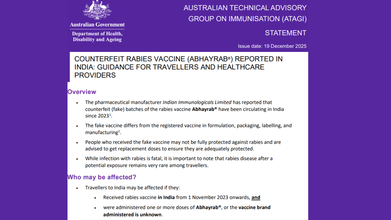
As it can be difficult to verify whether a dose was genuine or fake, the advisory takes a cautious approach. It says that anyone who received Abhayrab in India on or after November 1, 2023, should be considered as potentially having been given a counterfeit vaccine. Such individuals should be offered replacement doses as per Australian guidelines.
Why rabies protection is critical
Rabies is a viral zoonotic disease that attacks the central nervous system. In humans, it is most commonly transmitted through the bite of an infected dog. According to the World Health Organization (WHO), once rabies reaches the central nervous system and symptoms begin to appear, the disease is fatal in almost all cases.
India continues to bear a significant burden of the disease. WHO estimates suggest that rabies causes between 18,000 and 20,000 deaths every year in the country. India alone accounts for about 36 percent of rabies deaths globally, making effective vaccination and timely treatment especially critical.
Vaccine manufacturer responds
Abhayrab is manufactured by the Human Biologicals Institute, which is a division of Hyderabad-based Indian Immunologicals Limited. Responding to the advisory, the company said that it had proactively identified an issue in January related to a specific batch of the vaccine, as reported by Scroll.
According to the company, the issue involved Batch Number KA 24014, which was found in the marketplace with packaging that differed from the original. Indian Immunologicals Limited said it immediately informed Indian regulators and has been working closely with regulatory authorities and law enforcement agencies to address the issue. A formal complaint has also been lodged to support an investigation.
The company stressed that every batch of vaccine it produces is tested and released by the Central Drugs Laboratory under the Government of India before being made available for public use.
Broader concerns around medical quality
The advisory also comes at a time when India-made medical products have faced scrutiny abroad. In recent years, deaths allegedly linked to Indian-manufactured cough syrups were reported in countries like Gambia and Uzbekistan. Separately, Indian-made eye drops were suspected to be linked to infections in Sri Lanka.
Read: After Coldrif, WHO Bans 2 More Drugs, But This Is Not the Only Death from Indian Cough Syrup
Indian Immunologicals Limited, however, reiterated its commitment to safety and quality. It noted that Abhayrab has been manufactured since 2000, with over 210 million doses supplied in India and more than 40 countries. The company said the vaccine holds nearly 40 percent of the market share and assured healthcare professionals and the public that supplies made through authorized distributors are safe and meet quality standards.
PM Modi In Mann Ki Baat Highlights Growing Awareness Of Organ Donations In India
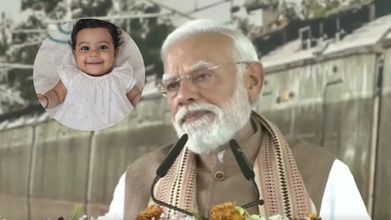
Credit: X
Prime Minister Narendra Modi, in his latest episode of Mann Ki Baat, highlighted the growing awareness of organ donations in India.
The Prime Minister lauded people who have undertaken such noble deeds.
According to the latest data from the Ministry of Health and Family Welfare, India has recorded a fourfold surge in organ transplants over the last decade. From less than five thousand in 2013, organ transplants in the country jumped to nearly 20 thousand in 2025.
“Awareness about organ donation is steadily rising in India these days. This is helping those who are in need of it. It is also strengthening medical research in the country. Many organizations and individuals are doing extraordinary work in this direction,” the PM said in the 131st episode of the monthly radio program.
The Prime Minister also paid tributes to 10-month-old Aalin Sherin Abraham, from Kerala, who lost her life in an accident but gave life to five people to become the youngest organ donor in the state.
“There is no greater sorrow for any parent than losing one’s own child. The pain of losing a very young child is deeper. Just a few days ago, we lost Aalin Sherin Abraham, a little innocent girl from Kerala. She left this world at the age of just 10 months.
PM Modi said even amidst "profound pain", Aalin's father, Arun Abraham, and mother, Sherin, decided to donate her organs.
"While on the one hand, they grieved the loss of their daughter, on the other, they were also filled with a spirit of helping others," PM Modi said.
“Aalin Sherin Abraham is no longer with us, but her name has joined the ranks of the nation's youngest organ donors,” he added.
He also mentioned the names of organ recipients -- Lakshmi Devi from Delhi, Gaurang Banerjee from West Bengal, and Ramdev Singh of Sikar, Rajasthan -- who, after receiving the transplants, got a second chance at life.
“You will come across many such inspiring examples. This proves once again that a single noble act can change the lives of countless people. I heartily commend all those who have undertaken such noble deeds,” the Prime Minister said.
Where Does India Stand In Terms Of Organ Transplants?
The National Organ and Tissue Transplant Organization (NOTTO) has recorded an unprecedented progress in organ donation, allocation, and transplantation across the country.
As per the Health Ministry, about 18 per cent of transplants are currently being performed with the organs donated from deceased donors.
In 2025 alone, more than 1,200 families came forward to donate organs of their loved ones after death. Each donor is now also a multiorgan donor, transforming the lives of many.
Since September 2023, more than 4.8 lakh citizens have registered to donate organs and tissues after death through an Aadhaar-based verification system.
Notably, India has also achieved competence in performing difficult organ transplants like the heart, lungs, and pancreas.
The country also leads the world in hand transplants and performs a greater number of hand transplants than any other country.
PM Modi In Mann Ki Baat Highlights Growing Awareness Of Organ Donations In India
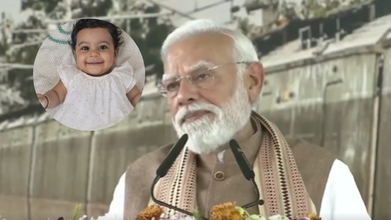
Credit: Canva
Prime Minister Narendra Modi, in his latest episode of Mann Ki Baat, highlighted the growing awareness of organ donations in India.
The Prime Minister lauded people who have undertaken such noble deeds.
According to the latest data from the Ministry of Health and Family Welfare, India has recorded a fourfold surge in organ transplants over the last decade. From less than five thousand in 2013, organ transplants in the country jumped to nearly 20 thousand in 2025.
“Awareness about organ donation is steadily rising in India these days. This is helping those who are in need of it. It is also strengthening medical research in the country. Many organizations and individuals are doing extraordinary work in this direction,” the PM said in the 131st episode of the monthly radio program.
The Prime Minister also paid tributes to 10-month-old Aalin Sherin Abraham, from Kerala, who lost her life in an accident but gave life to five people to become the youngest organ donor in the state.
“There is no greater sorrow for any parent than losing one’s own child. The pain of losing a very young child is deeper. Just a few days ago, we lost Aalin Sherin Abraham, a little innocent girl from Kerala. She left this world at the age of just 10 months.
PM Modi said even amidst "profound pain", Aalin's father, Arun Abraham, and mother, Sherin, decided to donate her organs.
"While on the one hand, they grieved the loss of their daughter, on the other, they were also filled with a spirit of helping others," PM Modi said.
“Aalin Sherin Abraham is no longer with us, but her name has joined the ranks of the nation's youngest organ donors,” he added.
He also mentioned the names of organ recipients -- Lakshmi Devi from Delhi, Gaurang Banerjee from West Bengal, and Ramdev Singh of Sikar, Rajasthan -- who, after receiving the transplants, got a second chance at life.
“You will come across many such inspiring examples. This proves once again that a single noble act can change the lives of countless people. I heartily commend all those who have undertaken such noble deeds,” the Prime Minister said.
Where Does India Stand In Terms Of Organ Transplants?
The National Organ and Tissue Transplant Organization (NOTTO) has recorded an unprecedented progress in organ donation, allocation, and transplantation across the country.
As per the Health Ministry, about 18 per cent of transplants are currently being performed with the organs donated from deceased donors.
In 2025 alone, more than 1,200 families came forward to donate organs of their loved ones after death. Each donor is now also a multiorgan donor, transforming the lives of many.
Since September 2023, more than 4.8 lakh citizens have registered to donate organs and tissues after death through an Aadhaar-based verification system.
Notably, India has also achieved competence in performing difficult organ transplants like the heart, lungs, and pancreas.
The country also leads the world in hand transplants and performs a greater number of hand transplants than any other country.
Zimbabwe Among the First African Countries to Roll Out Breakthrough HIV Injections
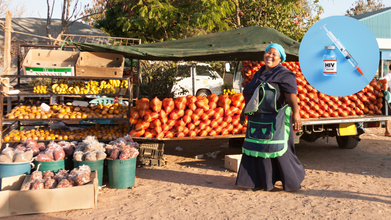
Representational Image (iStock and Canva)
Women, young ones and ones holding their babies, along with some men lined up on the outskirts of Zimbabwe's capital Harare for the injections of a new HIV prevention drug. The country launched it on Thursday. This drug needs to be administered only twice a year.
Why Is This Vaccine So Important For Zimbabwe?
Zimbabwe is a country where HIV led to tens of thousands of deaths in the last two decades. It is the first country to roll out lenacapavir, which is a long-acting drug that authorities have put their hopes on to slow down the HIV infection.
Also Read: Hangover Star Ken Jeong's Wife Beats Stage 3 Breast Cancer
What Is So Special About The HIV Injections?
Clinical studies have demonstrated near-total protection for the drug and has been described as a 'turning point' for high risk groups by many experts. However, many have warned that its broad impact would require overcoming funding constraints, infrastructure gaps and the challenge of keeping patients engaged.
Immunologist at Emory University Rama Rao Amara, calls it a "wonder drug". The drug, known as lenacapavir has been approved by the Food and Drug Administration (FDA) and is made by Gilead Sciences.
How Does This Drug Differ From Earlier HIV Prevention Drugs?
In 2021, FDA approved injectable form of PrEP medication called cabotegravir, however, this required patients to take it in every two months. This was also an intramuscular dose that healthcare providers were to administer into the buttocks.
What changes with lenacapavir is its easy administration. Each dose lasts longer compared to other medications and requires to be administered twice a year.
Read: 12.4 Lakh HIV Tests In Haryana Detect 5,877 Cases
The limitation with lenacapavir is its price tag of more than $28,000 per person per year. Carmen Pérez Casas, a senior strategy leader at Unitaid, a global health initiative based in Geneva, Switzerland said, "This is unaffordable. We need to get somewhere close to what previous options cost."
However, there is hope as the researchers published an analysis in The Lancet HIV that suggested generic versions of this drug could cost a person $25 per year.
Could This Drug Reshape HIV Prevention?
At the Zimbabwe launch, Constance Mukoloka, a sex worker, was among the first beneficiaries of this roll out which has happened by donor-support across 10 African countries, as reported by PBS News.
"I am safe, I can work with confidence now," said the 27-year-old sex worker. "When I took tablets, customers would see a container of pills and leave. They would never return due to fear," she said. "They couldn't tell the difference between PrEP and treatment drugs. With the work we do, that stigma costs you money."
Daily oral PrEP has been offered in Zimbabwe for years, along with condoms, vaginal rings and shorter-acting injections. However, sticking to the regimen has been difficult, especially for people dealing with stigma or irregular daily routines.
"I work in beer halls looking for clients. Sometimes I would get drunk and forget to take my drugs," Mukoloka said. "Sometimes I would work all night and not have time. Some clients refuse protection. They say ... 'Why should I use protection when I have paid?'"
- Follow Us :


© 2024 Bennett, Coleman & Company Limited