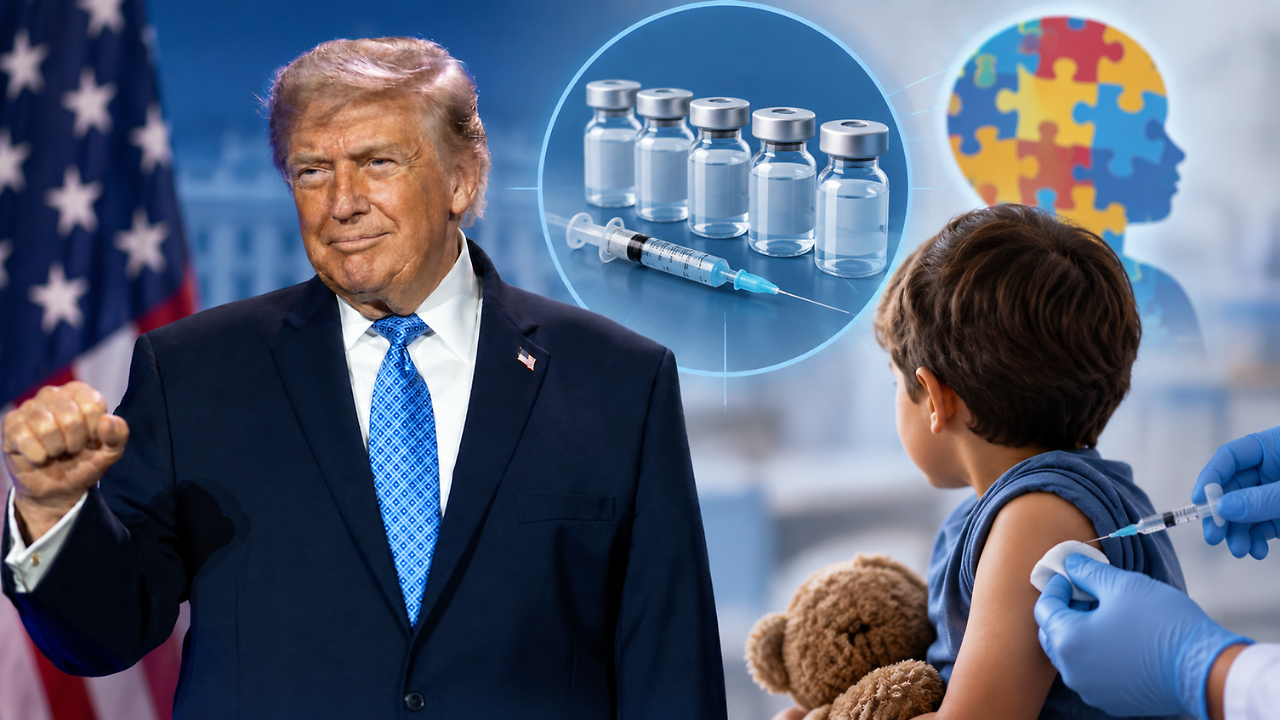
After US President Donald Trump’s executive order to split MMR into three shots came out in August, he put forth a proposal recently for some childhood vaccines to be divided into five doses. Trump recently said his administration plans to push vaccine makers to split some childhood vaccines into five separate shots, believing and claiming that giving smaller amounts at longer intervals could lead to a significant reduction in autism. Trump made the claims on September 18 but did not specify which vaccines he wants divided into five doses, nor did he provide scientific evidence linking vaccination schedules to autism. He said the doses would be given at six-month intervals. The proposal follows an executive order Trump signed in August, directing changes to federal childhood vaccine recommendations, including separating the combined measles, mumps and rubella (MMR) vaccine into three individual shots and administering them at separate visits. What Is Trump’s Proposal? Also read: Trump Nominates Dr Nicole Saphier As Third Surgeon General PickOn Friday, the President Trump said that his administration is planning to recommend that certain childhood immunizations should be separated into five shots, each with a “small amount of the vaccine.” He added that these doses would each be given six months apart. “Instead of a child going in and having a tremendous amount of different vaccines pumped into a big proportion of the body … we’re going to recommend that they do five doses marked one, two, three, four, five and that they be given in six-month intervals, so that a small amount of the vaccine gets pumped into the body,” Trump said. He also said he expects that this could lead to a “massive reduction in autism.” However, it remains unclear which childhood vaccines would be affected or how such a five-dose schedule would be implemented. HHS Secretary Robert F. Kennedy Jr., who was standing by Trump as he announced the vaccine changes, received a standing ovation Thursday at the conference of the anti-vaccine advocacy group Children’s Health Defense. He praised Trump’s embrace of vaccine skeptics, stating, “You have a strong and steadfast friend at the White House” and said that he would “stay in this fight.” Vaccine formulations and dosing schedules are established through clinical research and regulatory review. So, Trump’s proposal to divide an existing dose has sparked reactions. No Evidence That Vaccines Cause AutismAlso read: US Teen's Death Sparks Warning Over Synthetic Drug Deadlier Than FentanylDecades of research have not established that childhood vaccines cause autism. The CDC's current vaccine-safety information says multiple studies have found no link between MMR vaccination and autism. In August, Trump signed an executive order to change the federal government’s approach toward childhood vaccines, insisting that infants should receive fewer immunizations over a longer period. He advised that the measles-mumps-rubella (MMR) vaccine be separated into three individual shots, despite little to no scientific evidence. Research also proves that there is no published scientific evidence showing a benefit from separating the combined MMR vaccine into three individual shots. However, the CDC's current website reflects the Trump administration's position, stating it has not definitively ruled out every possible relationship between infant vaccines and autism. It also says that HHS is funding further research into biological mechanisms. The strongest available evidence for MMR specifically continues to show no association with autism, according to the CDC's cited evidence reviews. Would Splitting Vaccines Make Them Safer? There is currently no evidence that splitting combination vaccines into smaller doses prevents autism. The CDC also says there is no published scientific evidence that separating MMR vaccine into individual measles, mumps and rubella vaccines provides a safety benefit. Experts have also questioned the idea that simply dividing a vaccine dose would change its safety profile. José Romero, a former senior CDC official, told The Washington Post that vaccines are formulated in a way, so the total dose produces the intended immune response. Dr. Paul Offit, director of the Vaccine Education Center at the Children’s Hospital of Philadelphia told CNN that Trump’s plan would render vaccines ineffective and wouldn’t make them safer necessarily. Offit said, “When you create a vaccine, you do a dose response curve, and you’re trying to give the least amount of vaccine that induces an immune response that’s protective. So, you don’t want to give too much, where you know you don’t need all that, and you don’t want to give too little, where it’s you know sub-immunogenic.” He added, “What he’s suggesting would not work. He’s basically saying he wants to give vaccines in a manner in which they wouldn’t be protective.”