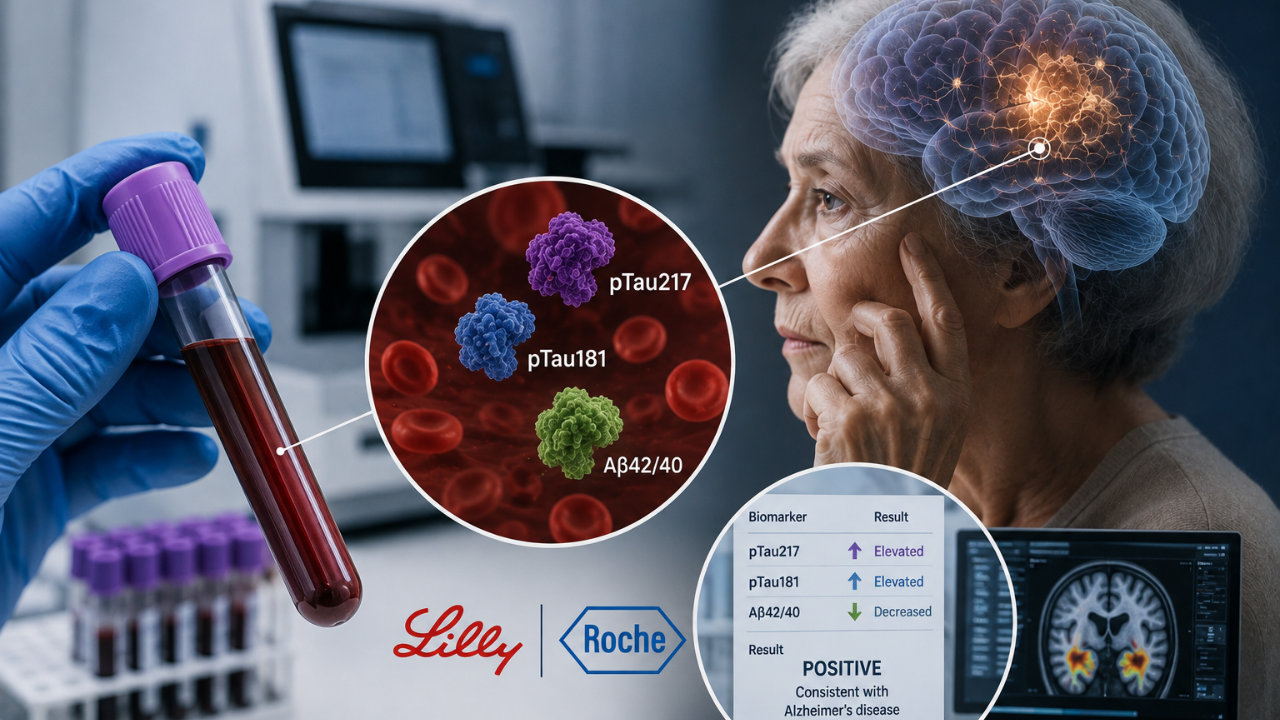
The US Food and Drug Administration (FDA) has approved a new blood test developed by Roche in collaboration with Eli Lilly that can help identify changes in the brain due to Alzheimer’s in people facing cognitive decline.Called Elecsys pTau217, the test is meant for adults aged 55 and older who have signs and symptoms of cognitive decline. Roche said it is the first FDA-cleared single-biomarker blood test that can both help rule in and rule out amyloid pathology associated with Alzheimer’s disease. The Test Identifies A Key Alzheimer’s BiomarkerElecsys pTau217 measures phosphorylated tau 217 (pTau217) in blood. Tau is a protein involved in the structure of nerve cells. In Alzheimer’s disease, abnormal tau changes occur alongside the accumulation of amyloid-beta plaques in the brain. Elevated pTau217 in blood is associated with the presence of Alzheimer’s-related amyloid pathology. The test categorises results as positive, intermediate or negative, indicating the likelihood of amyloid pathology. An intermediate result may require additional testing. Could A Blood Test Replace Brain Scans?The test could make the initial assessment of Alzheimer’s disease significantly easier as it needs just a blood sample, unlike amyloid PET scans or cerebrospinal fluid testing through a lumbar puncture.Roche said the test is designed to help clinicians decide which patients may need further evaluation, including PET imaging or CSF testing. It is not intended to be used as a stand-alone diagnosis. Dr Jared R. Brosch, a neurologist at Indiana University Health, said traditional methods can be “costly, invasive and not readily accessible” and that blood biomarkers could expand access to Alzheimer’s evaluation. He said, "For decades, clinicians have faced significant challenges in accurately diagnosing Alzheimer's disease in its early stages. While PET imaging and cerebrospinal fluid biomarkers can confirm amyloid pathology in patients with cognitive impairment, these approaches may be costly, invasive and not readily accessible for many patients." Adding further, he said, "Advances in blood-based biomarkers have the potential to transform the diagnostic pathway by expanding access to evaluation for Alzheimer's across a variety of care settings. As these tools become available, clinicians may be able to evaluate more patients earlier in the disease course, improving diagnostic confidence and helping patients and their families make more informed decisions at a critical time."Also read: Bruce Willis’ Wife Emma Opens Up On ‘Wrestling’ With Guilt Over 50th BirthdayA Significant Milestone In Alzheimer's TestingAlzheimer’s diagnosis can be a lengthy and invasive process, particularly because confirming amyloid pathology has traditionally required specialised testing.Roche said the new test can run on its existing laboratory infrastructure, with more than 4,500 Roche cobas instruments already installed across US clinical laboratories. Lab including Quest Diagnostics and Labcorp are expected to make the test available. Roche Diagnostics North America President and CEO Dan Malarek said, "FDA clearance of Elecsys pTau217 marks an important milestone in Alzheimer's disease diagnosis and underscores Roche's continued leadership in advancing innovative solutions that can help patients get answers sooner."He added, "As the first and only FDA-cleared, single-biomarker blood test supporting both rule-in and rule-out assessment of amyloid pathology, Elecsys pTau217 has the potential to transform how Alzheimer's is assessed across primary and specialty care. This kind of innovation can help bring diagnostic evaluation closer to patients and give clinicians greater confidence in determining the right step in their care."Also read: Want to Avoid Dementia? Start These 3 Habits In Your Late 40s, Study SuggestsLilly Neuroscience President Carole Ho, MD, said a timely diagnosis is an important step for families dealing with the uncertainty of Alzheimer’s disease. Carole said, "For millions of families navigating the uncertainty of Alzheimer's disease, a timely diagnosis is the first and most critical step toward meaningful care." She added, "Lilly's collaboration with Roche on Elecsys pTau217 was driven by a shared commitment to bringing one blood test into both primary care, where most patients with cognitive complaints are first seen, and specialty care, helping close the gap between symptoms and answers." Limitations Of The Test A positive result does not simply mean that a person has dementia. The test assesses the likelihood of amyloid pathology associated with Alzheimer’s disease. Cognitive symptoms can have several causes, and doctors still need to consider a person's medical history, symptoms, cognitive testing and other investigations.