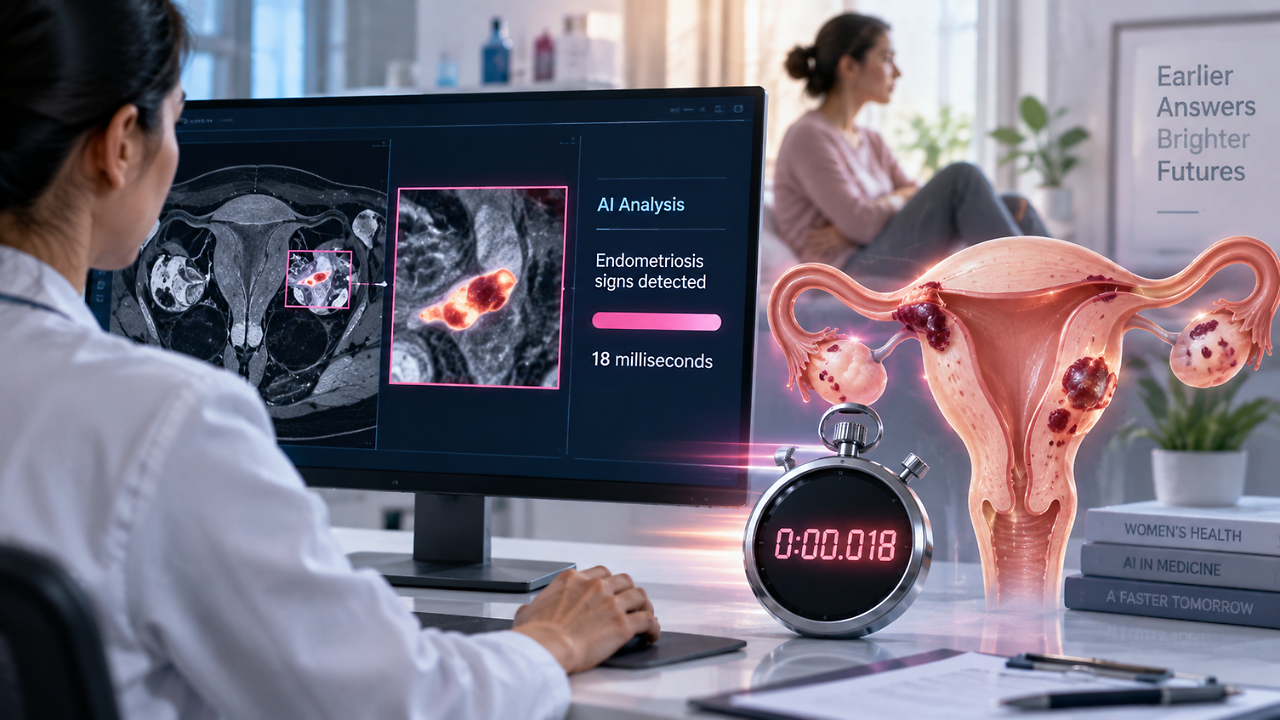
Endometriosis does not usually present with typical symptoms. Due to this, getting a diagnosis can take years. This may change soon as a team of Australian researchers recently developed an artificial intelligence tool that can identify two major imaging signs of advanced endometriosis in just 18 milliseconds. Called EndoFusion, the tool was developed by researchers at Adelaide University as part of the IMAGENDO research programme. The findings were published in Artificial Intelligence in Medicine. The 18-millisecond figure refers to how quickly the AI analyses a scan and produces its assessment. It does not mean that a woman can currently walk into a clinic and receive a confirmed diagnosis in 18 milliseconds. The technology is still in development and requires further testing before it can become part of routine clinical diagnosis. Endometriosis May Take Years To Diagnose Endometriosis occurs when tissue similar to the lining of the uterus grows outside the uterus, commonly affecting areas such as the ovaries and fallopian tubes. It can cause severe period pain, pelvic pain, heavy bleeding, fatigue, pain during sex and difficulty becoming pregnant. Diagnosis is challenging as symptoms can vary, and some women have little or no visible symptoms on conventional imaging. Research has consistently found substantial diagnostic delays. A systematic review found delays ranging from months to as long as 12 years. In Australia, women reportedly wait an average of around six and a half years for a diagnosis, according to Endometriosis Australia.Also read: 22-Year-Old Frozen Embryo Produced A Healthy Baby: Does An Embryo Have An Expiry Date?More About The AI Tool Work EndoFusion was trained using four datasets containing more than 9,000 pelvic MRI scans and over 800 transvaginal ultrasound scans as they can identify different signs of endometriosis effectively. A patient who receives only one type of scan may therefore have some symptoms of the disease missed. Associate Professor Jodie Avery of Adelaide University's Robinson Research Institute said, “Current scanning methods each have their own strengths when it comes to detecting two common markers that indicate the likelihood of endometriosis and patients will often only have access to one of them.” She added, “This means that some patients could be disadvantaged if they are scanned by the less optimal option for their particular signs. Some of the imaging tools also rely on operator experience and can be costly.” In its early evaluation, EndoFusion correctly distinguished positive and negative cases 83% of the time, performing better than the other AI models researchers compared it with. Lead author Dr Yuan Zhang said, “This is a positive step forward and moves us closer to a future where an AI tool can help clinicians to provide a faster, more accurate diagnosis without the need for surgery.” However, 83% accuracy is not enough to replace clinical diagnosis. The researchers say the next step is to expand the dataset and incorporate additional markers of endometriosis to improve classification accuracy.Also read: HHS Cancels Maternal & Infant Health Grants To Focus On Sperm Testing And ED: Here's WhyCould It Reduce The Need For Surgery? Endometriosis diagnosis has historically relied heavily on imaging and, in some cases, laparoscopy, in which a camera is inserted through a small abdominal incision to look for lesions. A reliable non-invasive tool could help doctors identify women who need specialist assessment sooner and potentially reduce unnecessary invasive investigations. As Avery said, “The development of accurate, non-invasive early diagnostic methods is critical to shorten the diagnostic timeline and reduce associated costs.”