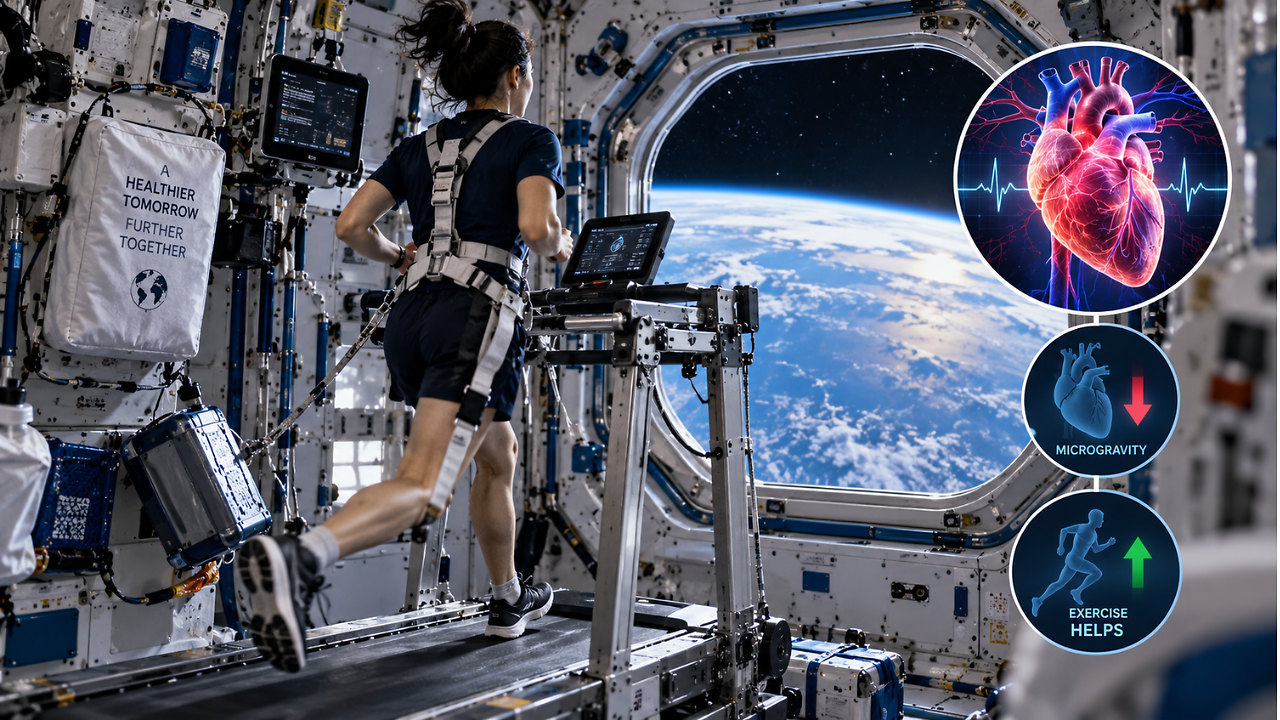
Physical fitness isn’t the only reason why astronauts exercise in space. Their daily workouts are a medical necessity meant to protect the heart, muscles and bones from the effects of microgravity. New research based on 13 astronauts suggests that this strategy may be working. Echocardiograms taken during six-month missions showed that the astronauts experienced mild changes in heart structure and function after entering microgravity, but these changes stabilised during the mission and returned to normal after they came back to Earth. The findings were published in Circulation. The results are particularly important as space agencies prepare for longer missions, including journeys to Mars. What Does Zero Gravity Do To The Heart? On Earth, gravity constantly pulls blood and other body fluids towards the lower half of the body. In microgravity, that pull largely remains absent. As a result, fluids shift towards the chest and head. The cardiovascular system initially receives more blood than it is accustomed to handling, but over time the body adapts by reducing blood volume. The heart also does not have to work against Earth's gravitational shift in the same way. NASA says this can reduce cardiovascular function and contribute to problems like low blood pressure and dizziness when astronauts return to Earth. Longer missions can make these changes more concerning. NASA notes that cardiovascular deconditioning can begin within days of entering a low-gravity environment.Also read: Obesity Should Not Be Defined Solely By BMI: AIIMS Director Explains Fat Distribution & Metabolic Health Astronauts Exercise For Around 2 Hours A DayAstronauts aboard the International Space Station use a treadmill, stationary bicycle and resistance-training equipment. NASA says crew members currently average around two hours of exercise per day, while another NASA health-care overview schedules astronauts for about 2.5 hours of daily exercise, including time for preparation and recovery. The goal is not simply to burn calories. Aerobic exercise helps maintain cardiovascular fitness, while resistance training provides mechanical loading that the body no longer receives naturally from Earth's gravity. NASA describes exercise as a vital practice for maintaining astronaut health and performance in low to zero gravity.Also read: Are Gaming Chairs Actually Bad For Your Back? Why Cushioning, Posture And Long Sitting Matter What Did The New Study Find? The researchers went beyond measuring astronauts' heart rate and blood pressure. The crew members were trained to perform their own echocardiograms, allowing researchers on Earth to remotely guide them through ultrasound imaging of the heart while they were in space. The scans showed that the heart adapted to microgravity, but the changes did not continue worsening throughout the six-month missions. After returning to Earth, the astronauts' cardiac structure and function returned to their earlier state. Benjamin Levine, NASA cardiologist, said the findings were “really reassuring” for future Mars missions. He noted that when astronauts were exposed to simulated Martian gravity, equal to three-eighths of Earth's gravity, none showed a cardiovascular response more stressed than standing upright on Earth before the mission. Essential For Longer Space Missions A Mars mission would be far longer than a typical six-month stay aboard the ISS. A planned mission could involve roughly six months travelling to Mars, an extended stay followed by another six-month journey home. The heart therefore cannot simply rely on the possibility of recovering after returning to Earth. Levine said future spacecraft will need exercise equipment capable of preserving “the entire spectrum of human adaptation to physical activity”, including the heart, skeletal muscles, bones, and even mental health.