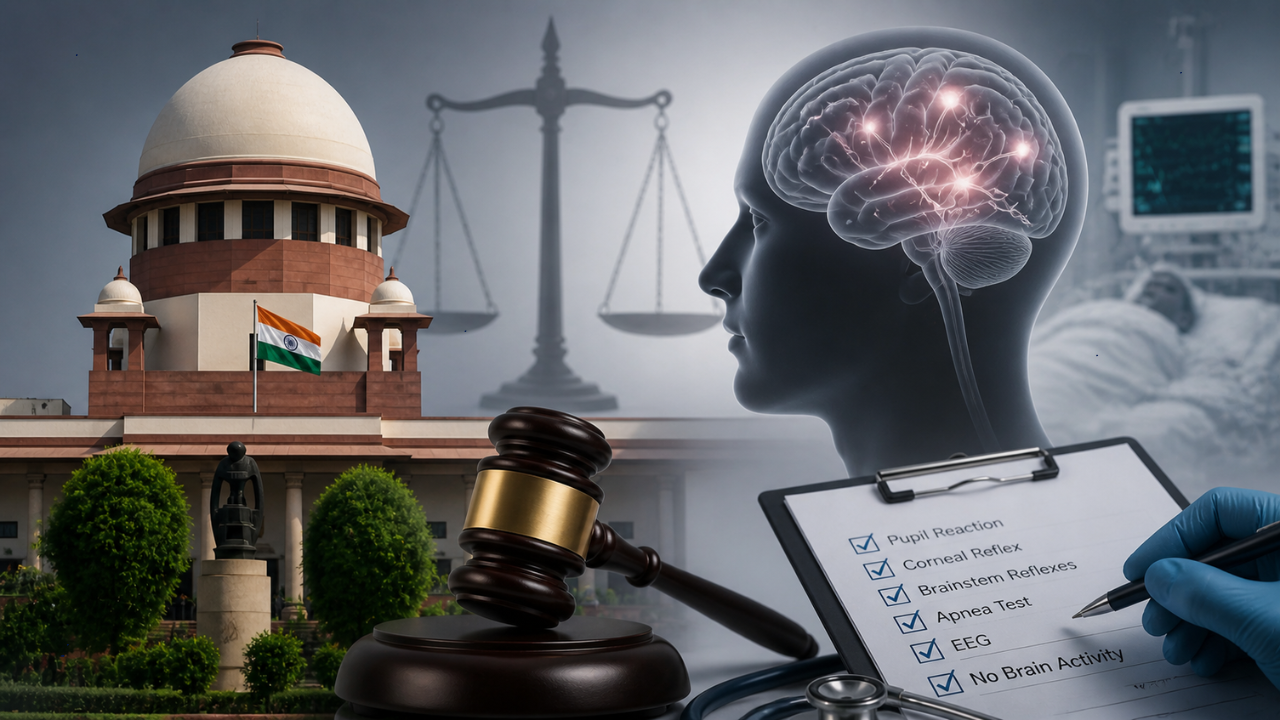
The Supreme Court of India has urged the All India Institute of Medical Sciences (AIIMS) to set up an expert panel to examine how brain death is certified in India. The apex Court has sought to know whether additional tests, such as electroencephalogram (EEG) and angiogram, are needed to declare a person brain dead. A bench of Justices Vikram Nath and Sandeep Mehta was hearing a petition filed by Kerala-based medic and activist S Ganapathy, alleging malpractices in brain death certification, Times of India reported. Ganapathy alleged that patients who may not be brain dead are sometimes declared so to facilitate organ donation. The petition also questioned the reliability of the apnea test—the standard method used to confirm brain death—calling it subjective and claiming that the legal requirement of video graphing the procedure is often not followed. What is Brain Death? Brain death, technically referred to as brain-stem death, is the irreversible end of all brain activity. In India, according to the Transplantation of Human Organs (THO) Act, 1994 (Subsection 6 of Section 3), 'brain stem death' refers to the stage at which all functions of the brain stem have permanently and irreversibly ceased. This is to be certified by a 'Board of Medical Experts' consisting of:(1) The medical superintendent (MS)/In-Charge of the hospital in which 'brain stem' death has occurred, (2) a specialist, (3) a neurologist or a neurosurgeon nominated by the MS, from a panel approved by the Appropriate Authority, and the doctor under whose care the 'brain- stem' death has occurred. Amendments in the THO Act 2011 have allowed the selection of a surgeon/physician and an anesthetist, if an approved neurosurgeon or neurologist is unavailable. “Brain stem death has to be certified by a panel of four independent doctors, including a neurologist or neurosurgeon, and confirmed twice with a minimum gap of six hours. The process is carried out with due diligence and seriousness,” Dr Manjari Tripathi, head of neurology at AIIMS, was quoted as saying. “While the guidelines require the team of doctors to meet and declare brain death at least twice, we end up doing it sometimes three times for the patients. The current guidelines require various bedside tests for the declaration of brain death. It does not specify the need for tests such as an EEG or angiogram,” added Dr. Tripathi. Experts said additional tests could add to the system burden. EEG is not routinely recommended for brainstem death certification, while an angiogram is used only in select cases where the apnea test cannot be performed. Globally, the apnea test remains the gold standard. These criteria are clearly laid down and cannot be altered, said experts. Challenges To Brain Death Certification In India The Indian Express reported that the lack of knowledge even among physicians is a significant challenge in India. This leads to several patients never being officially declared and asked to be organ donors. An AIIMS-led study, published in the journal Neurology India last year, found that more than half the doctors — including neurosurgeons, neurologists, and critical care specialists who are most commonly included in the certification process — did not receive any training on brain death certification at the time of their graduation.