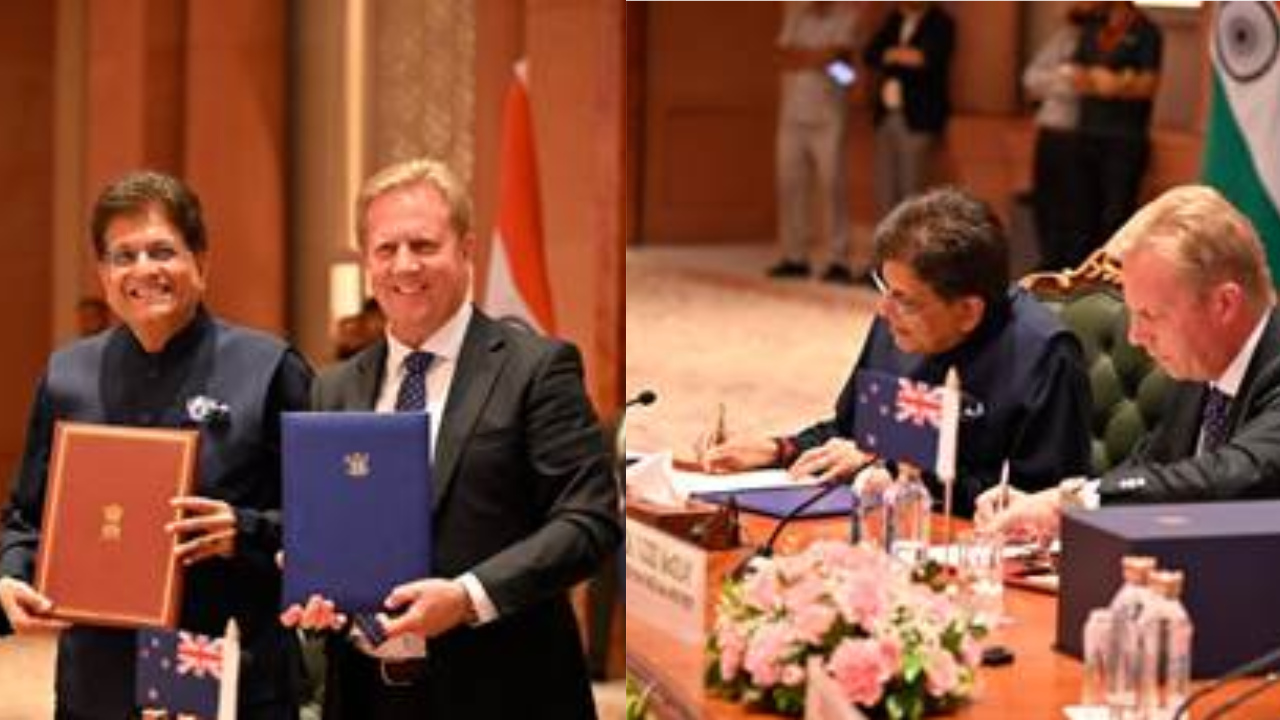
In a landmark deal, India and New Zealand today signed the India- New Zealand Free Trade Agreement (IN- NZ FTA).The Agreement was signed by Union Minister of Commerce and Industry Piyush Goyal and New Zealand’s Minister for Trade and Investment Todd McClay at Bharat Mandapam, New Delhi.The FTA will not only strengthen India’s global economic partnerships but also boost strategic opportunities for the medical devices sector, as well as the country's traditional medicine sector.In a post on social media platform X, Prime Minister Narendra Modi highlighted the agreement’s "role in promoting traditional knowledge systems, including AYUSH, yoga and organic products, positioning them for greater global relevance". "The FTA broadens its scope to agriculture productivity, organics, services, mobility, Ayush, and pharma access, making the opportunities all-inclusive and future-oriented," added Commerce Secretary Rajesh Agrawal.What The FTA Brings To IndiaFor the first time, New Zealand has facilitated trade in Ayurveda, yoga, and other traditional medicine services with India. This landmark provision promotes the global recognition of India’s AYUSH systems, supports medical value travel, and encourages collaboration in wellness services, according to an official statement.It also reinforces India’s position as a global hub for health, wellness, and traditional medicine services. It gives centre stage to India’s AYUSH disciplines (Ayurveda, Yoga & Naturopathy, Unani, Sowa-Rigpa, Siddha, and Homeopathy) alongside Maori Health practices. In a major breakthrough, the FTA streamlines access for pharmaceuticals and medical devices by enabling acceptance of GMP and GCP inspection reports from comparable regulators, including approvals by the US FDA, EMA, UK MHRA, Health Canada, and other comparable regulators."These will reduce duplicative inspections, lower compliance costs, and expedite product approvals, thereby facilitating smoother market access and supporting growth of India’s pharmaceutical and medical devices exports to New Zealand," it added. What Are The Industry Leaders Saying?The experts hailed the India–New Zealand FTA, calling it a strategic opportunity for the medical devices sector."For the healthcare and MedTech sector, the agreement is particularly consequential. A dedicated annex on pharmaceuticals and medical devices creates expedited regulatory pathways, with New Zealand agreeing to recognize GMP and GCP inspection reports from the US FDA, the EU’s EMA, and the UK’s MHRA—reducing duplicative compliance burdens and accelerating product approvals for Indian manufacturers," said Pavan Choudary, Chairman, Medical Technology Association of India (MTaI), in a statement."A separate annex on health services and traditional medicine opens structured avenues for medical value travel, digital health, and evidence-based AYUSH, positioning India not merely as a goods exporter, but as a global wellness and healthcare services hub," he added.Rajiv Nath, Forum Coordinator, Association of Indian Medical Devices Industry (AiMeD), also welcomed the India-New Zealand FTA and said that the reduced tariffs and streamlined regulatory cooperation will boost exports. It will also "enable technology partnerships, and support affordable access to quality devices. The pact enhances competitiveness for Indian manufacturers while ensuring resilient supply chains and mutual recognition standards, strengthening India’s position as a global MedTech hub," Nath added.However, Choudary cited that there is a significant gap. He cited that the FTA’s regulatory recognition framework does not yet include India’s Central Drugs Standard Control Organization (CDSCO). "As India’s pharmaceutical and MedTech industry grows in scale, quality, and global reach, the CDSCO is rapidly maturing into a credible, reference-class regulator. Its inclusion in such bilateral recognition frameworks is not a diplomatic nicety; it is a commercial and strategic imperative. Future trade agreements, and indeed revisions to this one, must correct this omission," the expert said.