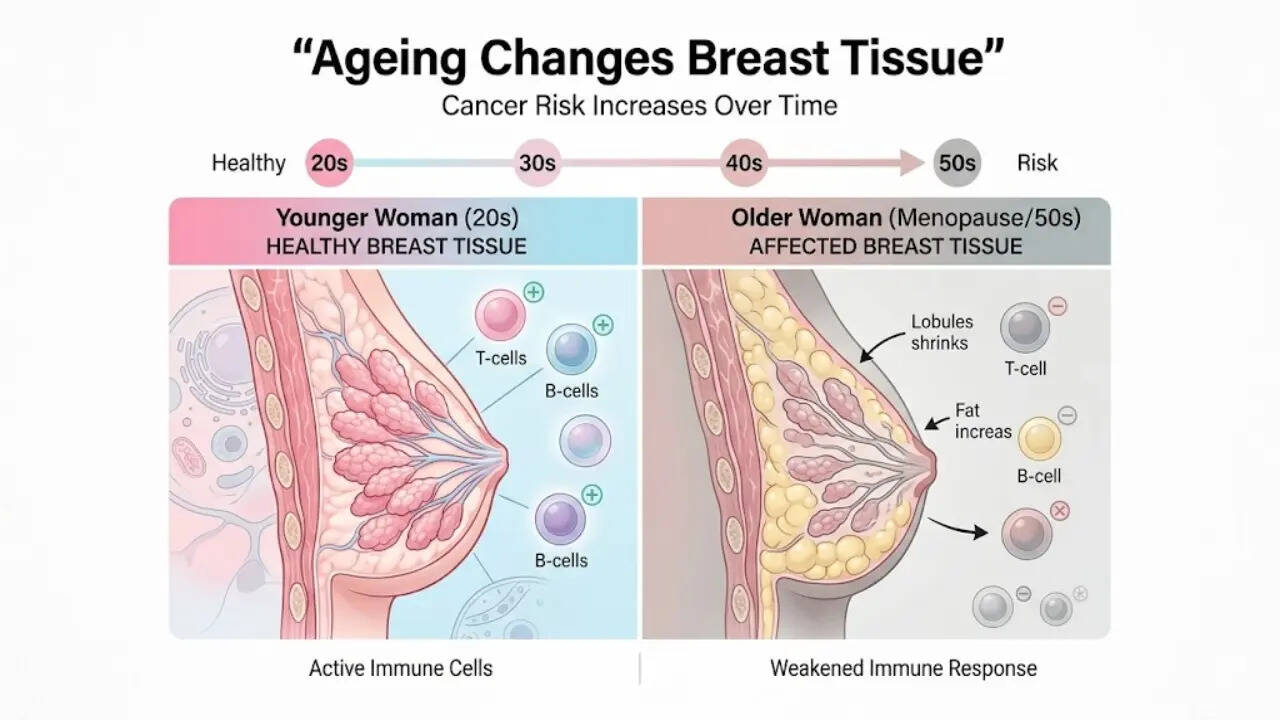
Breast cancer is the most common type of cancer reported among women living in metropolitan India. And while the causes have largely been genetic or linked to family history, a new study says that a woman's breast tissue undergoes dramatic changes with age, creating an environment where cancer cells are more likely to flourish. Researchers at the University of Cambridge in the UK and the University of British Columbia in Canada mapped how breast tissue changes over time. Comprising over three million cells, the map tracks how breast tissue undergoes changes in women as they age. It was found that the most striking shift occurs around menopause.How does age influence breast changes in women?Researchers found that as women age, their breast tissue undergoes changes. During the 20s, these changes can be attributed to pregnancy and childbirth. However, the major and most dramatic changes occur around menopause. With age, the number of cells in breast tissue declines. As a result, the structure of the tissue also changes. This creates favourable conditions in which cancer cells can thrive and survive more easily, thereby explaining why breast cancer risk increases with age.Researchers also identified a cluster of cell types in the breast tissue. As per the American Cancer Society, 320,000 women in the US might be diagnosed with breast cancer this year, making it the most common type of tumour in women. Breast cancer rates are also rising in younger women for unclear reasons, but most cases are still diagnosed in women aged 50 years and above. Age is an important risk factor for nearly all types of cancer. Researchers say that this is partly because people accumulate genetic mutations in their cells with age. As a result, abnormal cells spread uncontrollably and develop into tumours.Why is age a risk factor for breast cancer?Experts say that despite the rising incidence of breast cancer, it is not well understood how breast tissue changes with age and contributes to cancer risk. To investigate this, experts analysed normal breast tissue samples from 527 women aged 15–86 years who were undergoing breast reduction surgery. Using advanced imaging, experts mapped individual cells in a two-dimensional representation of how breast tissue changes over time.The map also found that breast tissue divides less often with age, and the number of immune cells declines. The number of epithelial cells that line the milk-producing structures and mammary ducts also declines with age. However, the scale of changes across the breast is surprising.Why does breast structure change with age?Researchers found that the structure of breast tissue also changes with age. The milk-producing lobules shrink, blood vessels decrease, and fat cells increase. Stromal and immune cells also move away from epithelial cells, thereby making it easier for cancer cells to spread and escape. Younger breasts also have relatively more immune cells, known as active T-cells and B-cells, that can identify and destroy tumour cells before they multiply.Older breasts have fewer cancer-fighting cells and immune cells that other studies implicate in cancer development. These changes create an inflammatory environment in which the immune system is less able to hold back cancer cells and is more permissive of carcinogenesis. However, it is unclear why certain types of cells change.The age when breast cancer risk peaksResearchers found that ageing peaks in the late 40s, corresponding to menopause. After this, depending on how quickly the breast tissue ages, one could be more prone to breast cancer risk. The study, however, did not analyse genetics and other breast cancer-influencing risk factors. Previous studies suggest that normal breast tissue in women with genetic risk factors in place ages faster than in others.The research was published in the Nature Aging journal.