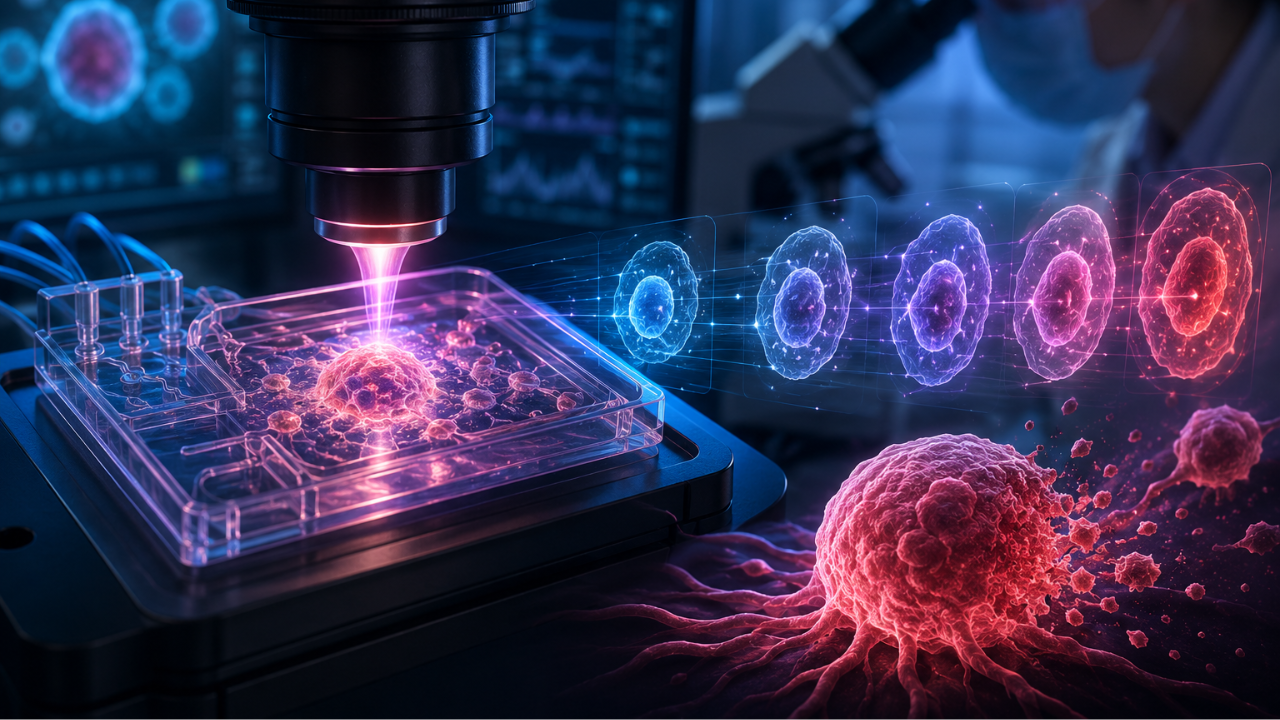
Cancer drug research may undergo a significant shift as scientists are not just studying what happens to a cell after treatment, but watch the process unfold in real time. Indian-origin biotech entrepreneur Parmita Mishra is developing a live-cell technology that combines Raman spectroscopy, photonics, microfluidics and computational biology to continuously monitor living cells without fluorescent labels or destructive sample preparation. The approach, described by the researchers as “live-cell cinema,” aims to address a longstanding problem in drug discovery: conventional laboratory techniques often provide snapshots of cellular behaviour rather than a continuous picture of how cells respond to treatment and other changes. Mishra said, "Biology is constantly moving, yet for decades we have largely studied it through static snapshots. If we want to understand why cancer cells change, adapt or resist therapy, we need technologies that allow us to observe living biology continuously rather than after the fact. Our mission is to give researchers that capability." Why This Could Be Game Changing In Cancer Drug Research? Cancer cells may initially respond to a drug, adapt to the treatment and eventually become resistant to the drug. Traditional experiments require cells to be fixed, stained, lysed or otherwise destroyed before researchers analyse them. Even studies that examine multiple time points may rely on different populations of cells at each stage of the research. A recent Drug Discovery News report highlighted research that cancer cells can move through intermediate molecular states as they develop treatment resistance, suggesting that important biological changes may occur before resistance becomes obvious. The idea behind live-cell examination is therefore simple: if biology changes continuously, why should scientists only measure it at the end? Also read: Lung Health After 40: Natural Changes, Warning Signs And Ways To Protect Your LungsHow Does The Technology Work? Raman spectroscopy analyses how light interacts with molecules, producing chemical information without necessarily requiring dyes or labels. Its system combines this optical technology with microfluidic chips that maintain cells under controlled conditions, including temperature, nutrients and carbon dioxide. This allows researchers to observe the same living cells as their biology changes. Mishra said that artificial intelligence can process enormous amounts of information, but its utility in drug discovery depends on having better biological data to learn from. Also read: Tudriqev: US FDA Approves Replimune's Skin Cancer Drug After Rejecting It TwiceHow Could This Impact Cancer Drug Discovery? Drug development in cancer has a notoriously high failure rate. Research has estimated that around 90% of clinical drug development fails due to lack of efficacy and safety. By capturing biochemical changes continuously, technologies such as live-cell Raman imaging could potentially help researchers identify drug responses, toxicity or resistance earlier during preclinical testing.Dr. Shyam Aggarwal , Chairperson, Department of Medical Oncology at Sir Ganga Ram Hospital, New Delhi said “Real-time observation technologies could help researchers better understand how cells respond to candidate drugs, monitor subtle biochemical changes earlier, and potentially identify promising therapies more efficiently during preclinical research. Understanding precision oncology with CGP comprehensive genome profiling and MRD minimal residual disease detection will help physicians improve targeted personised medicine for cancer patients. While such technologies are not themselves treatments, they may strengthen the scientific foundation on which future therapies are developed.” For cancer research, that window could eventually help scientists understand not only whether a drug works, but how a living cancer cell changes while the drug is working. Mishra further added "We are not trying to replace scientists or physicians—we are trying to give them a better window into living biology," "When researchers can continuously measure how cells behave instead of relying on biological 'autopsies,' they may uncover insights that were previously impossible to observe. That has implications far beyond cancer, extending into immunology, neuroscience, rare diseases and regenerative medicine. "For decades, we've been studying life after it has stopped.The future of biomedical research lies in understanding life while it is still unfolding."However, the technology is still being developed and requires independent validation before its potential impact on drug discovery can be established.Dr Rahul Bhargava, Principal Director of Hematology and Bone Marrow Transplant, Fortis Memorial Research Institute, Gurugram said “Cancer is an extraordinarily dynamic disease, and researchers around the world are exploring technologies that can better capture how living cells change over time. Innovations that enable continuous, non-invasive observation of cellular behavior could become valuable research tools for improving disease models and accelerating drug discovery. While clinical validation remains essential, this represents an exciting direction for biomedical science."