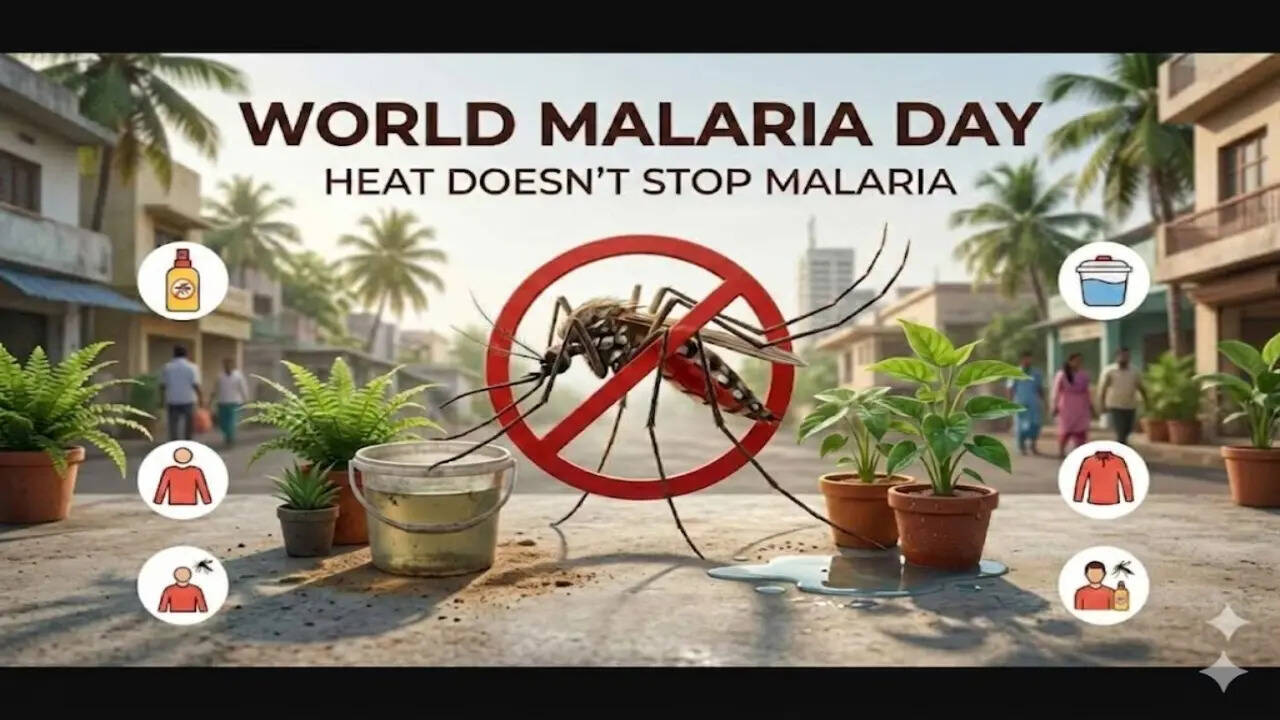
World Malaria Day is observed on April 25 every year to raise awareness of the infection, its causes, symptoms, and prevention strategies. At a time when the heatwave is at its most severe, many fall victim to the misconception that rising temperatures could mitigate infection risk. However, according to Dr Anil Ballani, Consulting Physician in Internal Medicine at Lilavati Hospital and Research Centre, this is just a myth.What is malaria?Malaria is a disease transmitted by mosquitoes, mainly female Anopheles mosquitoes, which transmit parasites of the genus Plasmodium. The term ‘malaria’ is derived from the Italian words “ma laria”, which translates to ‘bad air’. Malaria remains one of the major health problems in India, even though the incidence rate has been brought down from 33 million to 3.2 million in the last three decades.Is malaria only a monsoon concern?On World Malaria Day, Dr Ballani explained that, contrary to popular belief, malaria is not just a concern during the monsoon season. Unfortunately, it can occur in summer as well. It is well known that malaria incidence is highest during the rainy season due to stagnant water. However, surprisingly, there is also a surge in malaria cases during the summer season. The hot days of summer act as a precursor, as the warm temperature accelerates mosquito breeding. Also, people tend to store water in drums and buckets during the summer due to shortages, and these serve as perfect breeding grounds for mosquitoes.High temperatures in summer accelerate the mosquito life cycle and maturation, resulting in increased multiplication of larvae. High humidity and high temperatures in summer create ideal conditions for the mosquito life cycle. Faster maturation of the parasite in the mosquito leads to the rapid spread of malaria. Consequently, the risk of malaria transmission also increases. There is often poor vector control prior to the monsoon, as fumigation usually starts after the monsoon sets in.What makes children vulnerable to malaria?Schools are closed during the summer, and children venture out more to play. People spend more time in gardens and parks during the early hours of the day and in the evenings due to cooler temperatures, and all this increases their risk of exposure to mosquito bites. Many people travel to their hometowns and villages during holidays when schools are closed, where the incidence of malaria is higher. Due to warm weather, people avoid wearing full sleeves and long clothing, resulting in greater exposure of the arms and legs and increasing the risk of mosquito bites. All these are precursors to a high incidence of malaria in the summer months.Can malaria diagnosis be delayed?On World Malaria Day, Dr Ballani answered an important question - can malaria diagnosis be delayed? The expert said that sometimes doctors may delay the diagnosis of malaria because of low suspicion during the summer months. Hence, for proper diagnosis, doctors must maintain a high index of suspicion even during summer months and remain vigilant throughout the year. India aims to eliminate malaria by the year 2030, as guided by the National Framework for Malaria Elimination (NFME), and measures such as maintaining a high index of suspicion will go a long way in making this a reality.