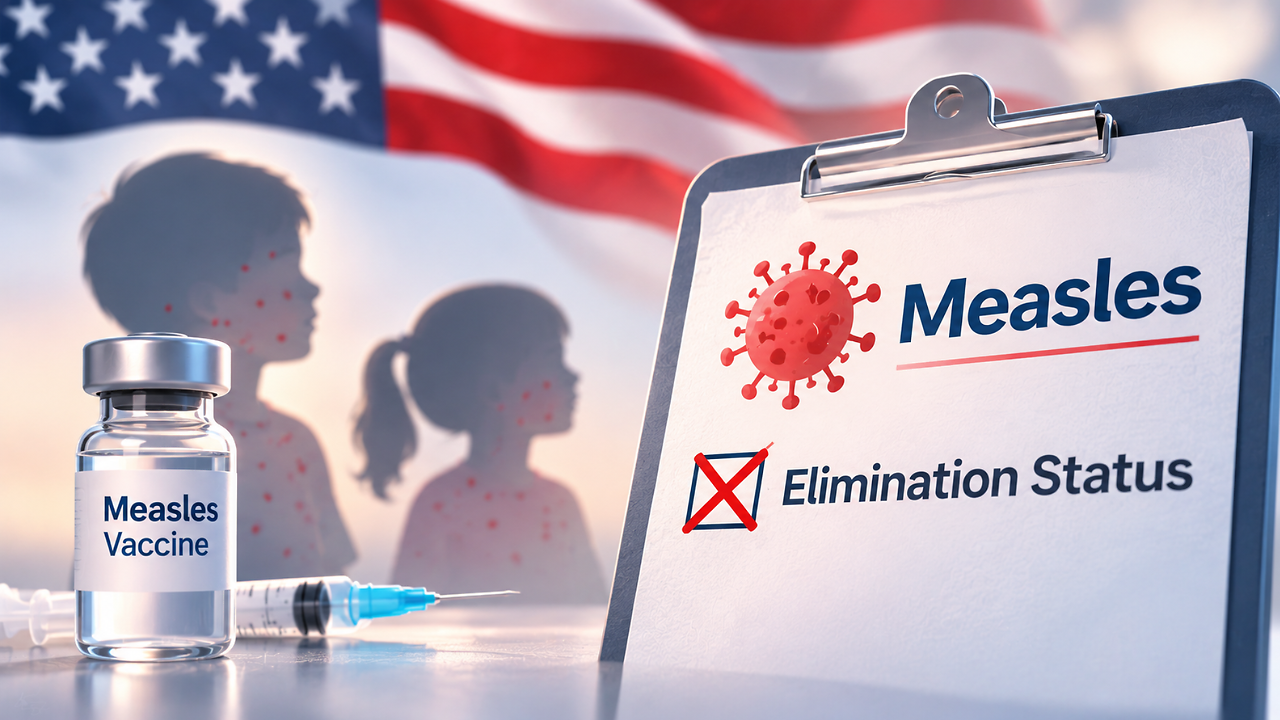
The United States has lost its measles elimination status after more than a year of sustained transmission, marking a major setback for a public health achievement the country obtained in 2000. The decision by the Pan American Health Organization (PAHO) comes after a sharp rise in infections as the US reported more than 5,400 measles cases in 2026. PAHO is expected to formally announce the decision on November 17.According to the US Centers for Disease Control and Prevention (CDC), the country had recorded 5,412 cases as of November 15, resulting in more than 590 hospitalisations and at least six deaths. Some states have reported additional fatalities. Cases have been confirmed in 45 states and Washington, DC. The United States had maintained its measles elimination status for more than 25 years. However, outbreaks that began in 2025 continued spreading into 2026. Approximately one-third of this year's cases were linked to those ongoing outbreaks.What Does Losing Measles Elimination Status Mean?Also read: US Set To Lose Measles-Elimination Status After 26 Years: Prof Devi Sridhar Explains Reasons Behind ResurgenceMeasles elimination does not mean a country has no cases of the disease. It means that local transmission has been interrupted and that occasional outbreaks do not lead to sustained community spread.Under the World Health Organization's definition, a country loses elimination status when it cannot stop continuous local transmission for at least 12 months.The United States first achieved measles elimination status in 2000, after decades of vaccination efforts dramatically reduced infections. Imported cases and smaller outbreaks still occurred, but public-health measures and vaccination coverage helped contain them.The current situation is different because the virus has continued circulating through communities for more than a year, creating ongoing chains of transmission.CBS News medical correspondent Dr Céline Gounder explained the implications, "It means that we're at risk of being exposed to measles and getting measles if we're not vaccinated," Gounder said. "It means ERs and pediatricians need to consider measles in anyone with a fever and rash, whether they've traveled overseas or not. And we may now become an exporter of measles to other countries." Measles Cases Are Rising In The USAlso read: US Measles Cases Cross 5,000 For First Time Since 1991; Country Risks Losing Elimination StatusDeclining childhood vaccination coverage has left more communities vulnerable to outbreaks. Measles is among the most contagious infectious diseases, and the virus can spread rapidly when it enters populations with gaps in immunity.According to CDC data, 96% of people infected in 2026 were either unvaccinated or had an unknown vaccination status. Only 2% of reported cases were among people who were fully vaccinated.The country recorded 2,242 cases in 2025, its highest annual total in more than three decades at the time. The number has more than doubled in 2026.Pennsylvania has reported the largest outbreak, with more than 1,500 cases and seven deaths this year. Wisconsin has reported two child deaths, while New York recorded its first measles death in more than 30 years. How Can US Regain Measles Elimination Status? People who have not received the measles vaccine are at the greatest risk of infection. However, infants who are too young to be vaccinated, pregnant women and people with weakened immune systems are the most vulnerable.Measles can cause complications like pneumonia and encephalitis or inflammation of the brain. In some cases, it can lead to permanent neurological complications, hearing loss and death.Children who have not received the recommended doses of the measles, mumps and rubella (MMR) vaccine are especially vulnerable.The CDC recommends two doses of the MMR vaccine. According to the public health experts, two doses are approximately 97% effective against measles. Losing elimination status does not mean the country cannot regain it. However, sustained efforts to interrupt transmission will be necessary.PAHO recommends maintaining measles vaccination coverage of at least 95%, alongside strong disease surveillance, laboratory testing and rapid outbreak response. Dr Omer Awan, an epidemiologist and public health contributor for Forbes, explained the importance of vaccination. "It's frustrating and heartbreaking ... because we have the tools to fight this. The tool is the MMR vaccine, which we know is 97% effective at preventing the onset of measles," Awan said.