
- Health Conditions A-Z
- Health & Wellness
- Nutrition
- Fitness
- Health News
- Ayurveda
- Videos
- Medicine A-Z
- Parenting
AIIMS Doctor Calls Zomato CEO’s ‘Temple’ Device Unscientific, Says It Offers No Proven Health Benefits
Credits: X
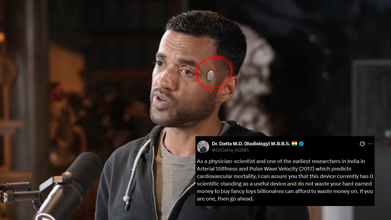
Zomato CEO Deepinder Goyal was seen using a "Temple" device during a podcast. A small metallic device which was placed on the CEO's head. While this drew a lot of trolls and jokes on the internet, for what looked like "chewing gum", and some said "charging pads", here's what Goyal said about it.
What Is The "Temple" Device?
Goyal was seen wearing this silver-colored device on one side of his head during a Raj Shamani podcast called Figuring Out. He claimed that this device measures blood flow in the brain in real time. The experimental health-tech device, as he claimed, is used to measure cerebral blood flow or CBF, in a similar manner as miniaturized MRI.
Also Read: Indore Water Contamination Leaves A Woman With Guillain-Barré Syndrome, What Is It?
The blood flow in brain is essential to survive and CBF usually remains unchanged or declines minimally during aging. This is not the first time Goyal was seen wearing this Temple. In fact, last November, he said he had been wearing this for a year.
At that time he said, "“While conducting research on the Gravity Ageing Hypothesis, we had to make an experimental device to calculate Brain Flow accurately, in real-time, and continuously. Been using it for a year, and I’ve been feeling that this could shape into an important wearable the world needs."
He also announced $25 million, which in INR is equivalent to 225.7 crore funds to research in human aging and biological health. His health and wellness project, Continue Research, is also looking into the reasons of aging.
What Are Experts Saying About This "Temple" Device?
While Goyal claims that it measures blood flow to the brain, experts say otherwise. Dr Suvrankar Datta, who is a radiologist with clinical training from AIIMS, Delhi, said that the device is unscientific.
“As a physician-scientist and one of the earliest researchers in India in Arterial Stiffness and Pulse Wave Velocity (2017) which predicts cardiovascular mortality, I can assure you that this device currently has 0 scientific standing as a useful device,” Dr Datta wrote on X.
He also asked people to not "waste" their hard earned money to buy "fancy toys billionaires can afford to waste money on".
Neurosurgeon Dr Vishwanathan Iyer from Mumbai’s Zynova Shalby Hospital, who spoke to NDTV said that the place where the device sits is a red flag it self, as a senior on the temple can only capture surface level signals.
“Such devices are designed to pick up surface-level signals, but they do not directly measure brain blood flow like an MRI,” he said. He also added that MRI scans are complex hospital-based tests and cannot be replaced by a small wearable gadget.
He also highlighted that wearing a device is not same as measuring real brain activity or circulation. The doctor explained that while such sensors could record indirect indicators like pulse or skin changes, they should not be confused with actual cerebral circulation.
He also seconded with Dr Iyer and said that there is not enough clinical evidence to support its use and more research on Temple is required. Until then, it should be seen strictly as a wellness experiment and not a medical device. “People should be careful before spending money on them, especially if they are expecting medical benefits,” he said.
Doctors Issue New Alert For Popular Weight-Loss Jabs Semaglutide And Tirzepatide

Credits: Canva
People using injectable weight loss drugs may need long-term medical and lifestyle support, researchers have warned, after a large study found that weight is regained far more quickly than with traditional diet and exercise plans. Scientists at the University of Oxford found that people taking medications such as semaglutide (Wegovy) and tirzepatide (Mounjaro) lose weight while on treatment, but typically regain it within around 20 months after stopping the injections.
The study also showed that improvements in blood sugar control, cholesterol levels, and blood pressure fade once the drugs are discontinued, leaving patients back at their original health markers. By comparison, people who lose weight through structured diet and exercise programmes tend to maintain the loss for longer, close to four years on average, although most eventually regain weight as well.
Health Gains Reverse After Treatment Ends
The findings come alongside separate research from University College London and the University of Cambridge, which suggests that people prescribed newer weight loss drugs could face risks such as nutrient deficiencies and loss of muscle mass. Under current NHS rules, Wegovy can only be prescribed for up to two years, while Mounjaro has no set time limit.
Most people using these medications pay for them privately, due to strict NHS eligibility criteria. Research indicates that around half stop treatment, often because of cost, side effects, or because they feel they have reached their target weight.
The Oxford analysis, published in the British Medical Journal, reviewed 37 studies involving more than 9,000 participants. On average, people stayed on medication for 10 months and were followed up for eight months after treatment ended.
Across all weight loss drugs, participants lost an average of 8.3 kg during treatment, but regained 4.8 kg within a year, returning to their starting weight within about 1.7 years. Those taking Wegovy or Mounjaro lost nearly 15 kg, but regained around 10 kg in the first year after stopping. Based on projections from one year of data, full weight regain occurred within roughly 1.5 years. Measures linked to heart and metabolic health, including blood glucose and cholesterol, also returned to baseline within about 1.4 years.
Experts Say Obesity Requires Ongoing Care
Professor Susan Jebb, professor of diet and population health at the University of Oxford and an adviser to ministers and the NHS on obesity, said the findings were clear. “What we’ve shown is that weight regain after medication is common and happens quickly. The benefits for blood sugar and cholesterol closely track weight changes, so when weight comes back, those benefits disappear too.”
She noted that weight regained after medication happens almost four times faster than after behaviour-based programmes, regardless of how much weight was initially lost. Professor Jebb said long-term solutions may be necessary, whether through ongoing medication, behavioural support, or a combination of both.
“Obesity is a chronic, relapsing condition,” she said. “It’s reasonable to expect that treatment may need to continue for life, much like medicines for high blood pressure. We should think of this as long-term treatment for a long-term condition.”
She added that combining diet and exercise programmes with drug treatment helps people lose more weight initially. However, once medication stops and appetite returns, those strategies alone often fail to prevent regain. In contrast, people in behavioural programmes without drugs may practice these habits more consistently, which could explain why weight regain is slower.
Professor Jebb said it is clear that some form of ongoing intervention is needed if the benefits of weight loss drugs are to last. Some patients try tapering doses or using medication intermittently, while others rely on lifestyle support alone, but she said evidence on what works best remains limited.
Sam West, a postdoctoral researcher at the University of Oxford and co-author of the study, said: “People on medication lose more weight than those in behavioural programmes, but they regain it about four times faster.”
The researchers also questioned whether long-term drug treatment is cost-effective for the NHS. They concluded that since obesity is a long-term, relapsing condition, extended use of weight management medications may be needed to maintain health benefits.
Concerns Over Nutrition and Muscle Loss
Separate findings published in Obesity Reviews highlighted gaps in nutritional guidance for people taking semaglutide and tirzepatide. Dr Marie Spreckley from the University of Cambridge said many patients receive little structured advice on diet quality, protein intake, or micronutrient needs, despite significant appetite suppression.
“If nutritional care isn’t built into treatment,” she said, “there’s a real risk of trading one health problem for another, through avoidable nutrient deficiencies and unnecessary muscle loss.”
An NHS spokesperson said that while these drugs are a valuable addition to weight loss treatment, they are not a quick fix. “They must be combined with lifestyle and behavioural support, including advice on healthy eating and physical activity, to help people maintain weight loss over time,” the spokesperson said.
COVID Symptoms 2026: Study Maps Common Symptom Patterns Seen In Long COVID Patients

Credits: Canva
Long COVID should be viewed as a web of overlapping symptoms rather than a single, uniform condition, according to a new systematic review published in eClinicalMedicine and reported by the Center for Infectious Disease Research and Policy (CIDRAP). The review highlights several recurring symptom patterns linked to long COVID, including neurological, respiratory, smell and taste-related, cardiopulmonary, and fatigue-driven clusters.
Researchers led by a team from Lanzhou University in Gansu, China, examined data from 64 studies conducted across 20 countries, covering nearly 2.4 million people. They grouped long COVID patients into subtypes using different approaches: symptom overlap in 30 studies, affected organ systems in 16 studies, symptom severity in nine, clinical markers in three, and other classification methods in the remaining research.
COVID Symptoms 2026: Fatigue Emerges As The Most Common Symptom
Among studies that focused on how symptoms appear together, fatigue stood out as the most consistently reported issue. It often occurred alone or alongside problems such as muscle and joint pain, brain fog, or breathlessness. Other symptom pairings that appeared frequently included loss of smell and taste, anxiety with depression, and various forms of musculoskeletal pain.
When researchers classified patients based on affected organ systems, respiratory problems were the most widespread, seen in about 47% of long COVID patients. Neurological symptoms followed at 31%, while gastrointestinal issues were reported by 28%. The authors stressed that these percentages reflect how often these clusters appeared within long COVID cases studied, not how common they are in the general population.
A smaller number of studies sorted patients by how severe their symptoms were, dividing them into mild, moderate, or severe categories using symptom scores, symptom counts, or quality-of-life measures. Three studies used clinical indicators for classification, including abnormal triglyceride levels and signs of restricted lung function on imaging.
COVID Symptoms 2026: Women Report Fatigue More Often
The review also found that long COVID subtypes vary based on demographic, socioeconomic, and medical factors. Women were more likely to report fatigue and neuropsychiatric symptoms, while men more commonly experienced respiratory issues. Older adults tended to show higher rates of respiratory, cardio-renal, and ear, nose, and throat symptoms.
Racial and ethnic differences also emerged. Black and Hispanic individuals were more likely to experience respiratory, cardiac, and neuropsychiatric symptoms, whereas White patients showed higher rates of fatigue and musculoskeletal complaints.
COVID-19 variants appeared to influence symptom patterns as well. The researchers noted that the Alpha variant was closely linked to smell-related and respiratory symptoms, while the Delta variant raised the risk of ENT-related problems. In addition, higher body mass index, socioeconomic disadvantage, and existing conditions such as chronic obstructive pulmonary disease were strongly associated with cardiopulmonary symptom clusters and a heavier overall long COVID burden.
Overall, the findings reinforce that long COVID rarely affects just one system in the body. Instead, it tends to involve multiple overlapping symptom groups, pointing to the need for more tailored, patient-specific care.
The authors call for future studies to focus on creating standardized ways to classify long COVID, identifying the biological mechanisms behind different symptom clusters, and testing targeted treatments for specific subtypes. They note that this approach will be essential for moving toward precision medicine and improving outcomes for people living with long COVID.
Measles Cases Hit Record Highs In The US: When Are Infected People Most Contagious?

Credits: Canva
Measles is one of the most infectious illnesses known, and as case numbers rise across the United States, health experts warn the country is close to losing its measles elimination status. The current surge marks the highest number of measles cases recorded since the disease was officially eliminated in the U.S. in 2000. In 2025 alone, more than 2,100 cases have been reported nationwide. Texas has emerged as the hardest-hit state, accounting for roughly two out of every five confirmed infections. So just how easily does measles spread?
Measles Cases Increase In The US
As of January 8, a total of 2,065 measles cases had been confirmed across the country, according to the latest figures from the U.S. Centers for Disease Control and Prevention (CDC). The last time the U.S. recorded a higher annual total was in 1992, before the routine recommendation of two doses of the measles-mumps-rubella (MMR) vaccine for children, CNN reported.
Several major outbreaks remain active, including one in upstate South Carolina and another along the Arizona-Utah border. These clusters have renewed fears that the U.S. could lose its measles elimination status, which it has maintained for more than two decades. While measles spreads easily, vaccination remains highly effective. One dose of the MMR vaccine offers about 93% protection, and two doses increase effectiveness to 97%, according to the CDC.
What Is Measles?
Measles, also known as rubeola, is a highly contagious viral illness that typically causes fever, cough, a runny nose, red and watery eyes, and a distinctive red, blotchy rash that usually begins on the face and spreads downward. The virus spreads through the air when an infected person coughs or sneezes and can lead to serious complications such as pneumonia or brain inflammation. Despite its severity, measles is preventable through a safe and effective vaccine, as per the Mayo Clinic.
How Contagious Is Measles?
Measles is among the most contagious diseases in the world. The virus spreads through airborne droplets that can linger in the air or on surfaces for hours. Up to 90% of unvaccinated people who are exposed to measles will become infected. A single infected person can pass the virus to an estimated 12 to 18 others through close contact or shared spaces. People can transmit the virus days before symptoms become obvious and continue spreading it after the rash appears, according to the World Health Organization.
How Long Is Someone Contagious With Measles?
Someone infected with measles can spread the virus from four days before the rash develops to four days after it appears. The virus spreads so efficiently that about 90% of people who are unvaccinated or have never had measles will become infected after being exposed.
In November, Canada lost its measles elimination status following a significant outbreak, according to the Pan American Health Organization, which works closely with the World Health Organization.
“It’s important to say that all the other 34 countries in the region, they keep their certification as measles-free,” said PAHO/WHO Director Dr. Jarbas Barbosa at the time, as per NPR News.
U.S. health officials have also warned that genetic links between outbreaks in different states suggest continued spread.
“The trajectory that we’re looking at now is that we do anticipate more cases well into January,” Bell said. “What that means for us nationally in terms of how they are defining our designation in this country as having eliminated measles is unclear.”
- Follow Us :


© 2024 Bennett, Coleman & Company Limited