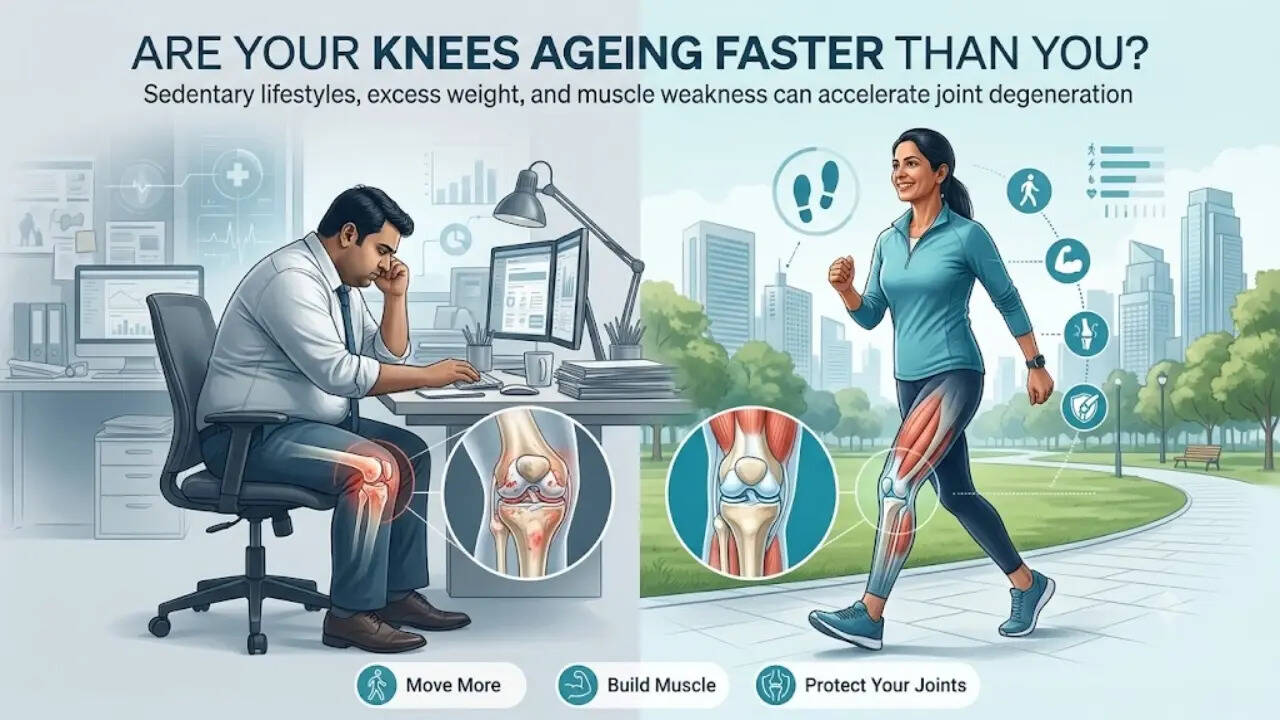
India has a physical inactivity problem that is contributing to a growing burden of joint and musculoskeletal disorders among its working-age population. Close to half of Indian adults were insufficiently active in 2022, according to a Lancet study, and among women, that figure climbed to 57%. Behind those numbers is a generation whose muscles have quietly stopped supporting their joints and whose weight has quietly started punishing them for it.Also Read: Can A Heatwave Affect The IVF Process In A Lab? Why do Indians struggle with weak, ageing knees?In an interview with Health and Me, Dr Deepak Gautam, Sr. Consultant Orthopaedic & Robotic Joint Replacement Surgeon, Apollo Hospitals, Navi Mumbai, explained how a patient's knees can start ageing faster than their actual biological age. Young Indians broadly assume joint problems are inherited with age. Clinical practice keeps demonstrating that they are earned much earlier, through years of small daily choices that never feel consequential until they are. The best time to address this is before a patient ever needs to describe where it hurts.The knee absorbs roughly four times a person's body weight with every step. Add excess weight over several years, and that force erodes cartilage far ahead of schedule. Obesity also drives systemic inflammation through the release of molecules from fat tissue, which attack joint cells independently of any mechanical load. Patients frequently describe their pain as having an insidious onset and, at times, being sudden. Clinically, joint degeneration develops gradually over many years before symptoms become apparent.Read more: Feeling Weak In Your Knees? Here Are Tips To Maintain Them As You AgeWhat are the consequences of weak knees? Muscle weakness makes that threshold arrive sooner. The quadriceps and core do the work of absorbing shock and stabilising the joint under load. Sedentary work strips that capacity away gradually, and screen time beyond three hours a day has been directly linked to weight gain and metabolic deterioration. For a large portion of India's urban workforce, three hours of daily screen exposure is where the morning starts.None of this stays contained to the joints. Around one in five Indian adults is already managing several chronic conditions at once, and 45.4% of Indians with coronary heart disease remain physically inactive. Musculoskeletal decline and cardiovascular disease tend to share the same lifestyle roots and reinforce each other. Globally, inactivity rates are still climbing and are expected to reach 35% by 2030, up from 31% in 2022.When should you take action? Once cartilage degeneration starts, it is very difficult to reverse the process. We can, however, retard the progression of the disease or prevent it from occurring in the first place. That single fact should change how people think about when to seek help. By the time climbing stairs or a regular walk in the market or garden becomes painful, the window for conservative management has already narrowed. Waiting for symptoms is the wrong strategy. People with sedentary work patterns, weight above the healthy range, or significant screen exposure should have their joint mobility, gait, and muscle strength assessed before pain enters the picture at all. Resistance training twice a week, clinician-guided weight management, and dietary changes that dial down chronic inflammation are not complicated prescriptions. They are what separates someone who stays mobile in their forties from someone who is discussing surgical options.