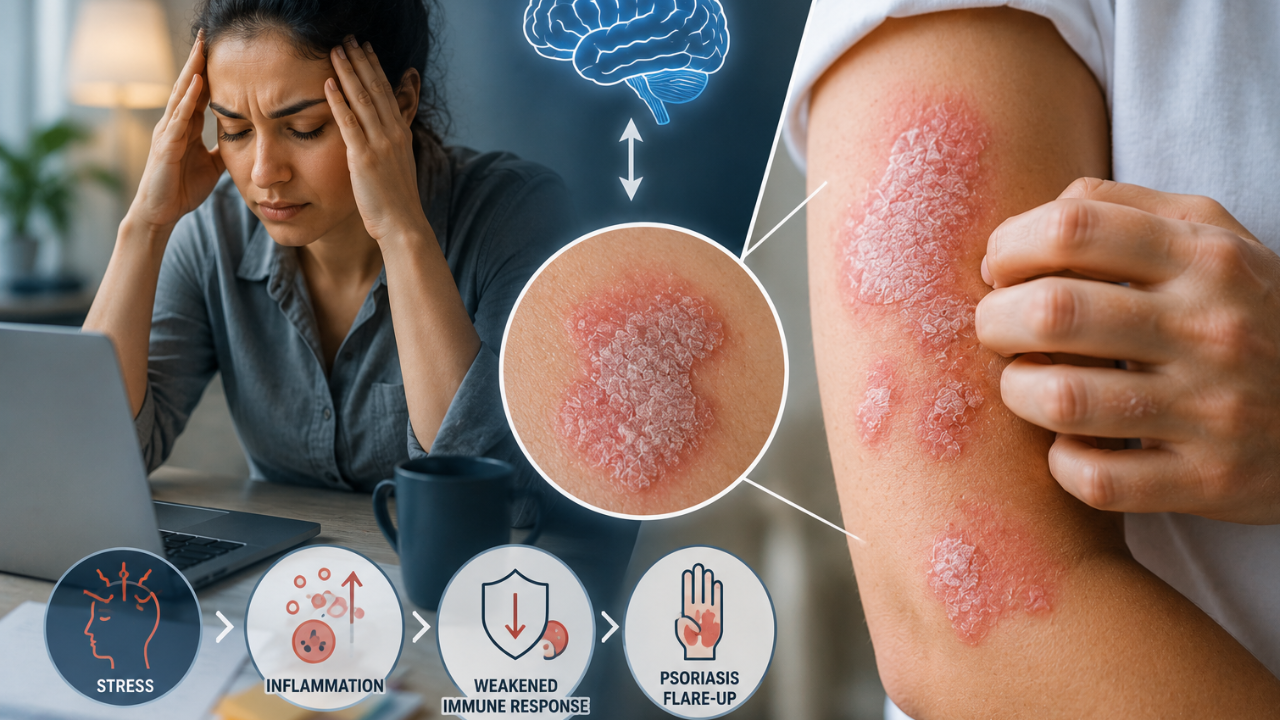
The association between stress and psoriasis is one of the better-documented cases of the mind and skin connection within dermatology. Consistent across studies, at least in most case series, there is a sizable proportion of patients who experience an important stressful event within the weeks prior to onset or flare-up. The mechanism is quite clear cut. While the skin is often seen as being passive, it is far from it. Skin itself is immunologically active, having a stress response system of its own, able to produce corticotropin-releasing hormone and cortisol independently from adrenals.The Mind-Skin Connection Under prolonged stress, the shift happens in the hypothalamic-pituitary-adrenal axis, leading to a reconfiguration of the immune response towards inflammatory pathways, specifically IL-17 and IL-23 pathway which was targeted by most biologics developed up to now. Neuro-endocrine innervations lead to the release of neuropeptides such as substance P, attracting inflammatory cells while lowering the threshold of itching. Chronic stress also impairs barrier recovery process, relevant for a disease where the slightest skin damage leads to a plaque formation. So whenever a patient claims stress caused her flare-up, she is describing an actual immunological phenomenon. And the cycle, which is the part that entraps people. And here lies the complexity, the place where I believe most of the articles end prematurely.Also read: ‘Sunscreen Is A Health Essential’: UK Skin Cancer Survivor Urges Govt To Scrap TaxStress Aggravates Psoriasis Then the psoriasis becomes the source of stress. Highly visible plaques on hands, scalp or face are hard to hide within a culture where we greet, eat and worship with our hands. Patients start dressing in ways that conceal their plaques. They avoid public showers, salons, wedding events. Itch affects their sleeping habits, causing higher inflammation levels. Then come the questions patients do not usually disclose unless specifically asked. The shame. Some patients have experienced people wondering whether they could catch the condition. Some of them have been asked to leave the salon where they went. This is not just an annoyance, but also a hurt, directly feeding back into the loop. The prevalence of depression and anxiety in psoriasis is much higher than among healthy people. Moreover, these problems cannot be explained only by a reaction to one's appearance. The same inflammatory mediators, which cause psoriasis, are now associated with depression. Therefore, psoriasis and depression can be two symptoms of one inflammatory condition. Also read: Mpox Spreads in Guinea-Bissau, Half Of Suspected Cases Are ChildrenWhat Really Helps? Here I need to be very careful, since the idea that stress provokes psoriasis can be twisted into the belief that the patient has caused his/her own illness. But it is not true and is insulting to people suffering from the condition. It should be said again that psoriasis is a genetically based immune disorder. It is stress that exacerbates the disease. Within this framework, stress management techniques are useful and there is the trial evidence for their efficiency. In one study, mindfulness-based intervention helped to improve the outcome and even accelerated clearance with phototherapy. Physical exercise has an independent anti-inflammatory effect and treats metabolic syndrome associated with psoriasis. Sleeping is an obligatory factor because sleep deprivation increases the level of cytokines that we need to suppress. Cognitive behavioral therapy helps people to cope with itching-scratching cycle. There is no doubt that alcohol and smoking make psoriasis worse, although they are usually used as a coping strategy in response to stress. They serve as an additional burden on health. All of this is important but not an alternative to treatment. Topicals, phototherapy, systemic medications, and biological agents still remain the core of the treatment regimen. Stress management is only an adjunct, and I always remind my patients about it so that they never feel guilty for taking medicine. Treat The Whole Person Now I ask two questions at each review of psoriasis. How much of the body surface area is affected and how much of the person's life does it occupy. The answer to these questions often does not coincide. I saw patients with rather small involvement of the skin surface, whose psoriasis completely ruined their self-esteem. And I met patients with large involvement who coped with the disease perfectly. Body surface area does not measure suffering. If we treat only what we can see, we will treat half of the disease.