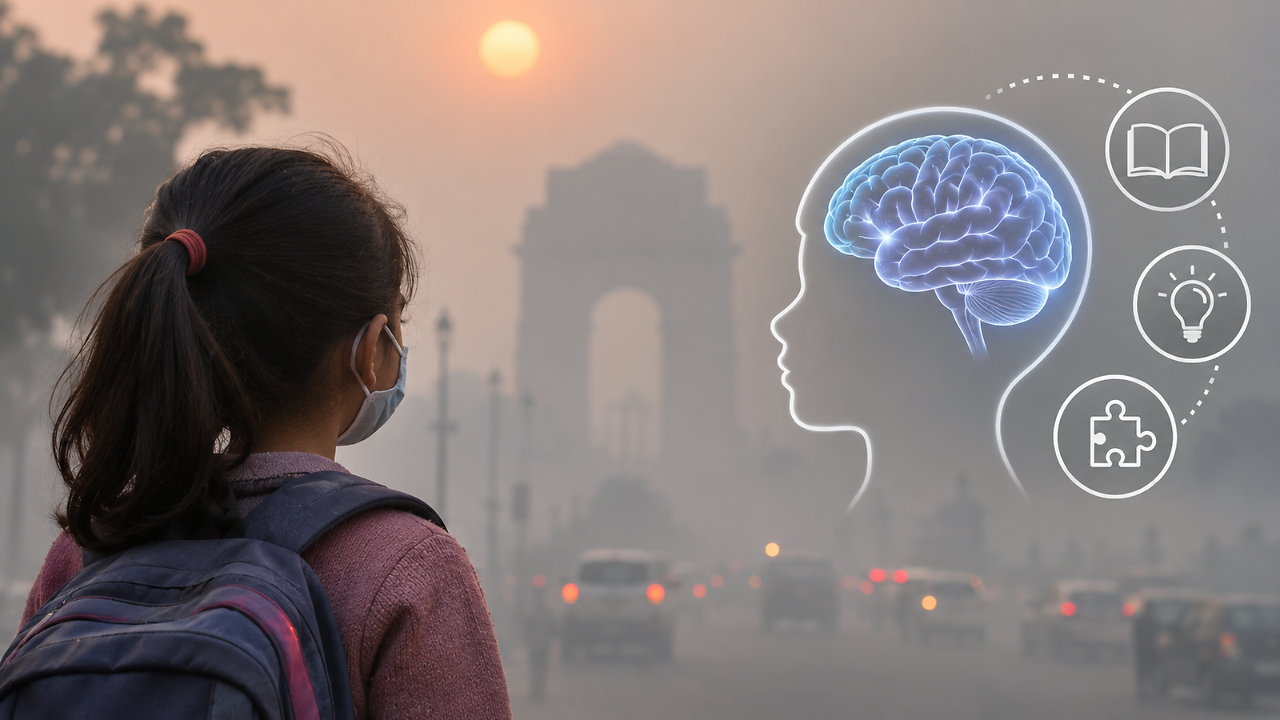
Delhi’s air pollution has worsened even before the onset of peak winter. This has raised concerns about development and health of children who are constantly exposed to high levels of fine particulate matter (PM2.5). While the immediate effects of polluted air like coughing, wheezing and breathing difficulties are known, research says that long-term exposure can also impact children’s developing brains, including effects on their memory, attention, IQ and ability to learn.Delhi Winter Pollution Highest In 3 YearsOn November 12, Delhi's air quality got listed under 'very poor' category. Stations like IIT Delhi and Delhi IITM recorded an AQI of 416, while NSUT Jaffarpur and Delhi DPCC recorded 404. Anand Vihar station recorded 319 while DTU Delhi stated 372. A new analysis by the Centre for Science and Environment (CSE), released recently, found that Delhi’s average PM2.5 concentration during the week preceding Diwali stood at 236 micrograms per cubic metre (µg/m³), the highest in the last three years. This was 97% higher than the 120 µg/m³ recorded in 2025 and 32% above the 179 µg/m³ recorded in 2024.The analysis also found that pollution levels during the early winter period were higher this year than in 2025. Vehicular emissions and pollution from neighbouring NCR districts were among the major contributors. The findings suggest that firecracker smoke from Diwali aggravated an already high pollution burden.Delhi’s pollution crisis is not only threatening people’s lungs and cardiovascular health, it is also posing significant risks to children’s brain health. Could breathing polluted air affect how well children concentrate, recall information and learn at school?Also read: World Pneumonia Day 2026: Post-Diwali Cough Or Pneumonia? Doctors Explain Warning SignsEffects Of PM2.5 On Children’s Cognitive HealthPM2.5 refers to fine particulate matter with a diameter of 2.5 micrometres or smaller. These particles are small enough to travel deep into the respiratory system, fueling inflammation and oxidative stress. Not just lungs, their effects may reach children’s nervous systems.Dr Sushil Singla, Director, Paediatrics, Sarvodaya Hospital, Sector 8, Faridabad told HealthandMe, “Exposure to PM2.5 (fine particulate matter) can affect children's cognitive development, including memory, attention span and learning abilities. These tiny particles can penetrate deep into the lungs and may trigger inflammation and oxidative stress, which can have wider effects on the developing brain. Children are particularly vulnerable because their brains are still developing and they inhale more air relative to their body weight than adults.”The developing brain goes through significant changes throughout childhood. Processes involved in learning, memory, attention and executive function continue to evolve during these years. Exposure to environmental pollutants during fragile developmental periods is therefore a huge concern.Also read: Delhi Air Pollution: PM2.5 Exposure May Raise Type 2 Diabetes Risk By 16%, Study FindsEffects On Learning And Academic PerformanceDifficulties in paying attention, memorising and processing complex information can make it harder for children to follow lessons in the classroom.“Prolonged exposure to high levels of air pollution has been associated with difficulties in concentration, attention, information processing and memory. This may also affect a child's learning abilities and academic performance over time. Although the extent of the impact varies depending on the duration and intensity of exposure, parents should take preventive measures,” says Dr Singla.What Does Science Say?Also read: Delhi Breathes Toxic PM2.5: Study Finds 9 Million Lives Could Be Saved Globally By Meeting WHO Air Quality LimitsSeveral studies suggest that air pollution exposure may be associated with poorer cognitive outcomes in children.A review and meta-analysis published in Environmental Health in 2024 examined six studies involving 4,860 children across North America, Europe and Asia. It found a statistically significant association between higher PM2.5 exposure and lower IQ scores. The researchers reported that every 1 µg/m³ increase in PM2.5 was associated with a 0.27-point decrease in full-scale IQ. A 2022 review of 86 studies also found evidence between particulate matter exposure and poorer executive function in children, specifically working memory. Executive function refers to a set of mental skills that help children plan, focus attention, remember instructions and manage multiple tasks. Recent research based on data from the US Adolescent Brain Cognitive Development (ABCD) study also showed that PM2.5 exposure was linked with smaller hippocampal volumes and lower working-memory in young people. The hippocampus is a brain region involved in learning and memory. The researchers suggested that exposure during both prenatal development and late childhood could affect brain structure and function. What Can Parents Do? While individual precautions cannot eliminate the pollution burden, they can help reduce exposure. Dr Singla advises parents to monitor AQI levels, limit outdoor activities during peak pollution hours and ensure adequate indoor ventilation. Other measures include:Check air quality before outdoor activities: Avoid outdoor sports, running and strenuous exercise when pollution levels are high.Keep windows closed during pollution episodes: Ventilate rooms when outdoor air quality improves. Where possible, use an air purifier with a HEPA filter.Use a well-fitting N95 mask: A respirator can reduce exposure to particulate matter when children need to be outdoors.Follow school advisories: Parents should stay informed about changes to outdoor classes, sports and school schedules during severe pollution days.