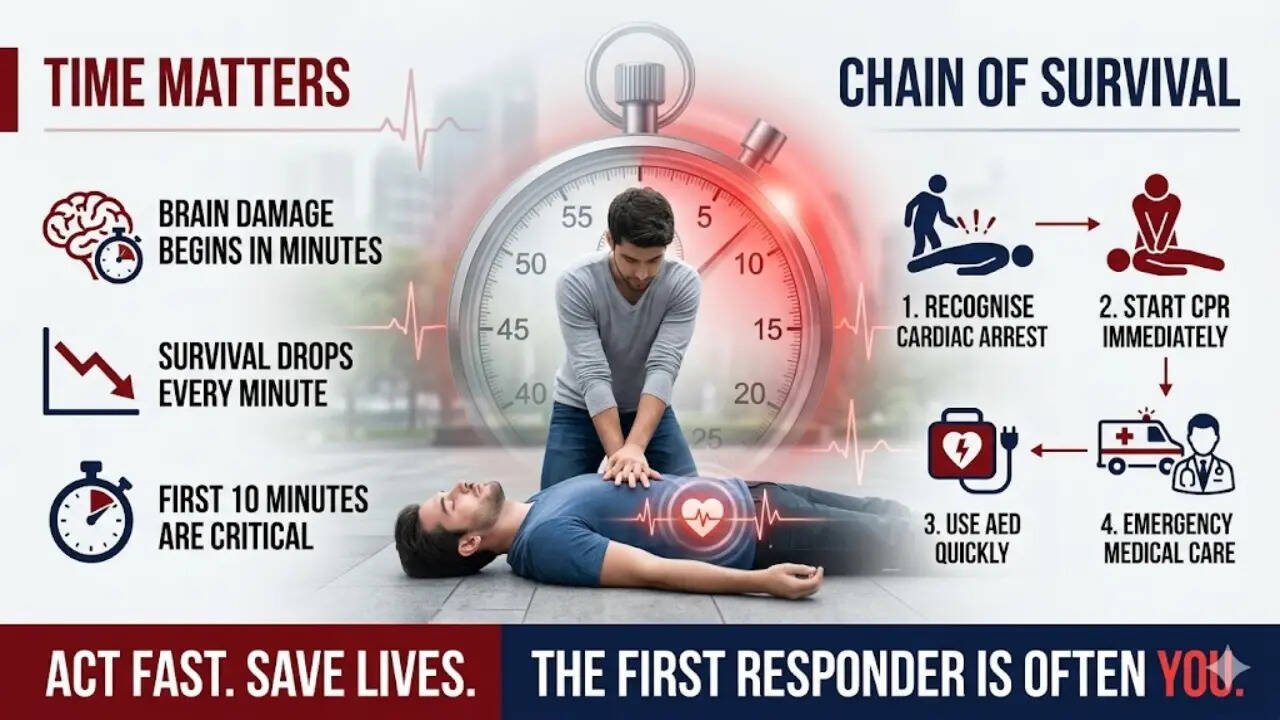
When the heart stops functioning, time doesn’t stop with it. In cases of cardiac arrest, time serves as one of the most decisive factors between survival and irreversible loss. Within a couple of seconds, the body starts losing its oxygen supply. In a few minutes, the brain starts to suffer damage. And with each passing minute without intervention, the chances of survival reduce significantly.This severe reality is at the centre of what Dr Ankit Desai, Paediatric Anaesthetist and Founder & Director of Children’s Anaesthesia Services, explains as “a race against biological shutdown — one where the bystander is the only lifeline”.The silent collapse: what happens in cardiac arrestSeveral people have the misconception that cardiac arrest is similar to a heart attack, but they are very different. A heart attack is a circulatory issue where the heart might still be beating. However, in cases of cardiac arrest, there is an electrical failure, and the heart suddenly stops pumping blood effectively.Whenever this occurs, blood flow to the brain and other vital organs ceases immediately. The oxygen reserves in the brain are extremely limited and typically last for about 4 to 6 minutes before any permanent injury occurs.This is where the concept of time sensitivity becomes more important. For every passing minute without CPR or defibrillation, the chances of survival drop by approximately 7–10%. By the time 10 minutes have elapsed without intervention, survival is extremely unlikely in most cases.“The tragedy is not just the cardiac arrest itself,” explains Dr Desai, “but the silence that follows — when no one knows what to do or hesitates too long to act.”The brain’s narrow window of survivalThe brain is the first organ to be affected during cardiac arrest. Neurons are highly sensitive to oxygen deprivation. Brain cells start to malfunction within 3 minutes. By 5 minutes, the damage starts becoming increasingly severe. Beyond 10 minutes, the chances of meaningful recovery drastically reduce. This is why immediate CPR is not just a supportive measure but a bridge that keeps oxygen flowing artificially until a normal rhythm can be restored.Chest compressions manually pump blood to the brain and heart, delaying cell death. Why bystander action matters more than ambulance timeEmergency medical services, even in well-equipped systems, often take several minutes to reach a patient. In urban areas, response times may be shorter, but they are rarely instantaneous. In cardiac arrest, those minutes matter more than any hospital intervention.Dr Desai emphasises that “the first responder is almost always not a doctor — it is a family member, a colleague, or a nearby stranger”.This makes bystander CPR the most critical determinant of survival. Studies consistently show that when CPR is initiated immediately, survival rates can double or even triple compared to cases where no bystander action is taken.Yet fear, hesitation, and lack of training remain major barriers. Many people worry about performing CPR incorrectly, causing harm, or being held legally responsible. In reality, doing nothing is far more dangerous than taking imperfect action.The Chain of Survival: breaking down the timelineMedical professionals often refer to this situation as the “Chain of Survival”, which includes early detection of cardiac arrest, immediate CPR, rapid defibrillation (AED use), advanced medical care, and post-resuscitation support. Every link in this chain is highly time-sensitive. Any delay in one step weakens the entire outcome. The strongest determinant, however, remains the second step — early CPR.Automated External Defibrillators (AEDs), if available, can help restore a normal heart rhythm if used quickly. But again, their effectiveness decreases sharply with delay. The combination of CPR and early defibrillation within the first few minutes offers the best chance of survival.Why awareness changes everythingThe key difference between life and death is less about complexity and more about readiness.Awareness training helps transform bystanders into responders. A person who knows how to identify cardiac arrest — unresponsiveness, absence of breathing, sudden collapse — is far more likely to act immediately rather than wait.Dr Desai highlights a critical cultural gap: “We often associate medical emergencies with hospitals. But cardiac arrest begins in living rooms, offices, gyms, and streets. The response must begin there, too.”Basic CPR training takes less than an hour to learn, but can influence outcomes for decades. Schools, workplaces, and community programmes play a vital role in normalising this skill.Overcoming hesitation: the psychological barrierOne aspect of cardiac arrest that often gets overlooked is human hesitation. Bystanders often freeze due to shock and uncertainty. Some assume that someone else will step in. Others underestimate the severity of the situation.Public awareness campaigns help highlight the simplicity of CPR, which helps overcome this barrier. Hands-only CPR focuses on continuous chest compressions without mouth-to-mouth breathing, making intervention much easier and more accessible. The message is simple: push hard, push fast, and don’t stop until help arrives.A shift from reaction to preparednessCardiac arrest survival is not just a medical issue, but also one of public preparedness. The Chain of Survival starts long before the emergency happens. It starts with education, confidence, and awareness.Dr Desai states that “if more people understood how little time they truly have, more lives would be saved not by hospitals, but by ordinary people doing extraordinary things in the first five minutes”.Conclusion: time is the real patientIn cardiac arrest, the patient is not just the person who collapses — it is time itself. Every second lost reduces the chance of recovery. Every trained bystander becomes a potential lifesaver. The science is clear, the timeline is unforgiving, and the solution is remarkably simple: act immediately, compress the chest, and keep blood flowing until professional help arrives.