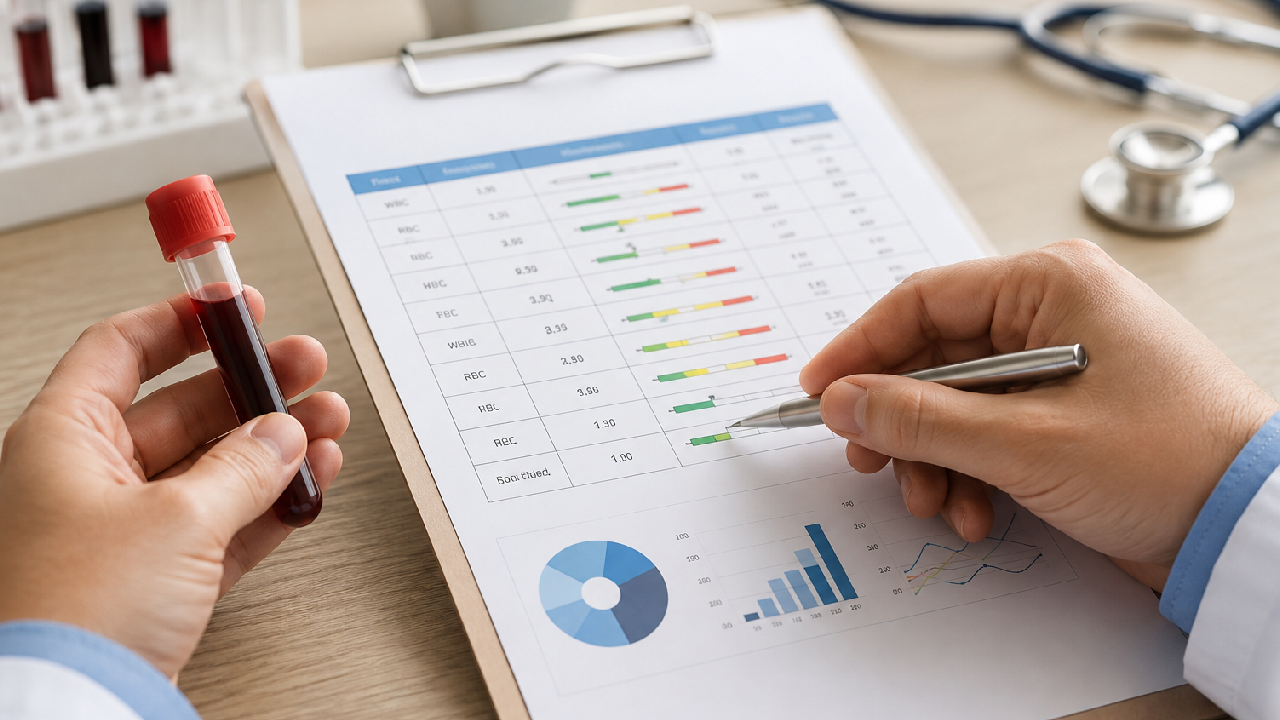
Blood tests are often a source of dread for people in our society. While many people dread the needle stick, most are scared of what the results may show. Even before consulting a physician, most people nowadays would consult an AI-powered platform to verify and interpret the values of their blood tests. However, such online searches most often give rise to more uncertainties and confusion rather than answering the basic queries. Thus, this article is an attempt to shed some light on the basics of common blood test results.LIPID PROFILELipid profile is one test that everyone should do, at least occasionally, after the age of 40. This is a silent epidemic, and without blood tests, no clinical symptoms can reliably identify raised lipid parameters. There are multiple parameters printed in the report, but the main values we are looking for are total Cholesterol, triglycerides, LDL, and HDL. There are many others, but the interpretation of those is best left to your physician. Total Cholesterol should be less than 200, triglycerides less than 150, and the “bad” cholesterol, or LDL, should be below 100. On the other hand, HDL, the “good” cholesterol, should be above 40 for men and above 50 for women. So, for HDL, we want the values to be higher! However, whether deranged lipid parameters warrant treatment and, if so, for how long, will be the clinical decision of your doctor.CBCCBC means complete blood count. This is the most basic test done for every patient. In this test, we check for levels of haemoglobin, total leukocyte count, differential white cell count, platelet count, and ESR. Besides, there are numerous other parameters printed in your report, like MCV, MCH, MCHC, RDW, and PDW. But let’s first look at the basic parameters. Haemoglobin is perhaps the most important parameter to look at. It shows how much oxygen your blood can carry. Low hemoglobin is called anemia. If you have anaemia, you need to get treatment ASAP. The standard normal values of hemoglobin depend on age and gender and also physical states like pregnancy. The normal hemoglobin of an adult male will be different from that of an adolescent girl. There are many different causes of anaemia in our society, like iron deficiency, worm infestation, thalassemia, and kidney disease. Your doctor will do further tests to elucidate the cause. The next most important parameter is total leukocyte count. This gives an indication of whether you have any infection or inflammation. Conversely, in some conditions like Typhoid, the counts may be low despite fulminant infection. Platelet count is also important in infections like dengue, where it may get dangerously low. We need to check platelet count repeatedly, sometimes even twice or thrice the same day, in dengue infection. Platelet count may be low in some forms of blood cancer too.The other parameters like MCV and RDW are too complex to be discussed in this short article. Suffice it to say, they are deranged in conditions like Thalassemia, sickle cell disease, vitamin B12 deficiency, and hereditary Red cell membrane disorders. Also Read: BTS’ V Opens Up About 2-Year Battle With Hearing LossAnd finally, the ESR is a very non-specific parameter. It can be raised in multiple conditions, ranging from cancer to inflammation. It is usually interpreted in unison with other necessary tests.Dr Rudrajit Paul, Consultant Physician, Manipal Hospital, Kolkata