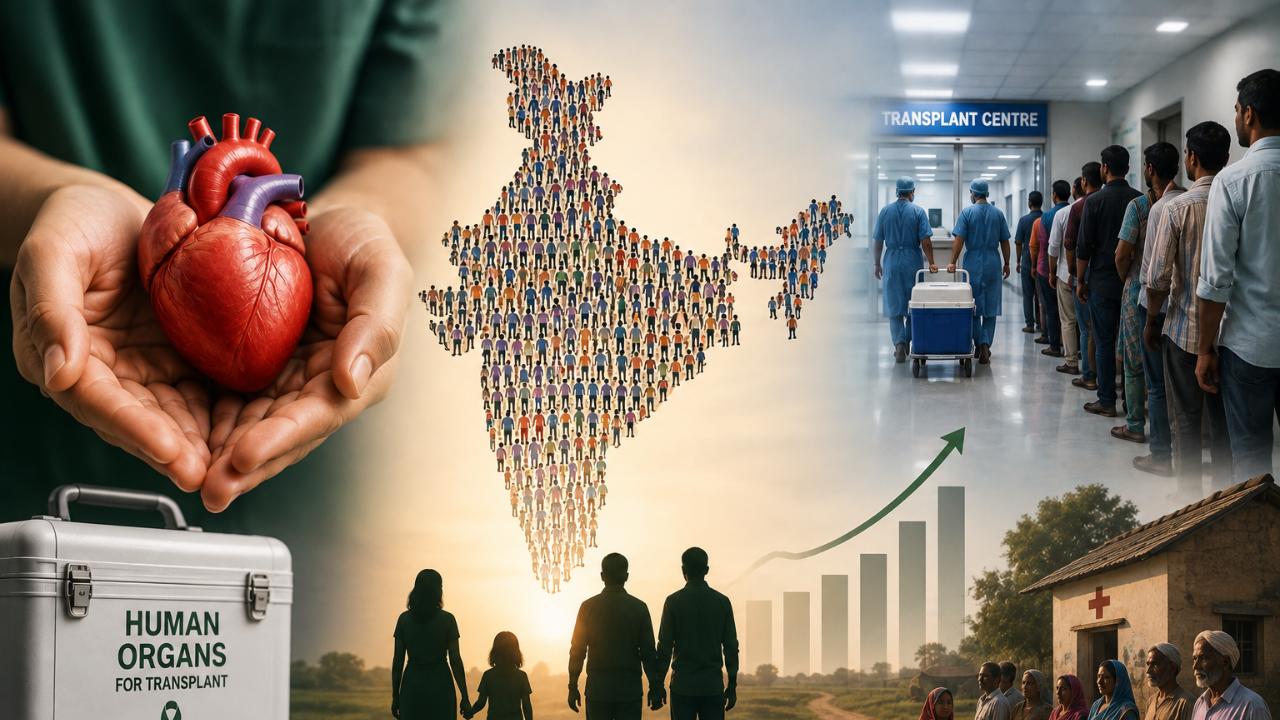
India crossed a quiet but significant threshold last year: over 20,000 organ transplants were performed in 2025, a fourfold jump from a decade ago. On paper, this looks like the success story Indian healthcare has been waiting for — better ICU infrastructure, sharper surgical skills, and a transplant ecosystem finally catching up with the need -- though dedicated neuro-critical care beds, where most potential deceased donors are actually identified, remain concentrated in a handful of cities, meaning many eligible donors outside these centres are never even flagged to a transplant coordinaton. However, these numbers tell only half the story. The other half is a persistent, almost stubborn, shortfall.India Still Has Far More Patients Waiting Than DonorsIndia's organ donation rate remains under 1% of the population. More than 63,000 patients are currently waiting for a kidney, and roughly 22,000 need a liver. For the vast majority, a matching donor will simply never arrive in time. Growth in absolute transplant numbers has not meaningfully closed this gap. It has merely kept pace with a demand curve that keeps climbing faster.Also read: Organ Donation: The Gift Of LifeWho Is Donating, And Who Is Receiving?What should worry health system planners even more is who is donating. National data shows that women made up roughly two-thirds of living organ donors last year, while men were overwhelmingly the recipients. This is not a new pattern and has been documented for years. However, it deserves to be treated as a policy failure rather than a cultural footnote.Why Are Women Bearing More Of The Donation Burden?The reasons are structural, not incidental. Financial dependency often leaves women with less autonomy to decline when asked to donate. Data suggests mothers and wives together account for the overwhelming majority of living donations within families, a pattern consistent with the idea that women are expected to absorb medical risk as an extension of caregiving. Meanwhile, families are frequently reluctant to accept an organ from a male relative, worried about the loss of a primary earner during recovery -- a calculation rarely applied in reverse.Also read: Post-Organ Donation And Transplant Care: How Can Donors And Recipients Stay Healthy?What Clinicians Can Do DifferentlyFor clinicians, especially those of us involved in end-of-life and brain-death conversations, this is not an abstract statistic. It shapes how we should be having donation conversations with families. Counselling protocols rarely interrogate who within a family is being nudged, however gently, towards donation, and who is being protected from the ask. Transplant coordinators and neuro-intensivists are well positioned to notice and push back against this pattern in real time, family by family, if they are trained to look for it.Three Changes That Could Make The System More EquitableAt a systems level, three things would move the needle. First, glomerular filtration rate estimation and transplant eligibility criteria need re-examination through a sex-disaggregated lens, not treated as gender-neutral defaults. Second, deceased donation -- which does not depend on a living relative absorbing risk -- needs far more investment; India still relies heavily on living donors precisely because deceased donor programmes remain underdeveloped outside a handful of states. Third, counselling teams need explicit guidance and training to ensure consent is genuinely voluntary and not shaped by household financial hierarchies. Growth Is Not The Same As EquityIndia's transplant numbers are, without question, moving in the right direction. But a donation system that quietly extracts more from women while directing more benefit to men is not a sustainable model of progress -- it is a gap dressed up as growth. Closing it will take more than better surgical throughput. It will take honest scrutiny of who is asked to give, and why.Dr Praveen Gupta, Chairman - Marengo Asia International Institute of Neuro and Spine (MAIINS), Marengo Asia Hospitals