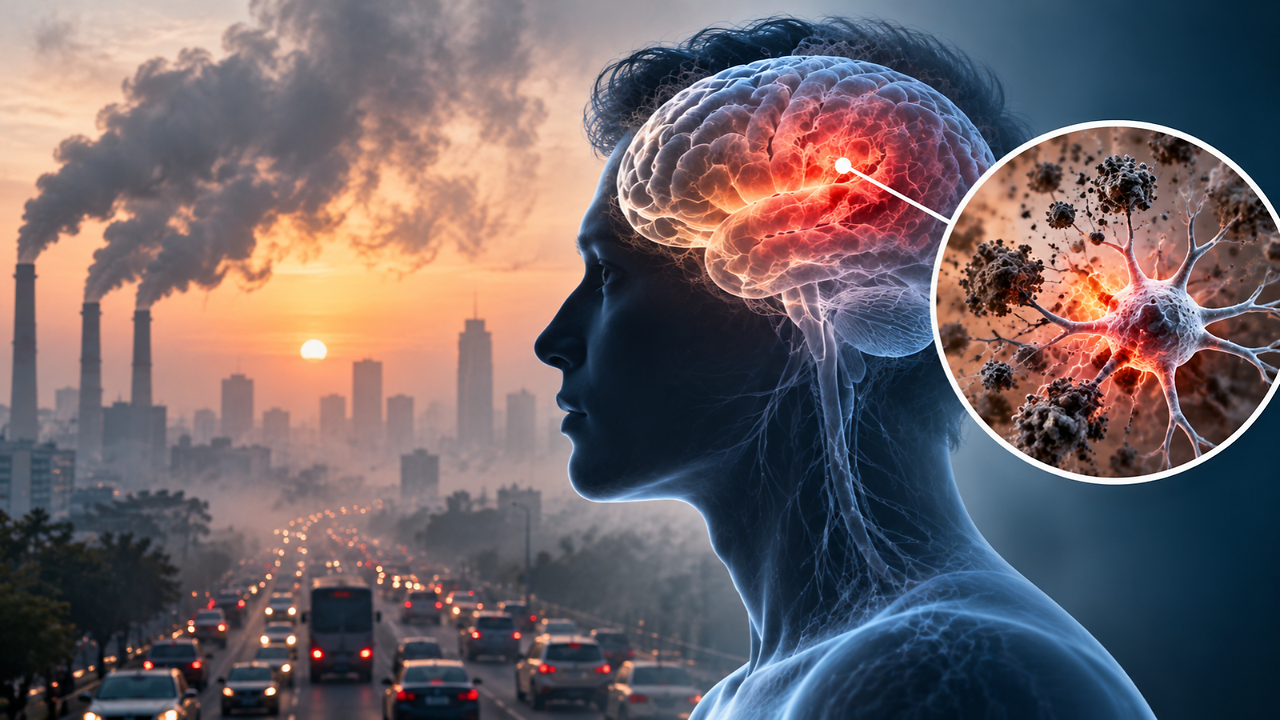
The fine particulate in air pollution could do more damage than brain inflammation. New research indicates long-term exposure to air pollution could lead to changes in the brain structure, rapid biological ageing and a higher risk of dementia.A study from the UK Biobank, which tracks the health of hundreds of thousands of people in Britain, found that those exposed to the highest levels of fine particulate matter (PM2.5) had a 14% higher risk of developing dementia than those with the lowest exposure. Researchers examined more than 400,000 participants for nearly 14 years, during which almost 9,000 dementia cases were recorded.The findings, published in the Journal of Nutrition, Health & Aging in April 2026, also identified that greater pollution exposure could be linked to reduced brain volumes. Polluted Air Could Affect The BrainAlso read: Heatwaves, Noise & Air Pollution Can Harm Mental Health Too: New Global Commission WarnsPM2.5 consists of particles small enough to penetrate deep into the lungs. Some components can enter the bloodstream, while other particles may reach the brain through ways that are still being investigated.One possibility is that pollution triggers inflammation throughout the body, which can affect blood vessels and brain tissue. Researchers are also examining whether particles that we inhale can reach the brain directly and influence the proteins, cells and processes that lead to neurodegenerative diseases.Caleb Finch, professor emeritus at the University of Southern California's Leonard Davis School of Gerontology, said evidence increasingly points towards a relationship between pollution exposure and dementia risk.“There’s a lot we don’t understand yet, but we do know that the risk of dementia increases in proportion to the amount of air pollution,” he said.Air Pollution & DementiaAlso read: 1 In 5 US Lung Cancer Patients Never Smoked: Report Highlights Hidden Risk FactorsEarlier research has identified mechanisms that link polluted air with neurological disease.A study published in Environmental Pollution in May 2026 examined nearly 270,000 people over approximately 14 years. Greater exposure to PM2.5 led to structural changes in the hippocampus, a brain region responsible for learning and memory. Inflammation and changes in fat metabolism appeared to explain the connection between pollution and dementia.Another study, published in Science in 2025, examined hospital records from 56.5 million Americans between 2000 and 2014. It found that people living in areas with higher PM2.5 levels were more likely to be hospitalised with dementia with Lewy bodies and Parkinson's disease dementia.Experiments in mice indicated that pollution exposure triggered abnormal folding and accumulation of alpha-synuclein, a protein that forms the deposits known as Lewy bodies. The animals also developed brain shrinkage, nerve-cell death and cognitive decline.Xiaobo Mao, a study author and professor of neurology at Johns Hopkins University, said, “This is something we were so surprised to see.”When researchers exposed mice that were genetically engineered without alpha-synuclein to the same pollution levels, a significant amount of damage was reduced. This suggested that the protein may play a role in the reduction.Outcomes From Different Airborne Particles Also read: Lancet Study Finds Air Pollution & Chemical Exposures Could Add To South Asia's Diabetes & Heart Disease BurdenIn a separate experiment published in September 2026, researchers exposed mice to different airborne particles like diesel exhaust, dust collected from the World Trade Center site and wood smoke.Diesel exhaust and World Trade Center dust changed more than 1,200 of the same genes, including genes involved in inflammation and amyloid processing. Wood smoke did not produce changes related to Alzheimer’s. The researchers observed that diesel exhaust and World Trade Center dust contained more metals, cementing the possibility that certain components of pollution may contribute to neurological harm more than others. How To Reduce Air Pollution Exposure Individuals can take a few practical steps to reduce exposure to air pollution. These include improving ventilation when cooking, using appropriate indoor air filtration, replacing heating and ventilation system filters regularly and limiting prolonged exposure to outdoor pollution.Mao said, “Indoor cooking may sometimes be worse than anything else.” He also emphasised that prevention involves maintaining a balanced diet, exercising and spending time outdoors when air quality is better.